
HVAC Upgrades 101: Filter Inversion Pollutants in Salt Lake City Homes
Why Salt Lake City Homeowners Need HVAC Filtration Upgrades for Inversion Season If you're wondering what HVAC upgrades help filter…
Why Salt Lake City Homeowners Need HVAC Filtration Upgrades for Inversion Season
If you're wondering what HVAC upgrades help filter inversion pollutants in a Salt Lake City home, here's a quick answer:
Top HVAC upgrades for filtering inversion pollutants:
- MERV 13 filters or media air cleaners — Capture fine PM2.5 particles that standard filters miss
- Whole-home HEPA filtration systems — Remove 99.97% of particles as small as 0.3 microns
- Energy Recovery Ventilators (ERVs) — Bring in filtered fresh air without wasting energy
- UV-C germicidal lights — Neutralize mold, bacteria, and viruses circulating through your system
- Whole-home humidifiers — Maintain healthy humidity levels that support respiratory defense
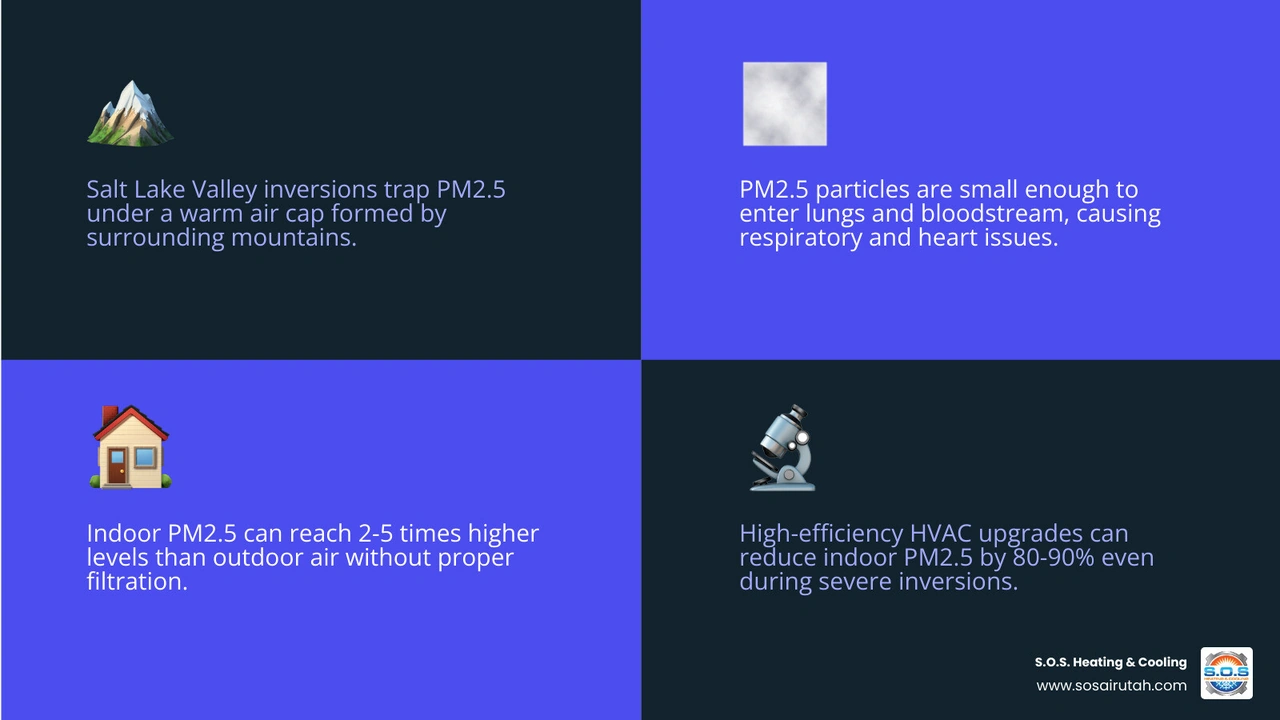
Every winter, the Salt Lake Valley turns into a pollution bowl. Cold, dense air settles into the valley floor while a layer of warmer air forms above it like a lid — trapping vehicle exhaust, wood smoke, and industrial emissions right where people live and breathe. These events, called temperature inversions, can push fine particulate matter (PM2.5) well above EPA safety thresholds for days at a time. And here's the part most people don't expect: closing your windows doesn't keep it out. Without the right HVAC upgrades, those microscopic particles slip indoors through gaps, cracks, and your system's own air intake — and indoor air can end up two to five times more polluted than the air outside.
For Salt Lake City homeowners, this isn't a minor inconvenience. PM2.5 particles are small enough to penetrate deep into the lungs and enter the bloodstream. Short-term exposure causes coughing, throat irritation, and asthma flare-ups. Long-term exposure is linked to heart disease and serious respiratory illness. The good news is that the right HVAC upgrades can make a real, measurable difference — studies in Utah winter conditions have shown that proper filtration can cut indoor PM2.5 concentrations roughly in half, and whole-home systems with high-efficiency filters can reduce concentrations by 80 to 90 percent even during severe inversion events.
I'm Bryson Ninow, an NATE-certified HVAC professional with hands-on expertise in indoor air quality, energy efficiency, and helping Salt Lake City homeowners understand exactly what HVAC upgrades help filter inversion pollutants in a Salt Lake City home — without the guesswork or the upsell. In this guide, I'll walk you through every upgrade worth considering, from filter ratings to whole-home systems, so you can protect your family's air this inversion season and every one after it.
Understanding Salt Lake City Winter Inversions and PM2.5
To understand why standard heating and cooling setups struggle between December and February, we have to look at the unique topography of the Wasatch Front. Our beautiful mountain ranges create a physical bowl. When high-pressure weather systems stall over the region, snow-covered valley floors cool the air directly above them. Meanwhile, warmer air aloft moves over the mountains, acting as a lid that seals the cold air inside the bowl.
Without wind or storms to mix these atmospheric layers, the air stagnates. Every car trip, fireplace use, and industrial stack adds to the trapped soup. The primary culprit in this winter haze is PM2.5—particulate matter that is 2.5 microns or smaller in diameter (about 30 times thinner than a human hair).
Because these particles are so incredibly small, they behave more like a gas than a solid. They easily penetrate the standard weatherstripping of homes in Salt Lake City, Sandy, Draper, or Bountiful. Once inside, they accumulate. When you couple this outdoor infiltration with normal indoor activities like cooking, vacuuming, and heating, your home's air quality can degrade rapidly. This is why understanding the Role of Indoor Air Quality in Your Home is the first step toward creating a safe, clean sanctuary during our worst winter weeks.
What HVAC Upgrades Help Filter Inversion Pollutants in a Salt Lake City Home?
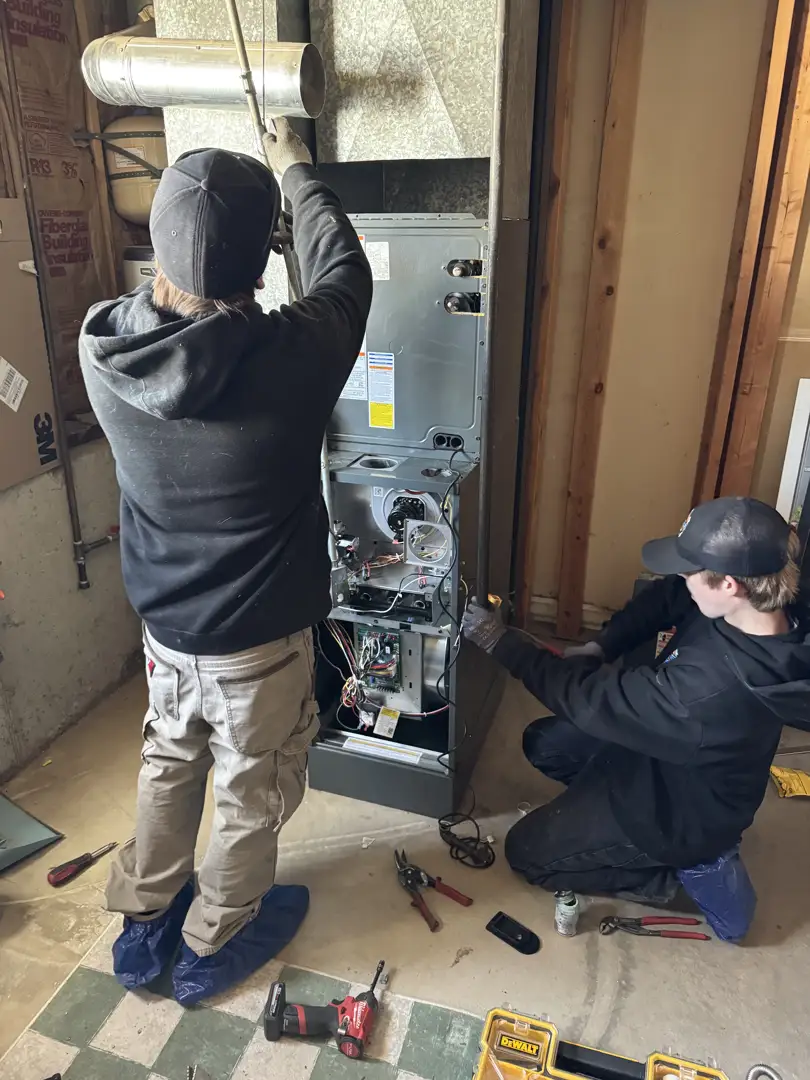
When outdoor air quality indexes (AQI) climb into the red, relying on a basic hardware-store furnace filter is like trying to catch sand with a chain-link fence. To truly clean your indoor breathing space, you need specialized Whole House Air Filtration Salt Lake City UT upgrades.
Different filtration levels target different sizes of airborne debris. To help you visualize where your current system stands and where you might want to upgrade, we have broken down the standard Minimum Efficiency Reporting Value (MERV) scale below:
| Filter Type / MERV Rating | Particle Size Target | Efficiency Against PM2.5 | Best Use Case |
|---|---|---|---|
| MERV 1–4 (Standard fiberglass) | > 10.0 microns | < 20% (Virtually none) | Protecting furnace components from large dust bunnies |
| MERV 5–8 (Basic pleated) | 3.0 to 10.0 microns | 20% to 49% | Standard residential use; captures pollen and lint |
| MERV 11 (Superior pleated) | 1.0 to 3.0 microns | 50% to 79% | Good mid-step for pet owners and mild allergy sufferers |
| MERV 13 (High-efficiency pleated) | 0.3 to 1.0 microns | 80% to 89% | Recommended minimum for capturing winter inversion PM2.5 |
| HEPA (High-Efficiency Particulate Air) | < 0.3 microns | 99.97% | Maximum protection; ideal for asthma, respiratory issues |
High-MERV Filters and Media Air Cleaners
Upgrading to a MERV 13 filter is the standard recommendation by the EPA and ASHRAE for wildfire smoke and winter inversion pollution. These filters are dense enough to trap microscopic combustion particles, bacteria, and tobacco smoke. However, simply sliding a highly restrictive 1-inch MERV 13 filter into a slot designed for a cheap fiberglass filter can cause major issues.
Thicker filters create more airflow resistance (also known as static pressure). If your furnace's blower motor has to work too hard to pull air through a restrictive filter, system efficiency drops, utility bills rise, and you risk overheating your heat exchanger or freezing your air conditioning coils.
To bypass this problem, we highly recommend upgrading to a deep-bed media air cleaner. These cabinets replace your standard 1-inch filter slot with a housing that accommodates a 4-inch or 5-inch thick pleated filter. Because these thick filters have far more surface area (unfolded, they contain dozens of square feet of filtering material), they can achieve a MERV 13 to MERV 16 rating without choking your system's airflow. This gives you superior PM2.5 capture with minimal static pressure drop. When planning this upgrade, scheduling a professional Air Filter Replacement Salt Lake City UT evaluation ensures your ductwork and system can handle the transition smoothly.
Whole-Home HEPA Filtration Systems
For the ultimate level of protection, a whole-home HEPA filtration system is the gold standard. True HEPA filters are rated to capture 99.97% of particles as small as 0.3 microns. Because HEPA material is incredibly dense, it cannot be installed directly in the main airflow path of a standard residential furnace without completely stopping airflow.
Instead, we install these as bypass systems. A bypass HEPA system pulls a portion of the air from your return duct, channels it through a dedicated, powerful blower motor inside the HEPA cabinet, cleans it to medical-grade standards, and then delivers it back into your home's main duct stream. This continuous loop ensures that your air is constantly purified without putting any static pressure load on your central furnace blower. For families living in areas like Murray or Millcreek who struggle with asthma or cardiovascular vulnerabilities, investing in Whole Home Air Filtration Murray UT provides unmatched peace of mind when the valley outside is blanketed in gray.
Advanced IAQ Upgrades for Comprehensive Inversion Protection
While capturing particulate matter is critical, a comprehensive approach to winter comfort requires looking at the whole picture. When we lock our homes down tight to keep the cold and smog out, we often trap other indoor pollutants like carbon dioxide, volatile organic compounds (VOCs) from cleaning products, and moisture. Taking a holistic look at Improving Your Home's Indoor Air Quality means pairing your filtration upgrades with smart ventilation and humidity controls.
Energy Recovery Ventilators (ERVs) for Balanced Ventilation
A challenge of winter in the high desert is fresh air. If you open your windows during an inversion, you let in toxic PM2.5. If you keep your house sealed tight, the air becomes stale, stuffy, and loaded with carbon dioxide.
An Energy Recovery Ventilator (ERV) solves this dilemma. These systems act as a controlled lung for your home. An ERV pulls fresh, cold outdoor air inside while simultaneously exhausting stale indoor air. As the two air streams pass each other inside the unit's core, they exchange heat. This means the incoming cold air is pre-warmed by the outgoing warm air, retaining roughly 70 to 80 percent of the energy you’ve already paid to heat your home.
Crucially for inversion season, the incoming outdoor air is passed through an integrated high-efficiency filter before it ever enters your living space. This allows you to enjoy fresh, oxygen-rich air year-round without importing the neighborhood's vehicle emissions.
Whole-Home Humidifiers and UV-C Lights
Utah's climate is naturally arid, but winter heating makes indoor dryness even worse. Without active humidification, indoor relative humidity in Salt Lake City homes often plummets to 10 or 20 percent.
Dry air does more than cause static shocks and split wood floors; it dries out your nasal passages and respiratory tract. Your body's natural defense against PM2.5 and airborne viruses relies on healthy mucous membranes to trap particles. When those passages dry out, you become far more susceptible to infection and irritation. Adding a whole-home bypass or steam humidifier to your HVAC system keeps indoor relative humidity at a comfortable, healthy 35 to 45 percent.
Additionally, we can install UV-C germicidal lights inside your air handler. While media filters trap physical particles, UV-C light neutralizes biological contaminants. Positioned near your indoor evaporator coil, these lights destroy mold spores, bacteria, and viruses that attempt to colonize the damp dark areas of your system, ensuring the air blowing through your vents is truly clean.
Pros, Cons, and Compatibility of High-Efficiency Filtration
Before you rush out to purchase the highest-rated filter on the market, it is important to understand the balance of pros, cons, and system compatibility.
- Pros: Dramatically improved respiratory health, less household dust, protection for vulnerable family members, and a cleaner HVAC system overall.
- Cons: Higher-efficiency filters must be replaced regularly to prevent airflow restriction, and some advanced systems require dedicated cabinet space near your furnace.
- Compatibility: Older furnaces with standard permanent split capacitor (PSC) blower motors are highly sensitive to airflow resistance. Newer systems with variable-speed ECM motors handle pressure changes better, but they still have limits.
To avoid Common Air Filtration Problems, we perform a series of vital compatibility checks before upgrading any home's filtration system:
- Static Pressure Testing: Measuring the resistance in your current ductwork to see how much "headroom" your blower motor has left.
- Ductwork Sizing: Ensuring your return air ducts are large enough to carry the volume of air your system needs.
- Filter Cabinet Space: Checking if there is physical clearance next to your furnace or air handler to install a 4-inch media cabinet or a bypass HEPA system.
- Blower Motor Capacity: Verifying that your furnace fan can maintain correct CFM (cubic feet per minute) airflow with a higher-MERV filter in place.
Sizing What HVAC Upgrades Help Filter Inversion Pollutants in a Salt Lake City Home
Proper system sizing is everything. If an air filtration system is undersized, it won't clean the air fast enough to keep up with the natural infiltration of outdoor pollutants. If it is paired with an overly restrictive filter that hasn't been professionally calculated, it can cause your furnace's heat exchanger to run too hot, shortening its lifespan or even causing it to crack (which introduces a dangerous carbon monoxide risk).
When we evaluate a home, we look at your total square footage, duct design, and the specific needs of your family to design a balanced filtration system that purifies your air safely and silently.
Maintenance Strategies to Keep Your Filtration Effective
Installing high-end indoor air quality equipment is only half the battle; keeping it running at peak performance requires consistent maintenance. This is especially true along the Wasatch Front, where our dry, dusty summers and polluted winters load filters faster than in other parts of the country.
Ductwork integrity is another overlooked factor. If your return ducts run through an unconditioned attic or crawlspace and have leaks, they will suck in unfiltered, polluted air from those spaces and blow it directly into your bedrooms. Professional duct sealing paired with regular Home Air Quality Testing Salt Lake ensures that the clean air you are paying for actually reaches your living areas.
Maintaining What HVAC Upgrades Help Filter Inversion Pollutants in a Salt Lake City Home
During the peak inversion months of December, January, and February, we recommend checking your air filters every 30 days. If you are using standard 1-inch pleated filters, they will likely need to be replaced monthly during these high-pollution periods.
If you have upgraded to a 4-inch or 5-inch media air cleaner, these typically last 6 to 12 months under normal conditions, but they should still be inspected mid-winter. A dirty, overloaded filter restricts airflow, strains your blower motor, and degrades your indoor air quality. Keeping your system clean and serviced to modern 2026 standards is the best way to ensure your home remains a safe haven all winter long.
Frequently Asked Questions about Inversion Filtration
For more quick tips and answers to common home comfort questions, you can always browse our comprehensive Indoor Air Quality FAQs.
Do standard 1-inch furnace filters protect against PM2.5?
No. Standard 1-inch fiberglass or basic pleated filters are designed to capture large dust particles, hair, and lint. Their primary purpose is to protect the internal components of your furnace from getting coated in dirt—not to clean the air you breathe. They allow microscopic PM2.5 particles to pass right through.
Can I run my HVAC fan continuously during an inversion?
Yes, but only if you have upgraded to a high-efficiency filter (MERV 11 or higher). Running your thermostat's fan setting to "On" or "Circulate" instead of "Auto" keeps air moving through your filtration system continuously, even when your furnace isn't actively heating. This provides constant purification and prevents pockets of stagnant, dirty air from settling in your home.
How do I know if my home has poor indoor air quality during winter?
Common signs include persistent dust coating your furniture shortly after cleaning, dry or itchy eyes, frequent throat irritation or coughing while indoors, static electricity, and waking up with a stuffy nose or sore throat. Using an indoor air quality monitor to track PM2.5 levels is also an excellent, objective way to see exactly how well your home is protecting you.
Conclusion
When winter inversions settle over the Salt Lake Valley, you shouldn't have to worry about the safety of the air inside your own home. Upgrading your HVAC system's filtration is one of the most effective, long-lasting investments you can make for your family's health, comfort, and peace of mind. Whether you want to start with a high-efficiency media air cleaner or install a complete whole-home HEPA and ERV system, our team is here to help you find the perfect solution for your specific home layout and budget.
We proudly serve homeowners across the entire Salt Lake Valley and South Davis County, including Bountiful, Centerville, Cottonwood Heights, Draper, Farmington, Herriman, Holladay, Kaysville, Layton, Millcreek, Mt. Olympus, Murray, Riverton, Salt Lake City, Sandy, South Jordan, South Salt Lake, and Woods Cross.
Ready to take control of your indoor air? Breathe Easier with S.O.S. Heating & Cooling and schedule your professional indoor air quality assessment today!
Contact Us
Let's Get You From Distress to Rest
No heat, no cool, a backed-up drain, or just due for a tune-up? Call now or request service and our local team will be on the way — upfront pricing, no surprises.