
All About How Wildfire Smoke Affects Indoor Air Quality in the Salt Lake Valley


.avif)

Why Wildfire Smoke Is a Serious Indoor Air Problem in the Salt Lake Valley
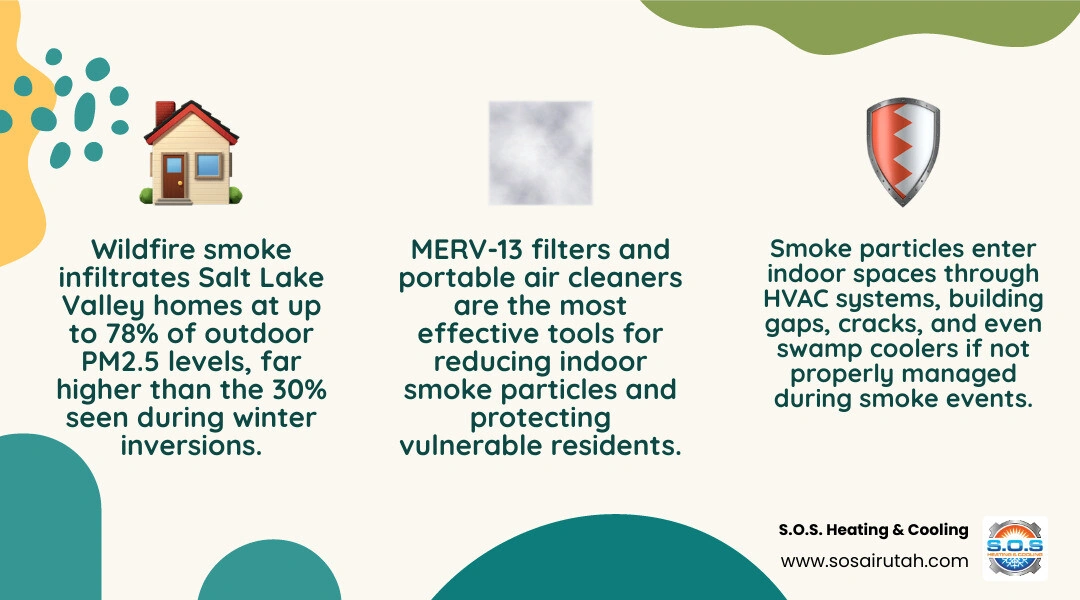
How wildfire smoke affects indoor air quality in the Salt Lake Valley is something every local homeowner needs to understand — especially as Utah's fire seasons grow longer and more intense. Unlike winter inversions, wildfire smoke particles are small, stable, and surprisingly good at slipping indoors. Research from a year-long monitoring study in Taylorsville found that during a 2018 wildfire event, indoor pollution levels reached 78% of outdoor levels — nearly three times higher than what inversions typically push inside. That means closing your windows helps, but it does not come close to keeping you safe on its own.
Here is a quick summary of what you need to know:
- Wildfire smoke infiltrates homes at up to 78% of outdoor PM2.5 levels, far higher than the ~30% seen during winter inversions
- Closing windows and doors reduces exposure but does not eliminate it — smoke enters through HVAC systems, gaps, and cracks
- MERV-13 filters and portable air cleaners are the most effective tools for reducing indoor smoke particles
- Vulnerable groups — children, elderly residents, and those with asthma or COPD — face the greatest health risk
- Swamp coolers and air-side economizers can actively pull smoky outdoor air inside if not managed properly
- Utah's bowl-shaped Wasatch Front geography traps wildfire smoke in populated valleys, worsening exposure for residents
In 2025, Utah saw 693 wildfires burn through 114,000 acres — and smoke from fires in neighboring states regularly drifts into the Salt Lake Valley as well. This is no longer a once-in-a-while problem. It is a recurring seasonal reality that demands a real plan for protecting the air inside your home.
I'm Bryson Ninow, an HVAC professional with certifications in indoor air quality and energy efficiency, and I've seen how how wildfire smoke affects indoor air quality in the Salt Lake Valley catches homeowners off guard when their systems aren't prepared. In the sections below, I'll walk you through exactly what's happening to your indoor air during smoke events — and what you can actually do about it.
Understanding How Wildfire Smoke Affects Indoor Air Quality in the Salt Lake Valley
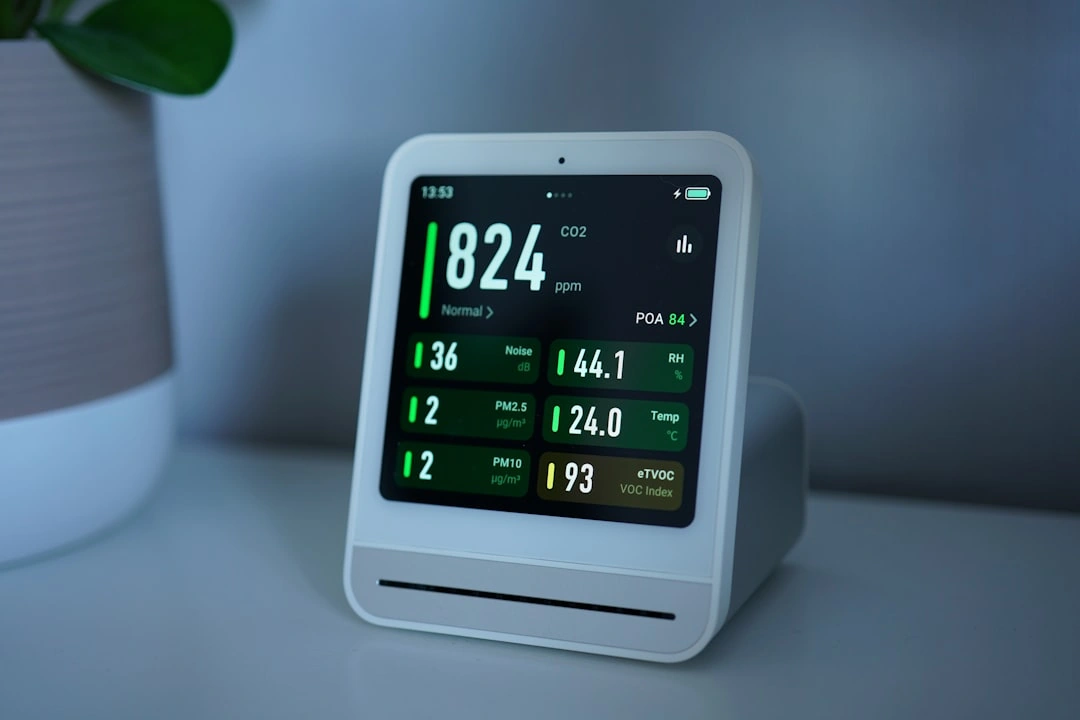
When we talk about air pollution, we measure it primarily by the size of the particles. The biggest culprit in wildfire smoke is PM2.5—fine particulate matter that is 2.5 microns or smaller in diameter (about 30 times thinner than a single human hair). Because these particles are so microscopic, they do not just float around outside; they behave almost like a gas, easily bypassing physical barriers.
To understand how outdoor smoke becomes indoor air pollution, scientists look at the infiltration factor ($F_{in}$). This is a decimal representing the fraction of outdoor pollution that makes its way inside a building. An infiltration factor of 0.20 means 20% of the outdoor smoke gets inside, while a factor of 0.80 means a staggering 80% penetrates the building envelope.
During heavy smoke days along the Wasatch Front, relying on your nose to tell you if your air is clean isn't enough. If you want to know exactly what you are breathing, scheduling a Home Air Quality Testing in Salt Lake City is the best way to establish a baseline and find out if your building envelope is leaking.
How Wildfire Smoke Affects Indoor Air Quality in the Salt Lake Valley Compared to Inversions
Many Salt Lake Valley residents assume that our winter inversions are the worst air quality events we face. However, the scientific reality is that wildfire smoke is far more invasive to our indoor spaces.
During a typical winter inversion, indoor air pollution sits at about 30% of outdoor levels. When the valley is locked in a cold, foggy inversion, the outdoor air is dominated by secondary particulates—specifically ammonium nitrate. When these secondary particles are drawn inside your warm, dry home, the change in temperature and humidity causes them to dissociate (essentially turning back into a gas phase and disappearing).
Wildfire smoke is entirely different. It is composed of primary carbonaceous particles (soot, ash, and organic carbon) that are incredibly stable. When they enter your home, they do not break down or evaporate. They stay suspended in your living room, bedroom, and kitchen. This is why during an August wildfire smoke event, indoor air pollution has been shown to climb to 78% of outdoor levels, keeping indoor air highly problematic for health-compromised populations for nearly 48 hours straight.
Fireworks smoke behaves almost identically to wildfire smoke. On July 4, 2018, indoor air quality in monitored local buildings reached unhealthy orange levels, registering about 30% of the massive outdoor spike, and did not clear out until 8:00 a.m. the following morning. Even a small, private 30-minute backyard fireworks show can temporarily spike indoor pollution to orange levels for several minutes if your home is downwind.
Infiltration Rates Across Different Building Types
Not all buildings in the Salt Lake Valley filter outdoor smoke equally. In fact, residential homes actually perform much better than commercial spaces and schools when it comes to passive smoke resistance.
The infiltration factor ($F_{in}$) varies widely across different structures:
| Building Type | Median Infiltration Factor ($F_{in}$) | Range |
|---|---|---|
| Residential Homes | 0.21 | 0.01 to 0.87 |
| Commercial Buildings | 0.45 | 0.30 to 0.71 |
| School Buildings | 0.68 | 0.41 to 0.80 |
Why do schools and commercial buildings let in so much more smoke? It comes down to ventilation standards. ASHRAE (the American Society of Heating, Refrigerating and Air-Conditioning Engineers) standards require commercial properties and schools to pull in a high volume of outdoor air to prevent carbon dioxide buildup and keep occupants alert. Unless these buildings are equipped with advanced, high-efficiency filtration systems, they end up actively pumping wildfire smoke straight into classrooms and offices.
Residential homes, on the other hand, have much lower natural air exchange rates, meaning they hold onto their indoor air longer and resist outside penetration—provided the windows remain shut.
Health Risks and Vulnerabilities Along the Wasatch Front
Wildfire smoke is not just an eyesore that ruins our mountain views; it is a complex, toxic cocktail of gases and fine particles. Because PM2.5 particles are so incredibly small, they bypass our body's natural defense systems (like nasal hairs and mucus) and travel deep into our lungs, eventually entering the bloodstream.
This exposure triggers systemic inflammation, which is why emergency department visits for asthma, COPD, and cardiovascular issues surge by 30% to 110% following extreme smoke days. Shockingly, this spike occurs even among people who actively shelter indoors, proving that standard indoor spaces without upgraded filtration do not offer adequate protection.
Certain populations along the Wasatch Front are particularly vulnerable to these health risks:
- Children: Their lungs are still developing, and they breathe more air per pound of body weight than adults.
- The Elderly: Older adults are more likely to have pre-existing heart or lung conditions.
- Individuals with Respiratory Conditions: Those with asthma, allergies, or chronic bronchitis will feel the effects of smoke almost instantly.
Last year, in 2025, Utah experienced 693 wildfires that burned over 114,000 acres—with 72% of those fires being human-caused, leading to over $103 million in suppression costs and a statewide state of emergency. As these fires become more frequent, taking proactive steps for Improving Your Home's Indoor Air Quality is no longer optional; it is a vital health measure.
The Role of HVAC Systems and Building Envelopes
Your home's "building envelope" is the physical barrier between your indoor living space and the outdoors. While walls, roofs, and double-pane windows do a decent job of keeping the elements out, no home is perfectly airtight. Smoke sneaks in through tiny cracks around doors, window frames, electrical outlets, and attic vents.
However, the single biggest pathway for wildfire smoke to enter your home is through your HVAC system.
In many commercial buildings, HVAC systems use "air-side economizers" or 100% outside air systems. These systems are designed to save energy by pulling in cool outdoor air when the weather is nice. But when the Salt Lake Valley is blanketed in smoke, these economizers act like a vacuum cleaner, pulling toxic PM2.5 straight into the building.
In residential homes, our central air conditioners and furnaces typically run on a recirculating system. This means they pull air from inside the house, cool or heat it, and push it back out. This is actually a major advantage during smoke events because it means your AC is not actively drawing in outdoor air.
However, there are a couple of major exceptions:
- Swamp Coolers (Evaporative Coolers): If you live in an older home in Salt Lake City, Sandy, or Murray, you might rely on a swamp cooler. These systems work by pulling 100% outdoor air through wet pads and blowing it into your home. Do not run a swamp cooler during a wildfire smoke event. Doing so will fill your home with smoky, toxic air in a matter of minutes.
- Altitude Effects: The Salt Lake Valley sits between 4,000 and 6,000 feet above sea level. This thinner mountain air reduces HVAC system efficiency by 10% to 15%. This means your system's blower motor has to work harder to push air through thick, high-efficiency filters. If you drop a highly restrictive filter into an older, unoptimized system, you risk freezing your AC coils or burning out the motor.
Evaluating Filtration Methods: HEPA, MERV-13, and DIY Solutions
When smoke rolls over the Wasatch Front, your standard, cheap fiberglass air filter (usually rated MERV 1 to 4) is practically useless. Those basic filters are designed to keep large dust bunnies and dog hair from damaging your HVAC equipment; they do absolutely nothing to stop sub-micron smoke particles.
To clean your air, you need to understand your filtration options:
MERV-13 Filters
MERV (Minimum Efficiency Reporting Value) ratings range from 1 to 16. A MERV-13 filter is the minimum rating recommended by the EPA to protect against wildfire smoke. It is designed to capture up to 90% to 95% of particles in the 0.3 to 1.0-micron range. Upgrading to a MERV-13 filter turns your central HVAC system into a whole-home air cleaner.
HEPA Filters
High-Efficiency Particulate Air (HEPA) filters are the gold standard, capturing 99.97% of particles down to 0.3 microns. While true HEPA filters are usually too thick and restrictive to be installed directly into a standard residential HVAC filter slot without major system modifications, they are the core technology behind high-quality portable air purifiers. If you want the ultimate level of protection, look into Whole-Home Air Purifiers in Salt Lake City that can be professionally integrated into your ductwork.
DIY Box Fan Filters
If you are on a budget or cannot find commercial air purifiers during a sudden smoke crisis, a DIY box fan filter is an incredibly effective alternative. By taping a 20-inch MERV-13 furnace filter to the intake side of a standard 20-inch box fan, you can create a highly functional air cleaner for around $30 to $50.
Academic studies have shown that a MERV-13 box fan filter unit can achieve over 75% reduction in PM1 particle mass concentrations indoors. It delivers a Clean Air Delivery Rate (CADR) of around 560 m³/h, making it just as efficient per watt as many expensive commercial HEPA purifiers.
If you are trying to decide which route is best for your family, check out our guide on How to Choose the Best Air Purifier for Your Home.
Practical Strategies for Salt Lake Valley Residents
Protecting your household from wildfire smoke requires a combination of smart HVAC habits, physical home sealing, and behavioral changes. Here is how you can keep your indoor air safe when the skies turn gray.
Actionable Steps: Managing How Wildfire Smoke Affects Indoor Air Quality in the Salt Lake Valley
- Keep All Windows and Doors Shut: Even if it cools down at night, do not open your windows if outdoor PM2.5 levels are elevated.
- Set Your Thermostat to "On" or "Circulate": Instead of setting your fan to "Auto" (which only runs when the system is actively heating or cooling), switch it to "On". This keeps air moving through your high-efficiency filter continuously.
- Close Fresh Air Intakes: If your home has a fresh air ventilation system, an Energy Recovery Ventilator (ERV), or a damper that pulls in outdoor air, disable or close it during heavy smoke days.
- Seal Gaps and Cracks: Use temporary weather stripping, door sweeps, or even damp towels at the base of exterior doors to block drafts.
- Avoid Indoor Particle Generation: Do not burn candles, use gas stoves, fry food, or vacuum (unless you have a HEPA vacuum) during a smoke event. These activities release additional fine particles into your already stressed indoor air.
Creating a Clean Room and Low-Cost DIY Filtration
If you do not have a whole-home air filtration system, you should designate a "clean room"—usually a bedroom where family members spend the most time.
To set up a clean room:
- Choose a room with as few windows and exterior doors as possible.
- Keep the door closed to isolate it from the rest of the house.
- Run a portable HEPA air purifier or your DIY MERV-13 box fan filter continuously in this room.
- Avoid any activity that kicks up dust, and keep electronics to a minimum to reduce heat.
This creates a safe sanctuary with low air exchange rates where your body can recover from outdoor exposure.
Pre-Season Home and Emergency Kit Preparation
Don't wait until the mountains disappear behind a wall of orange haze to prepare. Take these steps before fire season begins:
- Stockpile Filters: Buy 3 or 4 MERV-13 filters for your HVAC system ahead of time. During major smoke events, local hardware stores in places like Layton and Draper sell out of high-efficiency filters almost instantly.
- Prepare N95 Masks: Keep a box of N95 or KN95 respirators on hand. Standard cloth masks and surgical masks do not filter out microscopic PM2.5 smoke particles.
- Build an Emergency Kit: Follow guidance from Be Ready Utah and include air filtration supplies, a 5-day supply of food and medications, and critical documents in a grab-and-go kit.
Frequently Asked Questions About Wildfire Smoke and IAQ
Should I run my AC during wildfire smoke events in Utah?
Yes, you should run your central air conditioner or heat pump. Standard residential central AC systems do not pull air from the outside; they simply recirculate and cool the air that is already inside your home. Running your AC keeps you cool while continuously passing your indoor air through your system's air filter. Just make sure you have upgraded to a MERV-13 filter to capture the smoke particles. If you use a swamp cooler, however, keep it turned off.
How often should I change my HVAC filter during wildfire season?
During a heavy wildfire smoke event, you should check your filter weekly. A filter that normally lasts three months can become completely clogged and turn charcoal-black in as little as two weeks when outdoor PM2.5 levels are high. If you hold your filter up to a bright light and cannot see light passing through it, it is clogged and needs to be replaced immediately to prevent strain on your blower motor.
Why does wildfire smoke smell leak indoors even when windows are closed?
Standard air filters—including MERV-13 and HEPA filters—are designed to trap solid particles, not gases. The distinct, acrid smell of wildfire smoke is caused by volatile organic compounds (VOCs) and gases like carbon monoxide and formaldehyde. Because these gas molecules are much smaller than PM2.5 particles, they pass right through standard filters and slip through tiny cracks in your building envelope. To eliminate the smoke smell, you need a filter that contains activated carbon, which chemically bonds with and traps gas molecules.
Conclusion
Understanding how wildfire smoke affects indoor air quality in the Salt Lake Valley is the first step toward keeping your family safe and comfortable when fire season strikes. From Bountiful and Layton down to Sandy and Herriman, our valley's unique geography makes us highly susceptible to trapped air pollution.
You do not have to navigate these seasonal air quality challenges alone. If you want to make sure your home is fully prepared, our team at S.O.S. Heating & Cooling is here to help. We provide expert Indoor Air Quality Services and professional Indoor Air Quality Services in Salt Lake City to ensure your HVAC system is optimized, sealed, and equipped with the right filtration to handle whatever the summer throws our way. Reach out to us today to get your home smoke-ready!
Explore Our Latest Insights and Updates in Plumbing Services
The Complete Guide to Repiping ROI in Salt Lake City
The Definitive Guide to Trenchless Sewer Repair Lifespan
How to Extend Water Heater Life in Hard Water Areas