
The Magic of Cold Air and How Your AC Makes It


.avif)

What You Actually Need to Know About How Your Air Conditioner Works Explained Simply
How your air conditioner works explained simply comes down to one surprising idea: your AC doesn't create cold air — it removes heat from inside your home and moves it outside.
Here's the basic process at a glance:
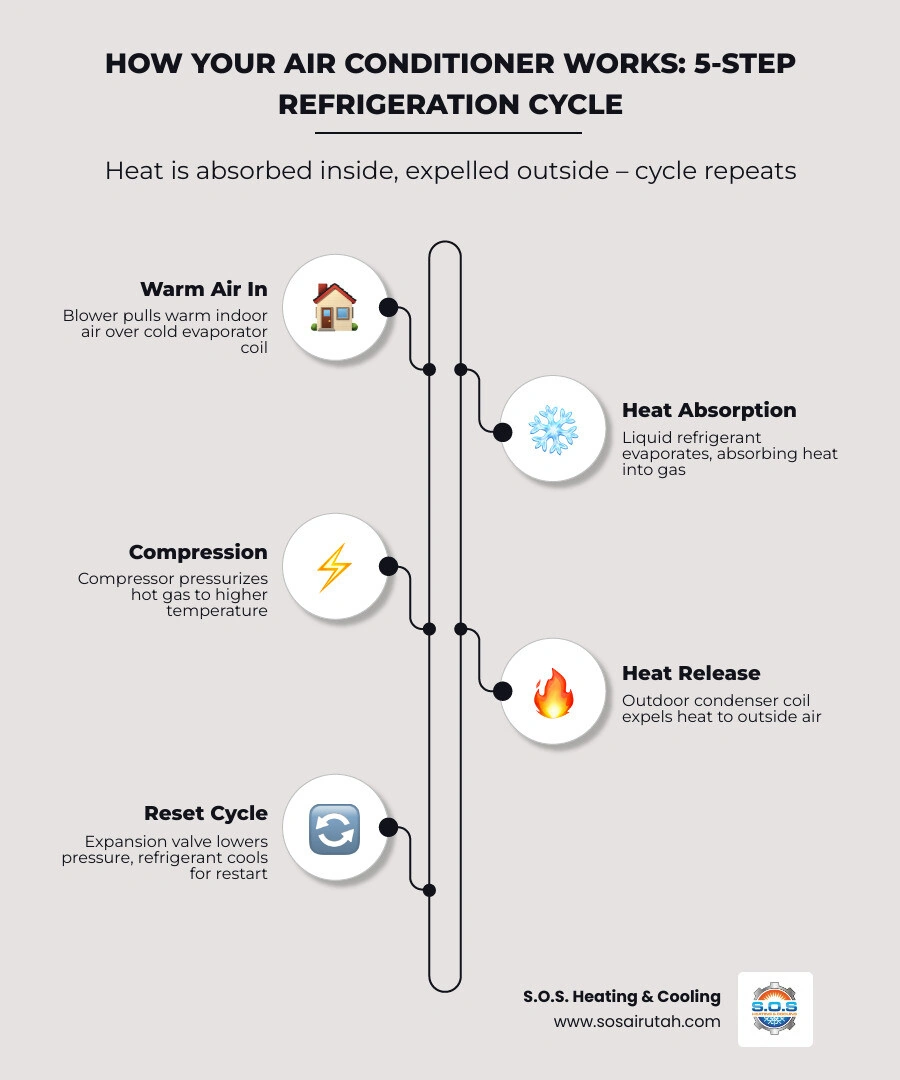
- Warm indoor air is pulled across a cold evaporator coil inside your home
- Refrigerant inside that coil absorbs the heat and evaporates into a gas
- The compressor pressurizes that gas, raising its temperature even further
- The condenser coil outside releases that heat into the outdoor air
- The expansion valve drops the refrigerant's pressure and temperature, resetting the cycle
- Cool, dehumidified air is blown back into your living space — and the cycle repeats
That loop runs continuously until your thermostat tells it to stop. The result? A cooler, more comfortable home — no magic required.
This matters for Salt Lake City homeowners because our summers push AC systems hard. When you understand what your system is actually doing, it's much easier to spot problems early, maintain it properly, and know when to call for help before a small issue becomes an expensive breakdown.
I'm Bryson Ninow, an NATE-certified HVAC professional with years of hands-on experience helping Salt Lake City homeowners get the most out of their cooling systems — and explaining how your air conditioner works explained simply is one of the most common and important conversations I have with customers. Understanding the basics of your system is the first step toward keeping it running efficiently for the long haul.
How Your Air Conditioner Works Explained Simply: The Heat Subtraction Secret
When the Wasatch Front hits those triple-digit temperatures in July, we often think of our air conditioners as "cold air machines." However, scientifically speaking, there is no such thing as "adding cold." There is only the removal of heat.
This is rooted in the second law of thermodynamics: heat naturally moves from a warmer place to a cooler place. Your air conditioner is essentially a transport vehicle that picks up heat inside your living room and drops it off on your driveway.
To do this, your system relies on a chemical "messenger" called refrigerant. This substance has a very low boiling point, meaning it can turn from a liquid to a gas even at relatively low temperatures. This transition, known as "phase conversion," is where the real work happens. When a liquid turns into a gas, it absorbs a massive amount of energy (heat).
In a typical split system—the kind most common in Salt Lake City—your AC doesn't pull in fresh air from the backyard. Instead, it recirculates the air already inside your home. It pulls that warm air through return vents, passes it over the chilling coils, and pushes it back out through the supply vents.
For more on the physics involved, check out our guide on How Does Air Conditioning Work? The Science Behind AC. On a healthy system, you can expect the air coming out of your vents to be about 20 degrees cooler than the air going in. If that "temperature drop" is smaller, your system might be struggling to subtract heat effectively.

How your air conditioner works explained simply through evaporation
The first half of the "magic" happens inside your home at the evaporator coil. Imagine you’ve just stepped out of a swimming pool on a breezy day. Even if it's 90 degrees out, you feel a chill. That’s because the water on your skin is evaporating, and as it turns into vapor, it "steals" heat from your body.
Your AC does the exact same thing. Very cold, liquid refrigerant enters the evaporator coil. A blower fan pulls warm air from your house and pushes it across these coils. The refrigerant inside absorbs the heat from that air and evaporates into a gas.
If there isn't enough airflow—perhaps because of a dirty filter—the coil can get too cold. Since it isn't absorbing enough heat from the house air, the moisture on the coil can actually freeze. If you see ice on your unit, it’s a sign the "heat subtraction" process has been interrupted. Learn more about Ice Forming on Your AC Unit: Causes and What to Do to prevent a total system freeze-up.
How your air conditioner works explained simply through compression and release
Once the refrigerant has "loaded up" with heat and turned into a gas, it travels through a copper line to the outdoor unit. This is where the compressor—the "heart" of the system—takes over.
The compressor squeezes the gas, which causes the temperature to spike even higher. Why would we want to make it hotter? Because for the heat to leave the refrigerant and move into the outdoor air, the refrigerant must be hotter than the outside temperature (remember that law of thermodynamics!).
The hot, high-pressure gas then enters the condenser coil. A large fan pulls outdoor air across these coils, "spitting out" the unwanted warmth into the Salt Lake City sky. As the heat leaves, the refrigerant cools down and turns back into a liquid. If your outdoor unit is blowing warm air, that’s actually a good sign—it means the system is successfully dumping heat! However, if the air inside your home is also warm, you should check out these troubleshooting steps for why your AC is blowing warm air.
The Five Main Components of Your Cooling System
To understand how your air conditioner works explained simply, you have to meet the "Big Five" components that make the cycle possible.
- The Refrigerant: This is the lifeblood of the system. In 2026, most modern systems use R-410A or the even more eco-friendly R-32. It’s a specialized chemical that changes states easily to move heat.
- The Evaporator Coil: Located inside (usually in your furnace or air handler), this is where heat is absorbed from your home.
- The Compressor: The outdoor "pump" that keeps the refrigerant moving and prepares it to release heat.
- The Condenser Coil: The outdoor "radiator" where the heat is finally expelled. Because these are outside, they get dirty fast. Knowing how to clean air conditioner coils is vital for keeping your system efficient.
- The Expansion Valve: This unsung hero sits between the condenser and the evaporator. It acts like a spray nozzle, depressurizing the liquid refrigerant so it becomes ice-cold again, resetting the cycle.
All of this is managed by your thermostat. Think of the thermostat as the brain; it monitors the indoor temperature and tells the compressor and fans when to start and stop.
Why Your AC Also Acts as a Dehumidifier
In Salt Lake City, we often brag about our "dry heat," but indoor humidity can still climb, making 75 degrees feel like 85. One of the best "side effects" of air conditioning is dehumidification.
Think about a cold can of soda on a porch in August. Within minutes, water droplets form on the outside of the can. This is because cold surfaces cause moisture in the air to reach its "dew point" and turn back into liquid.
As warm, humid air from your home passes over the freezing-cold evaporator coil, the moisture in the air condenses onto the metal. This water drips down into a drain pan and exits your home through a condensate drain line.
This is why you might see a small white PVC pipe dripping water near your outdoor unit—that’s just the humidity from your living room being escorted out! However, if that water ends up on your floor instead, you need to know why your AC leaks water inside your home. Often, the culprit is a blockage. Understanding what causes AC drain line clogs can save you from a messy ceiling or floor repair.
Common Types of Air Conditioning Systems in 2026
As of May 2026, air conditioning technology has never been more diverse. While nearly 87% of US households now have some form of cooling, the way they cool varies by home style and age.
| System Type | Best For | How It Works |
|---|---|---|
| Split-System | Most SLC Homes | A central unit with an indoor evaporator and outdoor condenser; uses ducts. |
| Ductless Mini-Split | Older Homes/Additions | Individual units mounted on walls; provides "zoned cooling" without ductwork. |
| Window Unit | Single Rooms | All components in one box; uses the least energy (900-1440 watts/hour). |
| Packaged Unit | Small Footprints | All components are in one outdoor cabinet, often on the roof or a concrete pad. |
| Portable AC | Renters | A mobile unit that vents heat through a window hose; usually the least efficient. |
In 2026, we also look closely at SEER2 ratings. This is the standard for energy efficiency. The higher the number, the less electricity the unit uses to move the same amount of heat. High-efficiency variable-speed systems can now reach SEER2 ratings of 20+, significantly lowering those summer utility bills in the Wasatch Front.
Maintaining Your System for Peak Performance
Your air conditioner is a heavy-duty piece of machinery. Globally, AC units used about 7% of all electricity in 2022, and that number is growing. To keep your "forgotten hero" from becoming an "energy hog," regular maintenance is non-negotiable.
- Change Air Filters: This is the #1 thing you can do. A clogged filter chokes your AC, forcing it to work harder and potentially causing the coils to freeze. Change them every 1-3 months.
- Clear the Outdoor Unit: Your condenser needs to "breathe" to release heat. Keep at least 18 to 24 inches of clearance around the unit. Clear away leaves, grass clippings, and Utah's famous tumbleweeds.
- Straighten the Fins: The thin metal slats on your outdoor unit can get bent by hail or stray basketballs. You can use a "fin comb" or even a butter knife to gently straighten them and restore airflow.
- Professional Tune-Ups: Some things require a pro. An annual inspection ensures your refrigerant levels are correct and your electrical components are safe. Check out our AC Maintenance Guide for Salt Lake City for a full checklist.
If you notice weak airflow or inconsistent temperatures, don't wait for the system to die. If your AC is not cooling properly, it's often a sign of a minor issue that can be fixed before it leads to a total AC repair in Salt Lake City.
Frequently Asked Questions About AC Operation
Does an air conditioner bring in fresh air from the outside?
No. This is a very common myth! Standard split-system air conditioners recirculate the air already inside your home. They pull air through the return ducts, cool it, and push it back through the supply ducts. While some commercial systems or specialized "fresh air intakes" exist, your typical home AC is a closed-loop system for air.
Why is my air conditioner blowing warm air?
There are three common culprits:
- Dirty Coils: If the outdoor coils are covered in dirt, the heat has nowhere to go, so it stays in the refrigerant and comes back into your house.
- Low Refrigerant: If there’s a leak, there isn't enough "messenger" to carry the heat away.
- Compressor Failure: If the "heart" stops pumping, the cycle stops. If you're feeling the heat, follow our guide on what to do when your AC stops cooling.
How much energy does a standard air conditioner use?
It varies by type. A window unit typically uses between 900 and 1,440 watts per hour. A central AC system for a standard Salt Lake City home usually pulls between 3,000 and 3,500 watts per hour. Because AC accounts for 10% to 20% of the average home's energy bill, efficiency matters. With 1.6 billion units in use globally as of 2016—a number expected to hit 4 billion by 2050—even small efficiency gains have a massive global impact.
Conclusion
Understanding how your air conditioner works explained simply helps you appreciate the incredible engineering that keeps us safe and comfortable. From Willis Carrier’s first invention in 1902 to the high-efficiency smart systems we install today, the goal remains the same: moving heat so you can stay cool.
At S.O.S. Heating & Cooling, we’ve been the trusted HVAC experts for the Wasatch Front for years. Whether you’re in Bountiful, Draper, Herriman, or right here in Salt Lake City, we are dedicated to keeping your "heat subtraction" machine running perfectly. We offer 24/7 emergency repairs, flexible financing, and a commitment to customer satisfaction that means we never charge evaluation fees during business hours.
Don't let the Utah heat get the best of your home. If your system is making strange noises, blowing warm air, or just hasn't been serviced in a while, our team is ready to help.
Schedule your professional air conditioning service today and ensure your home stays a cool sanctuary all summer long!

Plumbing
Expert plumbing services offering reliable repairs, installations, maintenance, and emergency support.

Air Conditioning
Comprehensive air conditioning services include installation, repairs, maintenance, and energy-efficient solutions.
Heat Pumps
Enjoy year-round comfort with our energy-efficient and professional heat pump solutions.

Indoor Air Quality
Enhance your home’s air with our cutting-edge indoor air quality solutions you can trust.

Fireplaces
Transform your space into a warm and cozy atmosphere with our professional fireplace services.

Heating
Specialized heating services provide reliable installation, repair, system maintenance, and energy-optimization solutions.
Explore Our Latest Insights and Updates in Plumbing Services
The Definitive Guide to Undersized AC Unit Signs and Problems

A Quick Start Guide to Deciding AC Repair vs Replace in Utah