

The Dynamic Duo of Home Cooling
How Your Indoor and Outdoor AC Units Work Together to Cool Your Home Understanding how your indoor and outdoor AC units work together is…
How Your Indoor and Outdoor AC Units Work Together to Cool Your Home
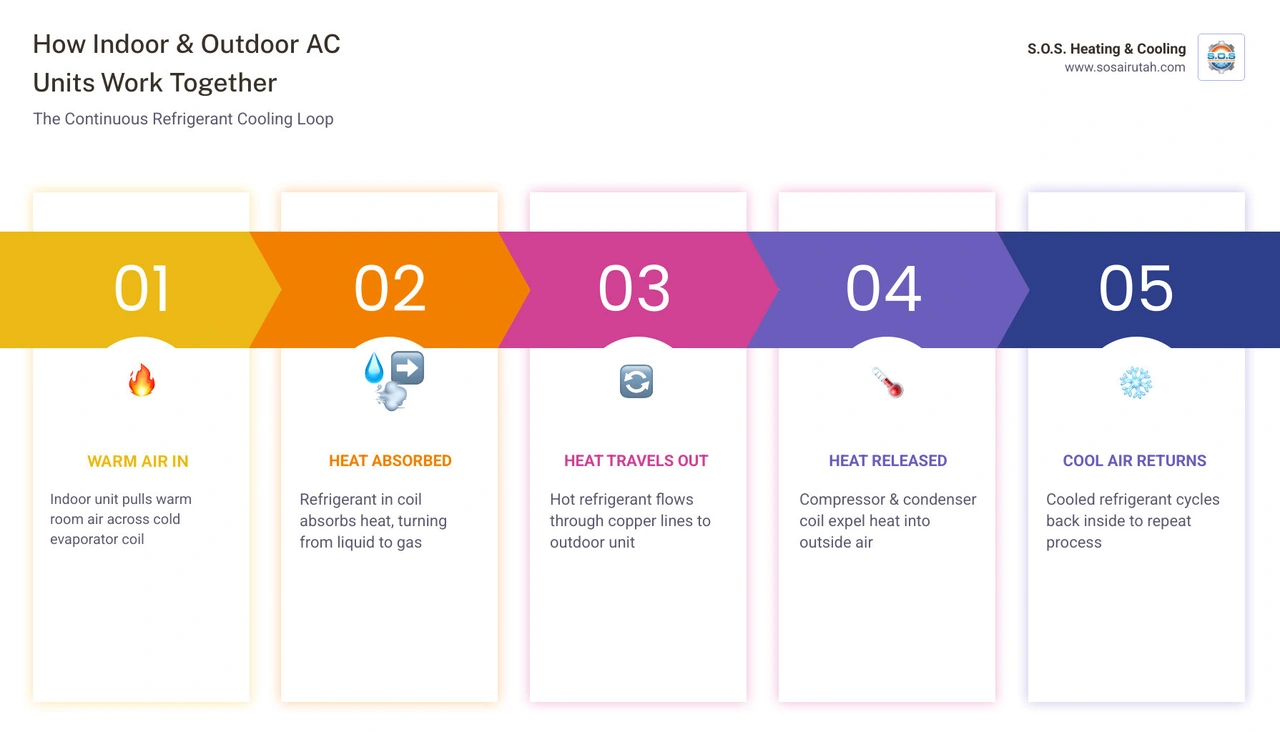
Understanding how your indoor and outdoor AC units work together is simpler than you might think. Here's the short version:
- Warm air is pulled in — Your indoor unit draws warm air from inside your home across a cold evaporator coil.
- Heat is absorbed — Refrigerant flowing through that coil picks up the heat like a sponge.
- Refrigerant travels outside — The heat-laden refrigerant moves through copper lines to the outdoor unit.
- Heat is released outdoors — The outdoor unit's compressor and condenser coil push that heat out into the outside air.
- Cooled refrigerant returns — The now-cool refrigerant cycles back inside, and the process repeats continuously.
These two units are not independent machines — they are two halves of one engineered system, designed to pass heat back and forth in a continuous loop until your home reaches the temperature you set.
When that loop is interrupted — by mismatched components, poor maintenance, or a failing part — your whole home feels it. That's why understanding how the system works together matters so much, especially when something goes wrong unexpectedly.
My name is Bryson Ninow, and with certifications in NATE, EPA, RMGA, and DOPL, I've spent years helping Salt Lake City homeowners get the most out of their HVAC systems by understanding exactly how their indoor and outdoor AC units work together. Whether you're dealing with a breakdown or just want to make smarter decisions about your home comfort, I'll walk you through everything you need to know.
Understanding the Split System: Why Your AC Has Two Halves
In HVAC, the most common setup we see in Utah homes is the "split system." As the name suggests, the system is split into two distinct parts: the indoor unit (often located in a basement, closet, or attic) and the outdoor unit (the humming metal box sitting on a concrete pad in your yard).
But why split them up? Why not just have one big machine? There are several practical reasons for this design:
- Noise Reduction: The most loud and "industrial" parts of your air conditioner—the compressor and the large exhaust fan—are kept outside. This allows you to sleep or watch a movie in peace while the system works hard to keep you cool.
- Heat Exchange Efficiency: Air conditioning isn't actually about "creating cold"; it's about moving heat. To get heat out of your house, you need a component inside to grab it and a component outside to dump it.
- Space-Saving: By splitting the components, the indoor portion can be tucked away into tight spaces like crawlspaces or utility closets, while the bulkier parts stay outdoors.
To dive deeper into the physics of this process, you can read more about How Air Conditioning Work - The Science Behind AC. Essentially, these two halves create a "comfort circuit" that relies on a constant exchange of energy.
The Science of How Your Indoor and Outdoor AC Units Work Together
The secret sauce that makes this whole operation possible is refrigerant. Think of refrigerant as a "heat courier." It is a special fluid that changes states from liquid to gas at very low temperatures, allowing it to absorb and release heat with incredible efficiency.
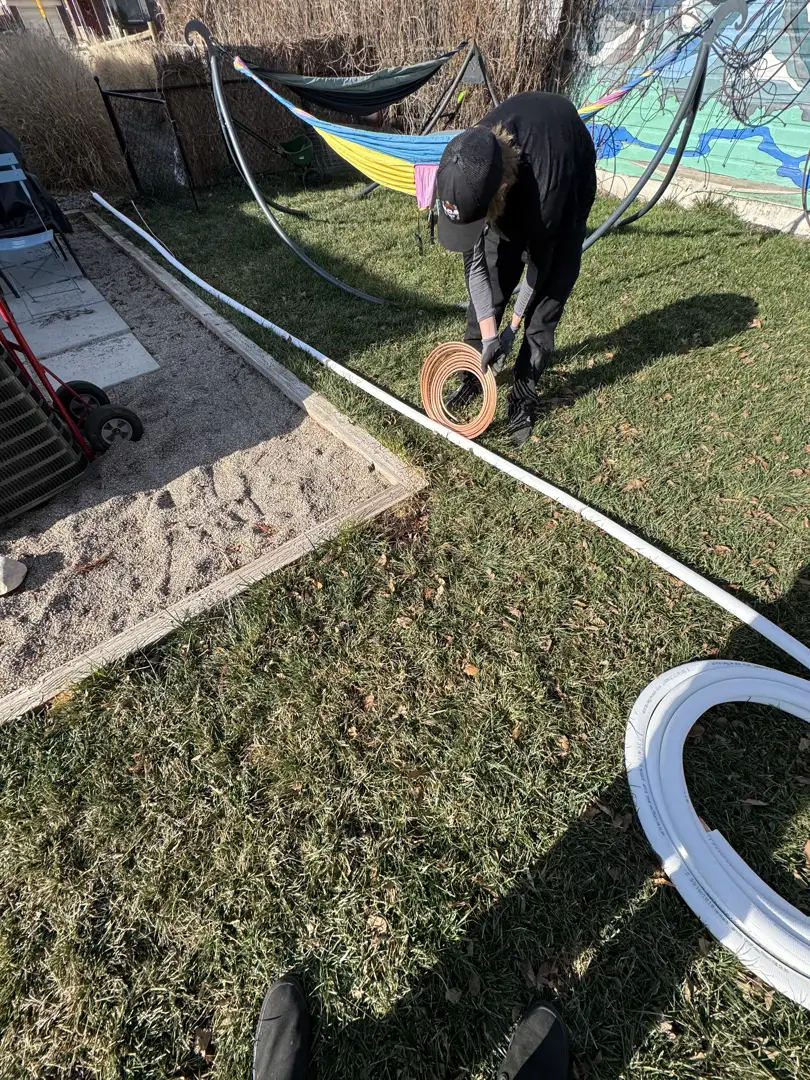
The two units are connected by copper refrigerant lines (the "lineset"). One line carries cold, low-pressure refrigerant into your home, and the other carries hot, high-pressure refrigerant back out.
This cycle is a continuous loop of evaporation, compression, and condensation. Without the outdoor unit to "squeeze" the heat out of the refrigerant, the indoor unit would just be blowing warm air. Conversely, without the indoor unit to absorb the heat, the outdoor unit would have nothing to process. For a full overview of these systems, visit our Air Conditioning page.
The Role of the Indoor Unit in How Your Indoor and Outdoor AC Units Work Together
The indoor unit's primary job is to interact with your home's air. It consists of three main parts: the evaporator coil, the blower motor, and the air filter.
When your thermostat calls for cooling, the blower motor pulls warm house air through the air filter and pushes it across the evaporator coil. Inside that coil, the refrigerant is very cold. As the warm air touches the cold metal fins of the coil, two things happen:
- Heat Absorption: The refrigerant inside the coil soaks up the heat from the air.
- Humidity Removal: Just like a cold soda can "sweats" on a hot day, moisture from your indoor air condenses on the cold coil. This water drips into a drain pan and is piped away. This dehumidification is a huge part of why AC makes us feel so much more comfortable in the summer.
If your indoor unit is struggling, it often leads to comfort issues. You can learn more about Why Your HVAC System Has Poor Airflow to see how a dirty filter or failing blower can break the cooling loop.
The Role of the Outdoor Unit in How Your Indoor and Outdoor AC Units Work Together
Once the refrigerant has "filled up" with heat from your living room, it travels outside to the condenser unit. This is where the heavy lifting happens.
- The Compressor: This is the heart of the system. It takes the warm, gaseous refrigerant and squeezes it. When you compress a gas, its temperature skyrockets. The refrigerant becomes much hotter than the outside air.
- The Condenser Coil: The hot gas flows through these coils.
- The Exhaust Fan: The fan pulls outdoor air across the condenser coils. Because the refrigerant is now hotter than the outside air (even on a 100-degree Salt Lake City day), the heat naturally moves from the coils into the outdoor air.
As the heat leaves, the refrigerant cools down and turns back into a liquid, ready to head back inside and start over. Keeping this outdoor unit clean is vital for the cycle to continue efficiently. If you haven't had yours checked recently, consider scheduling an AC Service Salt Lake City UT.
The Importance of a Matched HVAC System
One of the most common mistakes homeowners make is trying to "mix and match" components. They might replace a broken outdoor unit while keeping a 15-year-old indoor furnace and coil. In the industry, we call this a "mismatched system," and it's a recipe for trouble.
To get the efficiency and performance you're paying for, your indoor and outdoor units must be a matched system. This means they were engineered by the same manufacturer to work together.
The AHRI (Air-Conditioning, Heating, and Refrigeration Institute) provides certifications for these pairs. Think of an AHRI reference number like a VIN for your car; it proves that these specific components, when used together, will achieve a certain SEER2 (Seasonal Energy Efficiency Ratio) rating.
| Feature | Matched System | Mismatched System |
|---|---|---|
| Efficiency | Maximum (meets SEER2 ratings) | 20–40% loss in efficiency |
| Warranty | Full manufacturer coverage | Often voided or restricted |
| Lifespan | 12–15+ years | Premature compressor failure |
| Technology | Components "speak" the same language | Communication errors and poor modulation |
Communication and Inverter Technology
In May 2026, modern HVAC technology is more advanced than ever. Many high-efficiency systems now use inverter-driven compressors and electronic expansion valves (EEV).
These units don't just turn "on" or "off." Instead, they modulate. If your home only needs a tiny bit of cooling, the outdoor unit might run at only 25% capacity. To do this, the indoor and outdoor units must "talk" to each other via proprietary communication protocols and dedicated data wires.
If you try to pair a modern, communicating outdoor unit with an old "dummy" indoor unit, they won't be able to synchronize. It's like having a German speaker try to give complex instructions to a Japanese speaker—the message gets lost, and the system won't perform.
Risks of Mixing and Mismatching Components
Why are we so insistent on matching? Because the consequences of mismatching are expensive and often permanent.
- Efficiency Loss: An outdoor unit rated for 18 SEER2 might only perform at 13 SEER2 if it's paired with an old, high-wattage indoor blower motor. You're paying for high-end technology but getting entry-level results.
- Compressor Strain: If the indoor coil is the wrong size or uses a different refrigerant than the outdoor unit, it can cause liquid refrigerant to flood back into the compressor. This is the fastest way to kill a brand-new AC.
- Legal Penalties: New federal and state regulations are strict. In many cases, it is actually a code violation for a contractor to install a system that isn't AHRI-certified to meet minimum energy standards.
- Poor Comfort: Mismatched systems often struggle with humidity or leave hot and cold spots. This is a primary reason Why Your AC Has Poor Cooling Distribution.
Maintenance for a Synchronized System
Because your indoor and outdoor units are a "tag team," they both need attention to keep the "comfort circuit" running. If one side of the team is dragging, the whole system suffers.
- Filter Changes: A clogged filter indoors slows down airflow, which can cause the indoor coil to freeze into a block of ice. This stops the heat exchange process entirely.
- Coil Cleaning: If the outdoor condenser coil is covered in cottonwood fuzz or dust, it can't release heat. The compressor will have to work twice as hard, leading to a spike in your power bill.
- Airflow Optimization: We check both units to ensure the fans are moving the correct volume of air. You can read about How Airflow Affects Your Air Conditioner's Performance to understand why this balance is so delicate.
- Annual Tune-ups: A professional inspection ensures that refrigerant levels are exact and that the communication between the units is clear. If you're noticing issues, don't wait for a total breakdown—look into AC Repair Salt Lake City UT.
Frequently Asked Questions about AC Unit Coordination
Can I replace just the outdoor unit if the indoor one still works?
Technically, it is sometimes possible, but we rarely recommend it. Modern units use different refrigerants (like R-32, which is becoming the standard in 2026) and higher pressures than older units. An old indoor coil may not be able to handle the pressure or the new refrigerant type, leading to leaks and voided warranties.
How do I know if my system is AHRI certified?
Your HVAC contractor should provide you with an AHRI Certificate of Product Ratings. You can also take the model numbers of your indoor and outdoor units and look them up in the AHRI Directory of Certified Product Performance. This certification is often required to claim utility rebates or tax incentives.
Why do modern units need a communication wire?
In the old days, a thermostat just sent a 24-volt signal to tell the AC to turn on. Modern systems are "smart." The indoor unit tells the outdoor unit exactly how much heat it is absorbing, allowing the outdoor compressor to adjust its speed in real-time. This saves a massive amount of electricity and provides much steadier temperatures.
Conclusion
At S.O.S. Heating & Cooling, we know that your home's comfort depends on the perfect partnership between your indoor and outdoor units. Whether you live in Bountiful, Draper, or right here in Salt Lake City, your AC system is a high-tech circuit designed to move heat out of your life so you can enjoy your summer.
When these units work together in perfect harmony, you get lower energy bills, a longer-lasting system, and a home that stays perfectly cool even when the Utah sun is at its peak. If you’re worried your "dynamic duo" isn't playing well together, or if you're ready to upgrade to a perfectly matched, high-efficiency system, we’re here to help.
Don't let a mismatched or poorly maintained system ruin your summer. Schedule your professional air conditioning service today and let us ensure your home stays the sanctuary it’s meant to be.
Contact Us

Let's Get You From Distress to Rest
No heat, no cool, a backed-up drain, or just due for a tune-up? Call now or request service and our local team will be on the way — upfront pricing, no surprises.