

Don't Let the Desert Dry You Out: Pro Tips for Home Humidity


.avif)

Why Humidity Control Matters More Than You Think in the High Desert
Humidity control tips for high desert homeowners are something every Salt Lake City resident should know — because living in an arid climate doesn't mean indoor moisture takes care of itself.
Here's a quick summary of the most effective ways to manage indoor humidity in a high desert home:
- Target 30–50% relative humidity indoors year-round
- Use a whole-home humidifier during dry winter months to combat parched air
- Run exhaust fans in bathrooms, kitchens, and laundry rooms to vent moisture outdoors
- Deploy a dehumidifier during Utah's summer monsoon season when indoor humidity can spike
- Seal air leaks around windows, doors, and plumbing to retain or block moisture as needed
- Monitor levels daily with a digital hygrometer or smart thermostat with humidity sensors
- Schedule annual HVAC maintenance to keep humidity control features running efficiently
Most people assume the desert means dry air — end of story. But the reality is more complicated. Indoor activities like cooking, showering, and even watering houseplants can push humidity well above comfortable levels, especially in tightly sealed modern homes. And during Utah's monsoon season, outdoor moisture can sneak inside faster than you'd expect. On the flip side, during dry winter months, indoor air can drop so low it damages wood floors, irritates your airways, and turns your home into a static electricity experiment.
The sweet spot — 30% to 50% relative humidity — protects your health, your home's structure, and your HVAC system. Getting there takes a little know-how, but it's absolutely achievable.
I'm Bryson Ninow, an HVAC professional with certifications in indoor air quality and energy efficiency, and I've helped countless Salt Lake City homeowners navigate the unique challenges of humidity control in high desert climates. Whether you're battling bone-dry winter air or a surprise monsoon humidity spike, the humidity control tips for high desert homeowners in this guide are drawn from real-world experience right here in the valley.
Understanding the Ideal Indoor Humidity for High Desert Homes

When we talk about humidity, we are specifically referring to "relative humidity" (RH). This is the amount of water vapor present in the air compared to the maximum amount the air could hold at that specific temperature. In our high desert environment, finding the Perfect Home Humidity Levels is a balancing act.
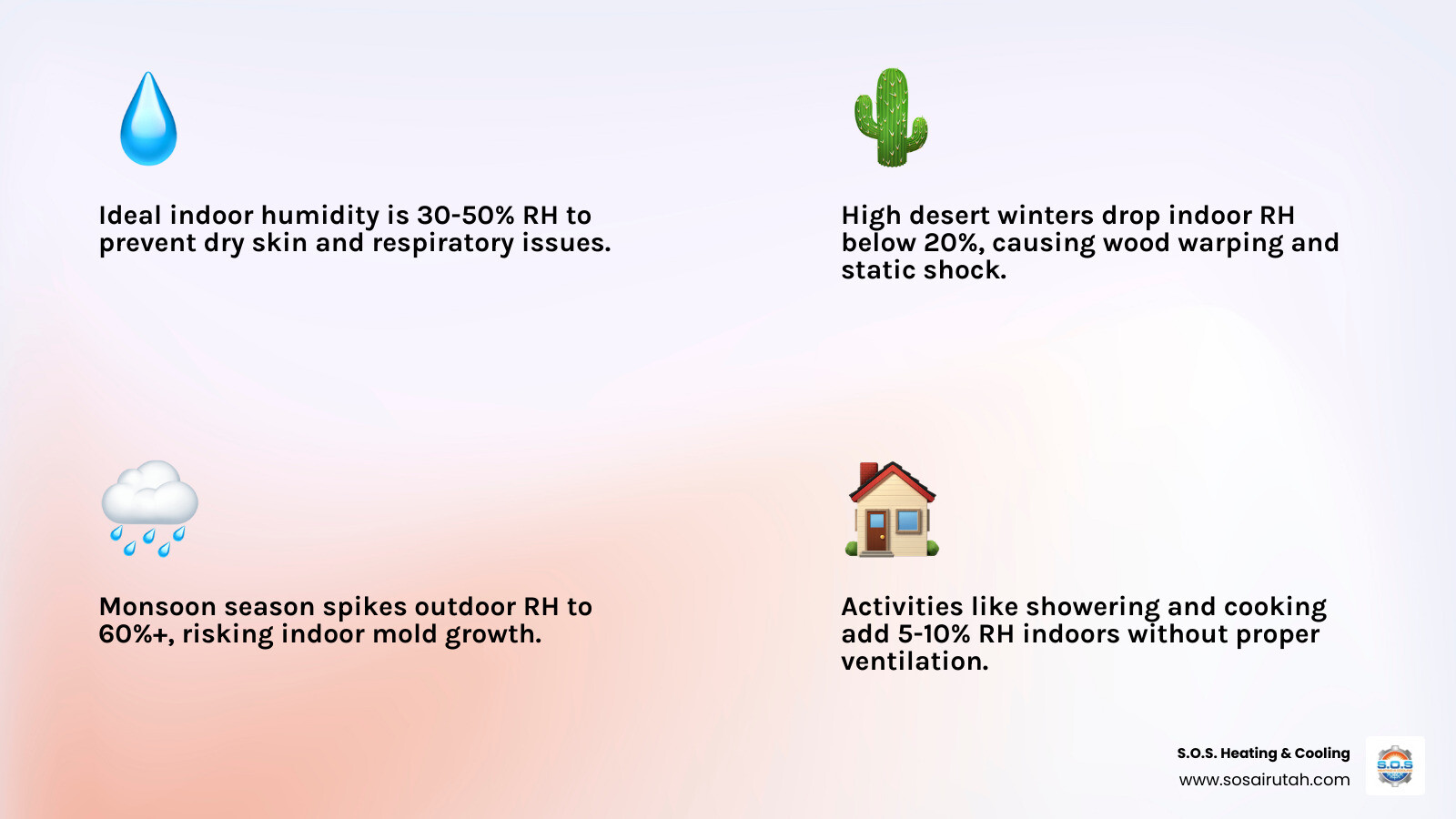
According to the Environmental Protection Agency (EPA), the ideal indoor humidity range is between 30% and 50%. Once you cross the 60% threshold, you enter the danger zone where mold, mildew, and dust mites begin to thrive. Conversely, dropping below 30% leads to the "parched desert" feeling that causes dry skin and respiratory irritation.
ASHRAE (the American Society of Heating, Refrigerating and Air-Conditioning Engineers) provides even more specific guidelines based on outdoor temperatures to prevent window condensation. For example, if it's 0°F outside, your indoor humidity should actually be closer to 25%. As we move through May 2026, you'll notice that the "dew point"—the temperature at which air becomes saturated and water droplets form—changes rapidly with our diurnal temperature swings (those massive shifts between hot days and chilly nights).
Measuring Your Air Quality
You can't manage what you don't measure. For Indoor Air Quality Salt Lake City UT enthusiasts, the first step is purchasing a digital hygrometer. These are inexpensive devices that provide a real-time RH percentage.
For the most accurate readings, place your sensors in central living areas. Avoid placing them near:
- Kitchens (where boiling water spikes the reading)
- Bathrooms (where showers create artificial peaks)
- HVAC vents (where the direct blast of air will skew the data)
Modern smart thermostats often have built-in humidity sensors that can even send alerts to your phone if your home gets too dry or too damp. This is particularly helpful in the Wasatch Front, where morning humidity can be high but afternoon air is bone-dry.
Essential Humidity Control Tips for High Desert Homeowners
Managing moisture in a place like Salt Lake City requires a dual strategy. We spend most of the year trying to add moisture, but there are specific times when we must work hard to remove it.
One of the most effective humidity control tips for high desert homeowners is to address the home envelope. Weatherstripping around doors and caulking around window frames doesn't just save on energy bills; it prevents "moisture dilution." In the winter, your humidified indoor air wants to escape into the dry outdoors. In the summer, humid monsoon air wants to seep in.
Additionally, we recommend checking your crawlspaces. Covering dirt floors with plastic sheeting (a vapor barrier) blocks ground moisture from rising into your living spaces—a common cause of "mystery" high humidity in older desert homes.
Managing Moisture During Monsoon Season
While we love the rain, the late summer monsoon season can bring a surprising amount of moisture into our homes. If you find your home feeling "sticky" or "clammy," you may need to focus on dehumidification.
For residents looking into Whole Home Humidifiers Riverton UT, these systems should be paired with robust ventilation. Always run your exhaust fans in the bathroom for at least 20 minutes after a shower.
Signs your humidity is too high (above 60%):
- Condensation or "sweat" on the inside of windows.
- Musty odors in closets or basements.
- Visible mold or mildew in bathroom corners.
- Doors that suddenly stick or floorboards that feel "cupped."
Mechanical Solutions: Humidifiers and HVAC Integration
If you find that portable "tabletop" humidifiers aren't cutting it, it’s time to look at professional Indoor Air Quality solutions. Portable units are often a "chore"—they require daily refills, frequent cleaning to prevent bacteria growth, and they only humidify one room at a time.
For true comfort, we recommend Whole Home Humidifiers South Jordan UT that integrate directly into your ductwork. These systems pull water from your home's plumbing and distribute it evenly through every vent.
There are three main types of whole-home systems:
- Bypass Humidifiers: These use the furnace fan to pull air through a water-soaked pad. They are reliable and low-maintenance.
- Fan-Powered Humidifiers: These have their own internal fan, making them more powerful for larger homes.
- Steam Humidifiers: These boil water to create pure steam. They are the "gold standard" for Whole Home Humidifiers Draper UT because they work independently of the furnace's heat.
| Feature | Bypass Humidifier | Steam Humidifier |
|---|---|---|
| Efficiency | High (uses existing air) | Very High (direct moisture) |
| Maintenance | Annual pad change | Periodic canister change |
| Output | Moderate | High |
| Control | Standard Humidistat | Precision Digital Control |
Why Whole-Home Systems are the Best Humidity Control Tips for High Desert Homeowners
The beauty of a whole-home system, like those we install for Whole Home Humidifiers Murray UT, is the "set-it-and-forget-it" nature. You don't have to carry heavy water tanks across the house. Instead, your HVAC system monitors the air and adds moisture as needed.
Furthermore, maintaining your Air Conditioner Filter Salt Lake City UT is vital. A clogged filter restricts airflow, which can cause your humidifier to work overtime or even lead to moisture backing up into your furnace cabinet.
The Role of Air Filtration and Ventilation
In modern, "tight" homes, air can become stagnant. This is where Energy Recovery Ventilators (ERVs) come into play. An ERV swaps stale indoor air for fresh outdoor air while "recovering" the humidity. In the winter, it keeps the moisture inside while bringing in fresh air.
Investing in Whole House Air Filtration Salt Lake City UT or Whole Home Air Filtration Holladay UT ensures that as you add moisture, you aren't also circulating dust or allergens. Air Filter Replacement Salt Lake City UT should happen every 1–3 months, especially during high-pollen or high-dust seasons.
Natural and Low-Cost Ways to Balance Moisture
If you aren't ready for a mechanical upgrade, there are several "low-tech" humidity control tips for high desert homeowners that can help.
One of the most effective natural methods is transpiration. This is the process where plants release moisture into the air. By choosing the right greenery and using Whole Home Air Filtration Layton UT to keep the air clean, you can create a mini-oasis.
Other DIY tricks include:
- Water Bowls: Placing decorative bowls of water near floor vents or on sunny windowsills.
- Indoor Fountains: A small stone fountain adds both aesthetic value and constant evaporation.
- Laundry Drying: Skip the dryer and use a drying rack for your clothes. This releases gallons of water into your air for free.
- Cooking Steam: Leave the lid off your pasta pot or use a slow cooker without the lid to boost kitchen humidity.
Using Plants and Daily Activities as Humidity Control Tips for High Desert Homeowners
To maximize the impact of plants, try "grouping" them. When plants like peace lilies, spider plants, and ferns are placed together, they create a localized microclimate with significantly higher humidity. Pairing this with Whole Home Air Filtration Murray UT ensures your "indoor jungle" stays healthy and dust-free.
Another tip: after you shower, leave the bathroom door open. Instead of letting that valuable steam get sucked out by the exhaust fan, let it drift into your bedroom to help you sleep better in the dry desert night. This is a favorite among residents in Whole Home Air Filtration Sandy UT and Whole Home Air Filtration South Jordan UT.
Protecting Your Health and Home Structure
Why do we care so much about these numbers? Because the desert air is aggressive. When humidity drops below 30%, your body’s first line of defense—your mucous membranes—dries out. This makes you more susceptible to colds, the flu, and respiratory infections.
Maintaining 30-50% humidity provides several health benefits:
- Better Sleep: No more waking up with a "scratchy" throat or "stuffy" nose.
- Healthier Skin: Reduces the cracking and itching common in Utah winters.
- Reduced Illness: Viruses struggle to travel in air that has balanced moisture.
- Static Control: Say goodbye to those annoying sparks when you touch a doorknob.
Beyond health, proper humidity protects your biggest investment: your home. Extremely dry air causes wood to shrink. This leads to gaps in hardwood floors, "popping" joints in crown molding, and even cracks in expensive musical instruments like pianos or guitars. On the other hand, excess moisture during a monsoon can lead to electrical corrosion and short circuits. Utilizing Whole House Air Purification Salt Lake City UT alongside humidity control keeps your home’s "lungs" and "bones" in peak condition.
Frequently Asked Questions about Desert Humidity
Can a desert home have too much humidity?
Yes, absolutely. Even in a desert, indoor activities like long showers, boiling water, and drying laundry can trap moisture inside, especially in energy-efficient, tightly sealed homes. If your indoor humidity stays above 60%, you are at risk for mold growth and structural damage. Proper ventilation is the key to preventing this.
How often should I service my HVAC for humidity control?
We recommend annual professional maintenance. As of May 2026, standard industry practices suggest a full system checkup once a year to ensure your humidifier pads are clean, your drainage lines are clear, and your sensors are calibrated correctly. Neglecting this can lead to mineral buildup (from our hard Utah water) which can eventually damage your furnace.
Does air conditioning make the air drier?
Yes. Air conditioners and heat pumps remove moisture from the air as a natural byproduct of the cooling process. This is great during a humid July afternoon, but it can make your home feel "crisp" to a fault. If you find your skin getting dry even in the summer, you may need supplemental humidification or a variable-speed AC system that manages moisture more precisely.
Conclusion
Living in the high desert is a dream, but the dry air doesn't have to be a nightmare. By following these humidity control tips for high desert homeowners, you can transform your Salt Lake City house into a comfortable, healthy sanctuary. Whether you're in Bountiful, Draper, or Herriman, the team at S.O.S. Heating & Cooling is here to help you find that perfect 30-50% sweet spot.
Ready to stop the static shocks and start breathing easier? Schedule your professional humidity consultation today with the experts who know Utah air best. We’ll help you choose the right system to protect your family and your home for years to come.
Explore Our Latest Insights and Updates in Plumbing Services

Step-by-Step Guide to How Bryson Ninow Built SOS on Fair and Honest Service

Why Your House and Lungs Hate Extreme Humidity
Why Your HVAC Needs a Humidity Sidekick to Keep You Comfortable