
Everything You Need to Know About Single Stage vs Two Stage vs Modulating Furnace


.avif)

Which Furnace Type Is Right for Your Wasatch Front Home?
Choosing between a single stage vs two stage vs modulating furnace for a wasatch front climate is one of the most important heating decisions a Utah homeowner can make — and the right answer depends on your home size, how long you plan to stay, and the unique demands of living at 4,200 to 5,000 feet above sea level.
Here is a quick breakdown to help you decide:
| Furnace Type | Best For | Key Benefit | Key Tradeoff |
|---|---|---|---|
| Single-stage | Small homes, rentals, short-term owners | Lowest upfront cost | Largest temperature swings, loudest startup |
| Two-stage | Most Wasatch Front homes, 1,800–3,500 sq ft | Comfort + value sweet spot | Moderate premium over single-stage |
| Modulating | Large homes, allergy concerns, long-term owners | Most even heat, quietest operation | Highest upfront cost, longest payback |
The short answer: For most Salt Lake Valley homeowners planning to stay 7 or more years, a 95%+ AFUE two-stage or modulating furnace with a variable-speed ECM blower is the best long-term choice. It delivers better comfort, helps manage Utah's notoriously dry winter air, and pays back through lower gas bills and utility rebates. If you are in a smaller home or plan to move within a few years, a single-stage furnace may still make practical sense.
Utah's high altitude alone changes the math significantly. A furnace rated at 80,000 BTU at sea level delivers closer to 70,000 BTU in Salt Lake City once you account for the standard 4% capacity derate per 1,000 feet above 2,000 feet elevation. That means the furnace type you choose — and how it is sized — matters more here than almost anywhere else in the country.
I'm Bryson Ninow, a NATE-certified HVAC professional with hands-on experience helping Wasatch Front homeowners navigate exactly this decision — from altitude derating and inversion-season air quality to rebate programs that make high-efficiency upgrades genuinely affordable. I've helped hundreds of families across the Salt Lake Valley choose the right single stage vs two stage vs modulating furnace for a wasatch front climate, and in this guide I'll walk you through everything you need to know to make a confident, well-informed choice.
Understanding Furnace Staging: Single, Two-Stage, and Modulating
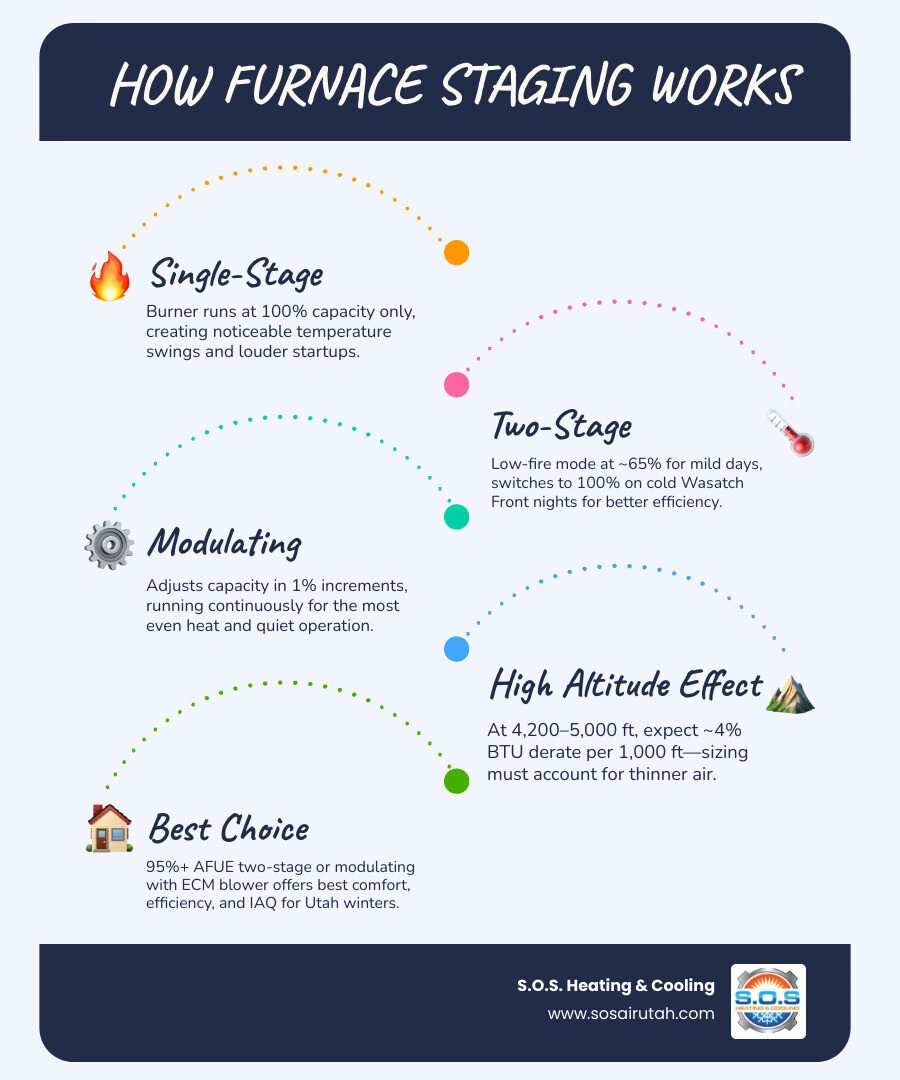
To make the best decision for your home in Salt Lake City, Sandy, or Layton, it helps to understand exactly what "staging" means. In HVAC, staging refers to how a furnace controls its burner capacity and gas flow.
Think of staging like the gas pedal in your car. A single-stage furnace is like a pedal that only has two positions: completely released (off) or fully floored (on). A two-stage furnace is like having two distinct gears: a low speed for cruising and a high speed for passing. A modulating furnace acts like an intelligent, modern cruise control system that automatically adjusts the throttle in tiny, 1% increments to maintain a perfectly steady speed.
Single-Stage Furnaces
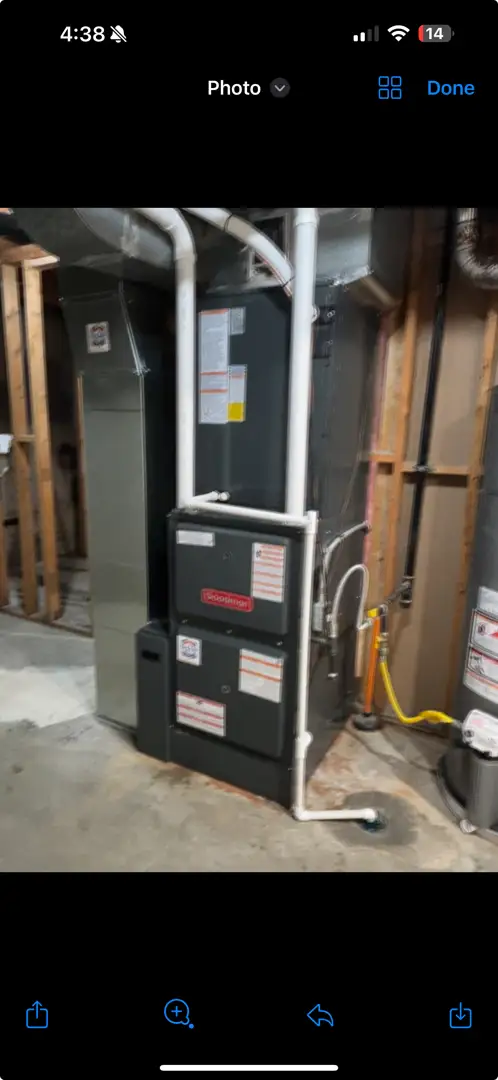
A single-stage furnace is the traditional technology that has warmed American homes for decades. It operates on a simple on-and-off cycle. When the thermostat calls for heat, the gas valve opens 100% of the way, and the burners ignite at full capacity.
Because it only operates at maximum blast, a single-stage furnace will quickly heat up the area closest to your thermostat, satisfy the temperature setting, and shut off. This rapid cycling leads to noticeable temperature swings of 3 to 5 degrees throughout the home. It also creates a distinct blast of hot air and produces the loudest startup noise of the three types, as the system must ramp up to full power instantly every time it turns on.
Two-Stage Furnaces
A two-stage furnace introduces a "low-fire" and a "high-fire" mode. Most of the time—approximately 75% to 80% of the winter in properly sized homes—the furnace will run in its low-fire mode, which typically operates at about 65% of the system's total burner capacity.
By running at a lower capacity, the furnace can run for longer, gentler cycles. This steady operation virtually eliminates hot and cold spots throughout your home and keeps temperature swings within a tight 1 to 2 degrees. When a severe winter storm rolls off the Wasatch Mountains and temperatures plummet, the furnace automatically steps up to its high-fire mode (100% capacity) to keep your home warm and cozy. If you want to learn more about how these units fit into your broader home replacement strategy, check out our Furnace Replacement Ultimate Guide.
Modulating Furnaces
Modulating furnaces represent the pinnacle of modern home heating technology. Instead of choosing between one or two settings, a modulating gas valve continuously regulates the amount of fuel burned in real-time. It can adjust its heating output in tiny 1% increments, running anywhere from 40% capacity all the way up to 100% capacity.
Because it can match your home's heat loss almost perfectly, a modulating furnace rarely shuts off completely during cold weather. Instead, it runs almost continuously at an ultra-low, highly efficient whisper-quiet level. This continuous operation provides unmatched temperature control, keeping your indoor climate within a fraction of a degree of your thermostat setting.
Choosing a Single Stage vs Two Stage vs Modulating Furnace for a Wasatch Front Climate
Living along the Wasatch Front means dealing with a highly demanding and unique climate. Our geography isn't just a beautiful backdrop; it is a technical hurdle for mechanical equipment. From the sub-freezing temperatures of January to our high elevation and dry air, Utah homes require specialized HVAC configurations. To understand the broader picture of how our local weather impacts your home's mechanical systems, read about How the Wasatch Front Climate Affects Your HVAC and Plumbing.
Sizing Challenges: Single Stage vs Two Stage vs Modulating Furnace for a Wasatch Front Climate
Sizing a furnace in communities like Draper, Herriman, or Bountiful requires careful high-altitude calculations. Because the atmospheric pressure is lower and the air is thinner at 4,200 to 5,000 feet above sea level, there is less oxygen available to support combustion.
To account for this, gas furnaces must be "derated." Standard industry guidelines dictate a 4% capacity loss per 1,000 feet of elevation above 2,000 feet. In Salt Lake City, this means a furnace rated for 80,000 BTUs of heat output at sea level will actually deliver closer to 70,000 BTUs of usable heat to your home.
If a contractor uses a basic "rule-of-thumb" sizing method without performing a proper Manual J load calculation, they will likely install a system that is either undersized (leaving you shivering during a cold snap) or oversized. Oversized furnaces are particularly problematic at high altitudes; they short-cycle constantly, which accelerates wear and tear and shortens the system's lifespan. We dive deep into these high-altitude mechanical considerations in our guide on the Best HVAC and Plumbing Setup for Utah Weather.
Comfort and Efficiency: Single Stage vs Two Stage vs Modulating Furnace for a Wasatch Front Climate
The staging level you choose directly impacts how your home handles Utah’s winter dryness and seasonal temperature swings. Because a single-stage furnace blasts hot air and then shuts off, it exacerbates the dry indoor environment, leading to static electricity, dry skin, and throat irritation.
Two-stage and modulating systems solve this problem by running longer, gentler cycles. When paired with a variable-speed ECM (Electronically Commutated Motor) blower, these multi-stage systems maintain a continuous, low-speed airflow. This steady circulation is crucial during our winter inversion season.
While a single-stage unit only filters your air when it is actively blasting heat, a variable-speed system running continuously on low power keeps your indoor air moving through your filtration system 24/7. This constant filtration helps capture harmful PM2.5 particles during heavy valley inversions, drastically improving your indoor air quality. For a closer look at installing these high-performance systems locally, read about Heating System Installation in Utah.
Technical Considerations for High-Altitude Upgrades
Upgrading from an older, standard-efficiency furnace to a modern two-stage or modulating system involves several technical adjustments. Most older systems are 80% AFUE (Annual Fuel Utilization Efficiency) models that vent their combustion exhaust through a metal chimney pipe. Modern 95%+ AFUE furnaces are condensing systems; they extract so much heat from the combustion process that the exhaust gas cools into water.
Because of this condensation, these high-efficiency systems must be vented using specialized PVC pipes run through an exterior wall, and a dedicated drain line must be installed to safely carry away the mildly acidic condensate water. Additionally, our technicians must carefully measure your ductwork's static pressure. Older homes in Millcreek, Murray, or South Salt Lake often have undersized return ducts. If you pair a highly sensitive variable-speed ECM blower with restrictive ductwork, the motor will overwork itself to overcome the resistance, leading to premature blower failure.
To ensure your home is ready for a high-efficiency transition, explore our Furnace and Heater Installation and Replacement Services.
Variable-Speed ECM Blowers and Inversion Air Quality
A variable-speed ECM blower is one of the smartest investments a Utah homeowner can make. Traditional PSC (Permanent Split Capacitor) blower motors operate at a single speed and consume a significant amount of electricity. An ECM motor, however, can adjust its speed gradually and uses up to 75% less electricity than an older PSC motor when running on its low, continuous-fan setting.
During winter inversions along the Wasatch Front, keeping your furnace fan running continuously is highly recommended. When paired with a high-quality MERV 13 media filter, a continuous low-speed ECM blower acts as a whole-house air purifier, constantly pulling fine particulate matter (PM2.5) out of your living spaces without causing a spike in your monthly electrical bill.
Dual-Fuel Heat Pump Integration
Another excellent long-term strategy for the Wasatch Front is a "dual-fuel" or hybrid heating system. This setup pairs an electric, cold-climate heat pump with a high-efficiency gas furnace backup.
During the milder autumn and spring shoulder seasons, the electric heat pump handles all the heating duties with incredible efficiency. When the true winter cold sets in and temperatures drop below freezing, the system automatically switches over to the gas furnace to provide rapid, high-temperature heat. This dual-fuel approach gives you the ultimate flexibility to balance your utility bills based on fluctuating gas and electricity rates.
Deciding When to Repair vs. Replace Your Utah Furnace
Every furnace eventually reaches a point where continuing to repair it is a losing financial proposition. Along the Wasatch Front, gas furnaces typically last between 15 and 20 years. However, our cold winters, dry air, and high-altitude combustion can accelerate wear on critical components.
When deciding whether to repair or replace your system, we recommend using two industry-standard guidelines:
- The 5,000 Rule: Multiply the age of your furnace by the cost of the proposed repair. If the result is greater than $5,000, replacing the system is generally the smarter financial choice. For example, a $400 repair on an 8-year-old furnace equals 3,200 (repair it). A $600 repair on a 15-year-old furnace equals 9,000 (replace it).
- The 50% Rule: If a single repair bill exceeds 50% of the cost of a brand-new furnace replacement, you should always opt for replacement, especially if the current unit is over 12 years old.
The ultimate dealbreaker is a cracked heat exchanger. The heat exchanger is the metal chamber where gas combustion takes place. If it cracks, toxic combustion gases—including carbon monoxide—can leak directly into your home's air stream. Because a cracked heat exchanger is a severe safety hazard, the system must be shut down immediately, and replacement is almost always the only viable option.
Frequently Asked Questions about Utah Furnaces
How does Utah's altitude affect furnace sizing?
Because of the thin air at elevations between 4,200 and 5,000 feet, gas furnaces must be derated by approximately 4% for every 1,000 feet above a baseline of 2,000 feet. This means that a furnace rated for 80,000 BTUs at sea level will only produce about 70,000 BTUs of actual heat output in the Salt Lake Valley. Professional HVAC technicians must calculate this altitude derating using a Manual J load calculation to ensure your new furnace is sized perfectly for your home's actual heating needs.
Is a modulating furnace worth it for Utah's dry winter climate?
Yes, absolutely. Modulating furnaces run longer, lower, and more consistent heating cycles compared to single-stage units. When a furnace runs continuously at a low speed, it allows your whole-house humidifier to distribute moisture evenly throughout your home. This steady humidity control drastically reduces static electricity, protects hardwood flooring, and prevents dry skin and respiratory irritation during our naturally dry Utah winters.
How long do gas furnaces typically last along the Wasatch Front?
A well-maintained gas furnace along the Wasatch Front typically lasts between 15 and 20 years. Standard 80% AFUE non-condensing models average around 18 years, while high-efficiency 95%+ condensing models average 15 to 17 years due to the extra wear and tear associated with managing acidic condensate water. Regular annual maintenance, changing your filters on time, and ensuring proper high-altitude commissioning are the best ways to maximize your system's lifespan.
Conclusion
Deciding on a single stage vs two stage vs modulating furnace for a wasatch front climate is all about finding the right balance between your budget, your long-term comfort goals, and the unique physical demands of our high-altitude environment. While single-stage furnaces are a reliable choice for rental properties or short-term living situations, a two-stage or modulating furnace is the clear winner for long-term home comfort, energy efficiency, and air filtration during our winter inversions.
At S.O.S. Heating & Cooling, we are dedicated to helping our neighbors in Salt Lake City, Sandy, Draper, Bountiful, and throughout the valley find the perfect heating solutions for their homes. We offer 24/7 emergency repairs, priority service for our maintenance partners, and transparent solutions tailored to your unique home.
Ready to upgrade your winter comfort? Contact us today to schedule a professional load calculation and explore your options on our Furnace Installation Services page!
Explore Our Latest Insights and Updates in Plumbing Services
Are Tankless Water Heater Benefits Real in Hard Water Areas?
Stop Wasting Watts with Variable Speed AC Technology
Upgrading Your Kitchen Sink and Faucet Without the Headache