

Summer AC Maintenance Checklist for Salt Lake Valley Homeowners


.avif)

Why a Summer AC Maintenance Checklist for Salt Lake Valley Homeowners Can Save You from a Costly Breakdown
Following a summer AC maintenance checklist for Salt Lake Valley homeowners is one of the smartest things you can do before temperatures climb past 100°F in July and August. Here is a quick overview of the most important tasks to complete before peak cooling season:
- Replace or clean air filters — every 30 to 60 days during summer
- Clear debris around the outdoor condenser unit — maintain at least 2 feet of clearance
- Check and clean the condensate drain line — pour white vinegar monthly to prevent clogs
- Inspect and test your thermostat — confirm accurate readings and replace batteries
- Clean indoor vents and registers — remove obstructions and vacuum dust buildup
- Inspect refrigerant line insulation — replace any damaged foam wrap
- Test system startup — listen for unusual noises and verify even airflow
- Schedule a professional AC tune-up — ideally in April or early May before the first heat wave
Salt Lake Valley's combination of dry desert air, high elevation, and intense summer sun puts extra strain on cooling systems. Homeowners who skip annual maintenance are significantly more likely to face an emergency breakdown during the hottest days of the year — exactly when HVAC technicians are busiest and your family needs relief the most. A well-maintained AC system can operate up to 15% more efficiently than a neglected one, which translates directly into lower monthly utility bills and fewer surprise repair calls.
For a deeper look at why spring prep matters so much in this region, see our guide on Spring AC Maintenance to Prevent Summer Failures on the Wasatch Front.
I'm Bryson Ninow, a NATE-certified HVAC professional with hands-on experience helping Salt Lake Valley homeowners build a reliable summer AC maintenance checklist that holds up against Utah's unique climate demands. Whether you're dealing with high-desert dust clogging your coils or an aging system showing signs of wear, I've seen how a little proactive care in spring and early summer prevents the kind of mid-July breakdowns that leave families sweltering. Let's walk through exactly what to do — and when to do it — so your system stays reliable all season long.
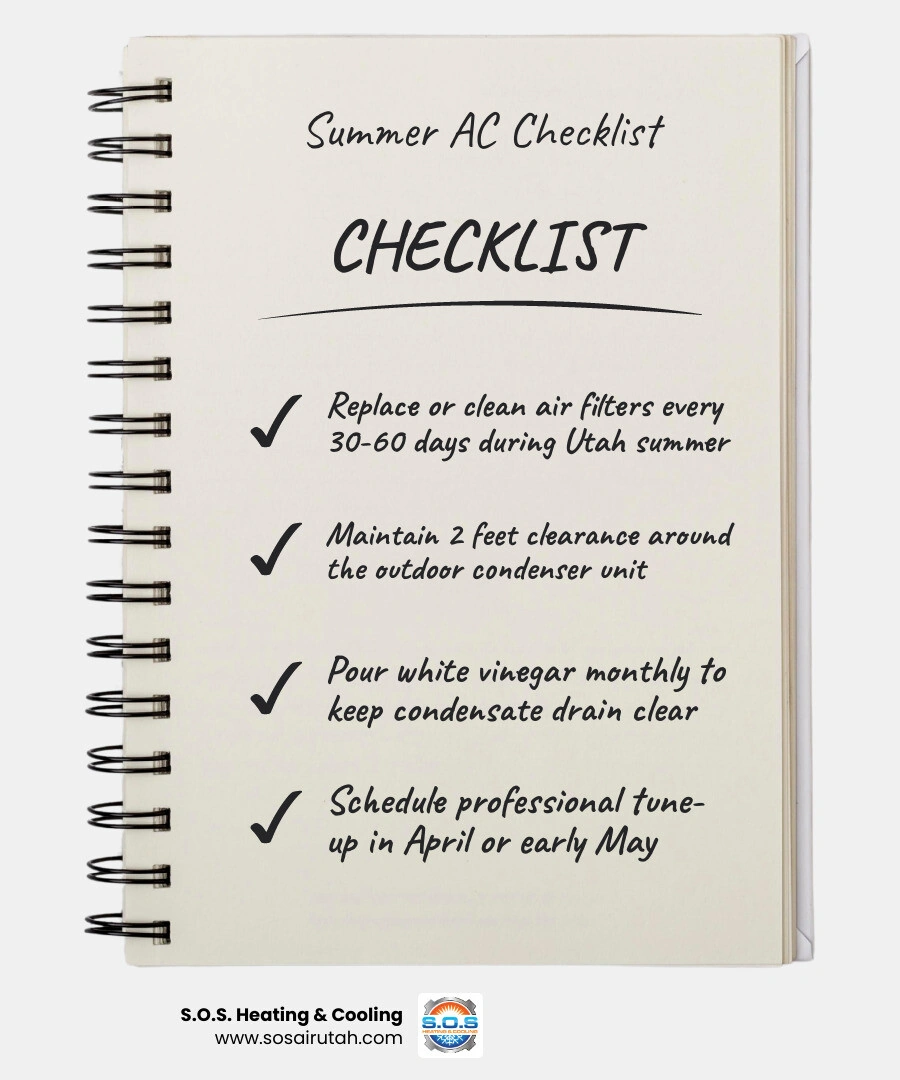
The Ultimate Summer AC Maintenance Checklist for Salt Lake Valley Homeowners
Taking care of your air conditioner doesn't have to feel like a daunting chore. By breaking your maintenance down into manageable, proactive steps, you can transition your system smoothly from its winter slumber into the heavy-duty cooling of Utah's summer months.
We recommend taking a Saturday morning in late spring or early summer to run through a quick DIY inspection. By handling the basic cleaning and monitoring yourself, you can keep your energy bills low and ensure your system is running reliably before the first true heatwave spikes temperatures in June 2026.
To help you get started, we have compiled a comprehensive Pre-Summer AC Inspection Checklist that covers the vital components of your cooling system.
Why This Summer AC Maintenance Checklist for Salt Lake Valley Homeowners Matters
Your air conditioner is a finely tuned machine, and like any machine, it relies on steady, unobstructed airflow to do its job. When dust, pollen, and debris accumulate on your system's components, they create a physical barrier that restricts airflow. In fact, a dirty air filter alone can reduce your system's airflow by up to 50%.
When airflow is restricted, your air conditioner has to work twice as hard and run much longer to cool your home. This extra strain doesn't just cause your utility bills to skyrocket; it also causes critical components like the compressor and blower motor to overheat, significantly increasing the risk of a sudden breakdown.
By keeping up with your summer AC maintenance checklist for Salt Lake Valley homeowners, you directly combat this efficiency loss. Regular, proactive maintenance can keep your system operating at peak performance, preventing up to 87% of emergency summer breakdowns and helping you save a bundle on monthly energy costs. To learn more about optimizing your home's cooling efficiency, check out our practical tips on How to Lower AC Bills During Summer Heat.
Step-by-Step Summer AC Maintenance Checklist for Salt Lake Valley Homeowners

Ready to roll up your sleeves? Here is your step-by-step DIY summer checklist to prepare your cooling system for the hot months ahead:
- Replace the Air Filter: Check your filter every 30 days. In the dusty environment of the Salt Lake Valley, filters clog quickly. If it looks gray or is covered in a layer of dust, slide in a fresh one.
- Clear the Outdoor Condenser Unit: Your outdoor unit needs room to breathe. Clear away any weeds, grass clippings, leaves, or branches within a two-foot radius.
- Wash the Condenser Coils GENTLY: Turn off the power to your AC unit at the outdoor disconnect box. Grab your garden hose and use a gentle spray setting to rinse away the dirt, dust, and cottonwood seeds that have settled into the metal fins. Never use a pressure washer, as the high pressure will bend and damage the delicate aluminum fins.
- Inspect the Thermostat: Test your thermostat to ensure it responds accurately. If it is battery-powered, swap out the old batteries for fresh ones to avoid a sudden system shutdown.
- Flush the Condensate Drain: Locate your AC's condensate drain line (usually a white PVC pipe near your indoor unit). Pouring a cup of white vinegar down the drain line once a month during the summer helps kill algae and prevent mold clogs that can back up and cause water damage to your home.
- Clear Indoor Vents and Registers: Walk through your home and make sure no furniture, rugs, or curtains are blocking your supply or return vents. Keep at least one foot of clear space around all vents to maintain proper system balance.
- Check Refrigerant Line Insulation: Look at the thick copper pipe running from your outdoor unit into your home. It should be covered in thick, black foam insulation. If the foam is dry-rotted, torn, or missing, replace it to prevent energy loss.
For a complete breakdown of how these tasks change as the seasons transition, take a look at our comprehensive Seasonal AC Maintenance Guide.
How Utah’s Dry Heat and High Elevation Affect AC Performance
If you have ever felt out of breath while hiking up in Millcreek Canyon or Mt. Olympus, you already know that our air is different up here. The Salt Lake Valley sits at an elevation of roughly 4,200 to 4,500 feet above sea level. This high elevation, combined with our dry desert climate, creates a unique set of challenges for residential air conditioning systems that standard, nationwide maintenance guides simply don't account for.
Because the air is thinner at high elevations, it is less dense. In fact, our air density is roughly 15% lower than it is at sea level. Because air conditioners rely on air density to transfer heat away from your living spaces, your system has to move a significantly higher volume of air to achieve the same cooling effect as a system installed at sea level. This means your blower motor and compressor are inherently working harder from the moment they are installed.
Additionally, our relative humidity routinely drops below 15% during the peak of summer. While low humidity makes high temperatures feel more tolerable to us, it causes rubber seals, gaskets, and O-rings inside your AC unit to dry out and crack prematurely. This increases the likelihood of refrigerant leaks.
Furthermore, our winter inversion season plays a silent role in summer AC failures. During the winter, fine particulate matter and grime settle onto your dormant outdoor condenser unit. If this winter grime is not washed away in the spring, it acts as an insulating blanket, trapping heat inside your system and forcing it to run longer, less efficient cycles.
| Performance Factor | Sea Level Baseline | Salt Lake Valley (4,200 - 4,500 ft) | Impact on Your AC System |
|---|---|---|---|
| Air Density | 100% (Standard) | ~15% Lower Density | Blower motor must work harder to move equivalent cooling volume. |
| Relative Humidity | Varies (Often High) | Extremely Low (Often <15%) | Dry air ages rubber gaskets and seals prematurely, raising leak risks. |
| Atmospheric Dust | Moderate | High (Foothill dust & dry soil) | Coils clog faster, requiring frequent cleaning to prevent overheating. |
| Inversion Grime | Low | High (Winter PM2.5 buildup) | Dormant units accumulate fine particulate that insulates heat if not washed. |
To combat these unique environmental factors, local expertise is essential. For professional support tailored to our climate, explore our specialized services for AC Maintenance Salt Lake City, UT.
When to Schedule a Professional AC Tune-Up
While DIY tasks like changing your air filter and clearing weeds are highly effective, they only cover the basics. Your air conditioning system is a complex combination of high-voltage electrical circuits, pressurized chemical refrigerants, and sensitive mechanical components. To truly protect your investment and prevent unexpected summer breakdowns, an annual professional tune-up is indispensable.
During a professional tune-up, a licensed technician performs a deep-dive inspection that goes far beyond what a homeowner can safely do. This includes testing the health of your capacitors (the components that jumpstart your motors), tightening loose electrical connections (which account for roughly 30% of all AC failures), checking refrigerant levels using superheat and subcooling calculations, and lubricating all moving parts.
Most major manufacturers actually require documented annual professional maintenance to keep your system's parts warranty valid. Skipping this service could leave you paying out of pocket for a major repair that would have otherwise been covered. For an in-depth look at what our team covers during a standard visit, read through our AC Tune-Up Guide for Wasatch Front Homeowners.
Warning Signs Your Cooling System Needs Immediate Repair
You shouldn't wait for your air conditioner to stop blowing cold air entirely before you call in the professionals. Your system will almost always drop subtle hints that something is going wrong under the hood. Keep an eye and an ear out for these common warning signs:
- Weak Airflow: If you feel only a faint breeze coming from your supply vents, you could be dealing with a failing blower motor, a heavily clogged evaporator coil, or leaking ductwork.
- Unusual Noises: Squealing, grinding, rattling, or loud buzzing noises are clear indicators of mechanical wear. A squealing noise often points to a failing belt or motor bearing, while buzzing usually signals an electrical issue.
- Short Cycling: If your AC turns on, runs for a couple of minutes, and then abruptly shuts off before completing a full cooling cycle, it is short cycling. This places immense strain on your compressor and can quickly lead to a total system failure.
- Warm Air Blowing: If the air coming out of your vents is lukewarm or warm, your system may have a refrigerant leak, a failed compressor, or a broken capacitor.
- Water Pooling Around the Indoor Unit: Water leaking around your furnace or indoor air handler is usually a sign of a clogged condensate drain line or a frozen evaporator coil.
Knowing When to Replace Your AC Unit
Even with meticulous maintenance, no air conditioner lasts forever. Generally, a well-maintained AC unit in the Salt Lake Valley has an expected lifespan of 15 to 20 years. However, if your system is over 10 to 15 years old and is neglected, it may begin to fail much sooner.
When deciding whether to invest in another repair or replace your system entirely, consider the following replacement factors:
- The Age of the Unit: If your system is approaching or has passed its 15th birthday, investing in major repairs is often throwing good money after bad.
- Frequency of Repairs: If you have had to call an HVAC technician for repairs more than once over the last two summers, your system is telling you it is on its last legs.
- Efficiency and SEER2 Ratings: Older units operate at much lower efficiency levels. Upgrading to a modern system with a high SEER2 (Seasonal Energy Efficiency Ratio) rating can reduce your cooling energy consumption by up to 50%, saving you significant money on your monthly utility bills.
- Refrigerant Type: If your older system still runs on R-22 Freon (which was completely phased out in 2020), any refrigerant leak will be incredibly expensive to repair. Replacing the unit is almost always the more cost-effective long-term choice.
Frequently Asked Questions About Salt Lake Valley AC Maintenance
How often should I change my AC filter during a Utah summer?
In the Salt Lake Valley, we recommend checking your air filter every 30 days and replacing it at least every 60 days during the peak summer months. If you live in a home with pets, reside near the dusty foothills of Draper or Herriman, or if we are experiencing a heavy wildfire smoke season, you should replace your filter every 30 days.
For the best balance of indoor air quality and system performance, look for pleated filters with a MERV (Minimum Efficiency Reporting Value) rating between 8 and 11. Avoid ultra-high MERV filters (MERV 13 or higher) unless your HVAC system has been specifically modified to handle them, as their dense material can severely restrict airflow and strain your blower motor.
Can regular AC maintenance really lower my monthly utility bills?
Yes, absolutely! According to the U.S. Department of Energy, keeping your AC well-maintained can improve its operating efficiency by up to 15%. When your coils are clean, your filters are fresh, and your electrical connections are tight, your system doesn't have to run as long to achieve your desired indoor temperature. This reduced runtime translates directly into lower energy consumption and lower monthly power bills.
What seasonal maintenance should I perform in late summer?
As summer winds down in late August and September, your AC has completed hundreds of hours of heavy lifting. Late summer is the perfect time to clear away any new vegetation or weeds that have grown around your outdoor unit over the summer. It is also wise to check your outdoor condenser coils one last time for cottonwood seeds or grass clippings that may have accumulated during lawn mowing season. Keeping the unit clean in late summer ensures it won't have to struggle through the final hot weeks of the year, preventing late-season breakdowns.
Conclusion
A comfortable, worry-free summer in the Salt Lake Valley starts with a proactive approach to your cooling system. By following this summer AC maintenance checklist for Salt Lake Valley homeowners, you can protect your home from sudden breakdowns, extend the lifespan of your cooling equipment, and keep your monthly energy bills under control.
At S.O.S. Heating & Cooling, we are dedicated to keeping your home comfortable no matter how high the summer temperatures climb. We proudly serve homeowners throughout the Salt Lake Valley and surrounding areas, including Bountiful, Centerville, Cottonwood Heights, Draper, Farmington, Herriman, Holladay, Kaysville, Layton, Millcreek, Mt. Olympus, Murray, Riverton, Salt Lake City, Sandy, South Jordan, South Salt Lake, and Woods Cross.
Whether you need a routine seasonal tune-up, a complex repair, or a complete system replacement, our team is here to help. We offer 24/7 emergency repairs to ensure you are never left stranded in the heat, priority service for our valued partners, no evaluation fees during regular business hours, and flexible financing options to fit your budget.
Don't wait for the next major heatwave to test your system's limits. Schedule your professional AC tune-up today and let us give you the peace of mind you deserve all summer long!
Explore Our Latest Insights and Updates in Plumbing Services
How to Stack Rocky Mountain Power and Federal Rebates for HVAC Upgrades in Utah

A Practical Guide to Drain Cleaning Frequency in the Wasatch Front
The Ins and Outs of How Hard Utah Water Causes Mineral Buildup in Toilet and Drain Lines