
All About AFUE Ratings for Utah Furnaces


.avif)

What AFUE Rating Should I Look For in a Furnace in Utah?
If you've been wondering what AFUE rating should I look for in a furnace in Utah, here's the short answer:
For most Utah homes, look for a furnace with at least 95% AFUE — and ideally 96% or higher.
| AFUE Rating | Efficiency Level | Best For |
|---|---|---|
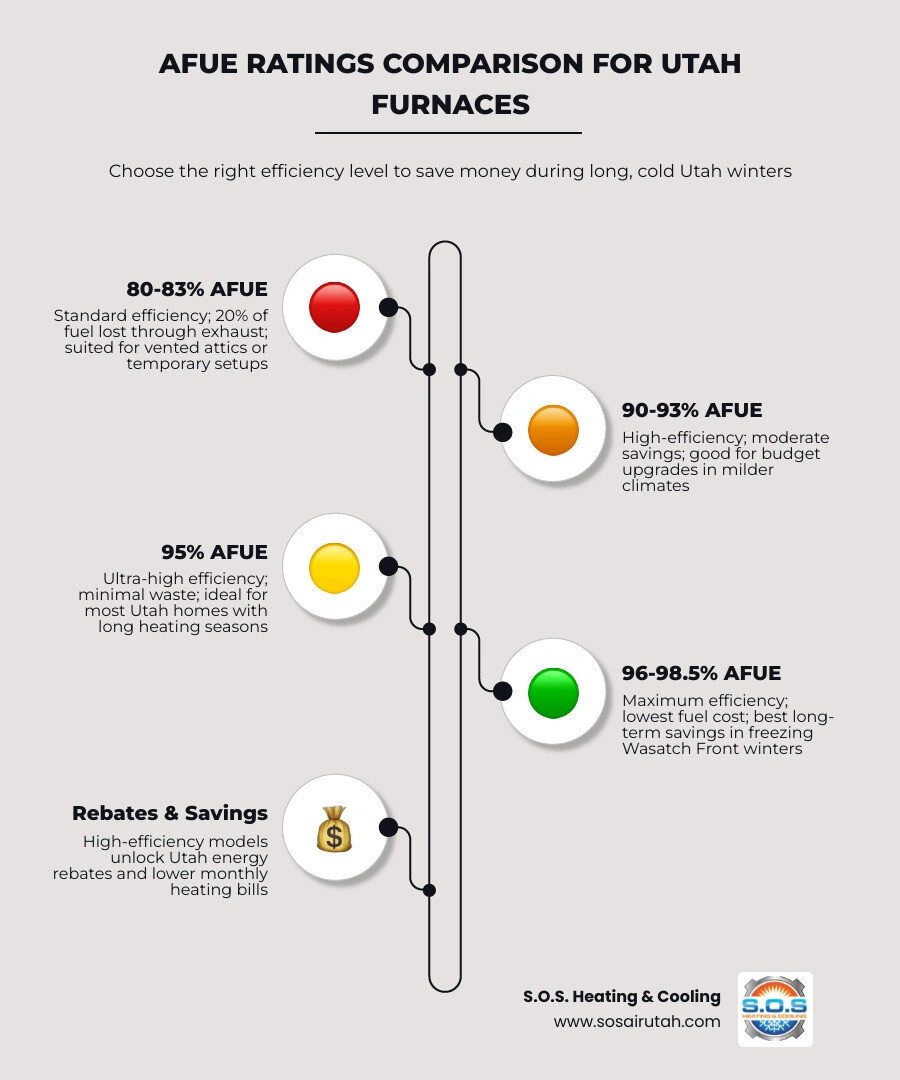
| 80–83% | Standard/Mid-Efficiency | Vented attics, crawl spaces, or short-term stays |
| 90–93% | High-Efficiency | Moderate climates, budget-conscious upgrades |
| 95–98.5% | Ultra-High Efficiency | Most Utah homes, long heating seasons, maximum savings |
Utah winters are no joke. Salt Lake City averages months of freezing temperatures, and the Wasatch Front heating season runs roughly four to five months a year. That means your furnace works hard — and an inefficient one quietly drains your wallet every single month it runs. The difference between an 80% AFUE furnace and a 95%+ model isn't just a number on a spec sheet. It's real money left on the table with every heating cycle.
AFUE stands for Annual Fuel Utilization Efficiency. Think of it like this: an 80% AFUE furnace turns 80 cents of every fuel dollar into actual heat, while 20 cents escapes out the exhaust. A 95% AFUE furnace wastes only 5 cents. In a climate like Utah's — where your heating system runs hard from November through March — that gap adds up fast.
I'm Bryson Ninow, a NATE-certified HVAC professional with years of experience helping Utah homeowners navigate exactly the question of what AFUE rating to look for in a furnace in Utah, from understanding efficiency ratings to unlocking rebate programs that make high-efficiency upgrades more affordable. Whether you're replacing an aging unit or installing a furnace for the first time, this guide will walk you through everything you need to make a confident decision.
Understanding AFUE and Why It Matters for Your Home
Annual Fuel Utilization Efficiency (AFUE) is the industry-standard metric used to measure how efficiently a gas furnace converts fuel into usable heat over the course of an entire heating season. Calculated as the ratio of annual heat output to annual energy input, AFUE provides a clear picture of a system's fuel-to-heat conversion performance.
When a furnace burns natural gas or propane, not all of that combustion energy goes toward warming your living spaces. In standard-efficiency systems, a significant portion of the heat escapes alongside combustion gases through the exhaust flue or chimney. For example, an older furnace with an 80% AFUE rating converts 80% of its fuel into heat, while the remaining 20% is lost entirely to the outdoors.
This energy waste directly impacts your monthly utility bills. Over a long, freezing winter along the Wasatch Front, those lost percentage points translate to wasted fuel. Selecting a modern system with a higher rating ensures that nearly all the gas you purchase is actively warming your family. When evaluating your options, understanding these efficiency metrics is the first step in Selecting the Perfect Furnace for Your Home.
What AFUE Rating Should I Look For in a Furnace in Utah?
When choosing a furnace in Utah, the local climate dictates your efficiency needs. Because our winters are consistently cold and the heating season spans several months, investing in a high-efficiency system is highly practical. For the vast majority of homes in areas like Salt Lake City, Sandy, Layton, and South Jordan, we recommend looking for a furnace with an AFUE rating of 95% or higher.
A 95% to 98.5% AFUE rating represents the ultra-high efficiency tier. These condensing furnaces utilize a secondary heat exchanger to extract additional heat from combustion exhaust before it leaves the home. This process squeezes almost every bit of heating value out of the fuel, ensuring maximum energy conservation and lower monthly operating costs.
Upgrading to a high-efficiency model is one of the most impactful Heating System Upgrades a Utah homeowner can make. While a standard 80% AFUE unit may still have its place in specific home configurations, a 95%+ unit is the modern standard for long-term comfort and environmental responsibility in our cold mountain climate.
What AFUE Rating Should I Look For in a Furnace in Utah to Handle Cold Winters?
The Wasatch Front is famous for its cold, dry winters and persistent freezing temperatures. During the peak of winter, furnaces in cities like Herriman, Draper, and Kaysville run almost continuously to maintain indoor comfort. This heavy gas consumption makes the efficiency rating of your heating system incredibly important.
If you plan to remain in your home for more than five years, a 95% or 96% AFUE furnace is highly cost-effective. The prolonged heating season in Utah means that the fuel savings accumulated month after month will steadily offset the higher initial purchase price of a high-efficiency unit. Furthermore, choosing a system that operates at 95% AFUE or higher makes you eligible for valuable Utah Energy Rebates for HVAC Upgrades, which helps lower the overall investment.
Standard-Efficiency vs. High-Efficiency Ratings
To help you visualize the differences between standard-efficiency and high-efficiency furnaces, it helps to compare their design, venting, and real-world performance side-by-side:
| Feature | Standard-Efficiency (80% AFUE) | High-Efficiency (95%+ AFUE) |
|---|---|---|
| Venting Type | Metal flue / chimney venting | Sealed PVC pipe venting |
| Combustion Air | Draws air from surrounding room | Draws fresh air directly from outdoors |
| Heat Exchangers | Single heat exchanger | Dual heat exchangers (Primary & Secondary) |
| Condensation | None (exhaust stays in gaseous state) | Produces moisture (requires drain line) |
| Upfront Cost | Lower initial equipment cost | Moderate to higher initial cost |
| Long-Term Savings | Higher monthly utility bills | Lower monthly utility bills |
While an 80% AFUE furnace is a reliable workhorse, its single heat exchanger design allows valuable thermal energy to escape. High-efficiency models (95% to 98.5% AFUE) are engineered with a secondary heat exchanger made of stainless steel. This secondary exchanger cools the combustion gases to the point where the water vapor condenses back into liquid water, releasing latent heat in the process. This extra step is what allows these systems to achieve such high efficiency levels.
Comparing 80% and 95% AFUE Furnaces: Operation and Installation
Choosing between an 80% and a 95% AFUE furnace involves looking beyond the efficiency percentage; their physical operation and installation requirements differ significantly.
An 80% AFUE furnace relies on non-condensing technology. It vents its hot combustion gases naturally up a metal chimney or flue pipe. Because the exhaust gases are extremely hot, they rise naturally without the need for complex venting. These units also typically pull combustion air from the room in which they are installed, meaning they require adequate ventilation space to operate safely.
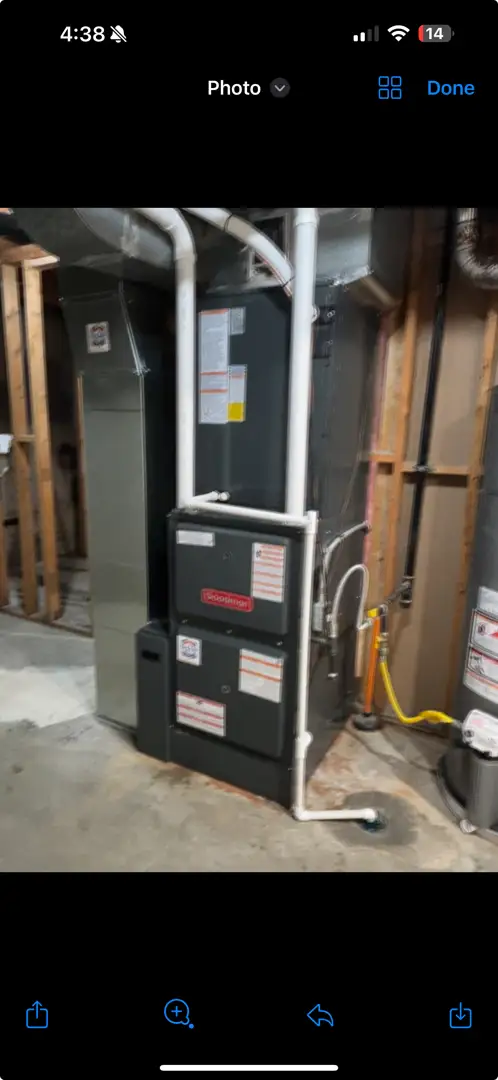
A 95% AFUE furnace is a condensing unit. Because it extracts so much heat from the exhaust, the remaining combustion gases cool down significantly and turn into an acidic liquid condensate. Because the exhaust is cool, it cannot rise naturally through a metal chimney. Instead, it must be actively pushed out of the home using a small inducer fan through durable PVC pipes.
This condensation must be properly managed. A 95%+ furnace requires a dedicated drain line or a condensate pump to safely route the acidic water to a nearby floor drain, laundry tub, or outdoor drain. If you are replacing an older 80% furnace with a 95% model, our technicians must run new PVC venting through an exterior wall and set up a reliable drainage system. To learn more about what to expect during this process, read our Furnace Replacement Ultimate Guide.
How Furnace Staging and Blowers Impact Real-World Efficiency
While the AFUE rating tells you how well a furnace converts fuel to heat, the furnace's burner staging and blower motor type determine how that heat is distributed throughout your home. Combining high AFUE with advanced staging technology delivers the ultimate home comfort experience.
- Single-Stage Furnaces: These systems operate like a light switch—they are either 100% on or completely off. When your thermostat calls for heat, the furnace runs at maximum capacity until the target temperature is reached, then shuts down. This can lead to noticeable temperature swings and noisier operation.
- Two-Stage Furnaces: These units feature a gas valve that can operate at two different levels: a low setting (typically around 65% to 70% of capacity) for mild days, and a high setting (100% capacity) for extreme cold. Two-stage furnaces run for longer, quieter cycles at a lower capacity, which creates highly consistent indoor temperatures and reduces energy consumption.
- Modulating Furnaces: The pinnacle of comfort, modulating furnaces adjust their heat output in tiny 1% increments. They run almost continuously at incredibly low, whisper-quiet levels, perfectly matching the heat loss of your home to keep your indoor climate incredibly stable.
Pairing a two-stage or modulating furnace with a variable-speed ECM (Electronically Commutated Motor) blower maximizes your savings. Variable-speed blowers adjust their airflow dynamically, using up to 75% less electricity than standard single-speed blower motors. This ensures your home stays warm without unnecessary electrical spikes.
Key Factors to Consider Alongside AFUE Ratings
When selecting a new heating system, focusing solely on the AFUE rating is a common oversight. A high-efficiency furnace will only perform as well as the system supporting it. Before upgrading, several critical home factors must be thoroughly assessed:
- Ductwork Condition: Leaky, uninsulated, or poorly designed ductwork can waste up to 30% of your furnace's heated air before it ever reaches your living spaces. If your ducts are in poor condition, even a 98% AFUE furnace will run inefficiently.
- Home Insulation and Air Sealing: Proper attic insulation and sealed windows prevent heat from escaping. A well-insulated home retains heat longer, reducing the workload on your new furnace.
- Home Age and Construction: Older homes in historic areas of Salt Lake City or Bountiful may have unique architectural challenges, plaster walls, or outdated ventilation systems that impact equipment compatibility.
- Altitude Derating: Utah's high elevation means the air is less dense. Furnaces require a specific air-to-fuel ratio for proper combustion. At higher altitudes, furnaces must be "derated" (typically a 4% reduction in heating capacity per 1,000 feet above sea level) to prevent incomplete combustion and ensure safe operation.
- Manual J Load Calculation: Never guess the size of your furnace based on square footage alone. A professional HVAC contractor must perform a precise Manual J load calculation to determine the exact BTU capacity your home needs. An oversized furnace will cycle on and off rapidly (short-cycling), wasting energy and wearing out components prematurely, while an undersized unit will run constantly without keeping you warm.
Evaluating these details helps determine Is a New Furnace Installation Right for You? and ensures your new equipment is perfectly matched to your home's unique footprint.
Determining What AFUE Rating Should I Look For in a Furnace in Utah Based on Your Setup
Your home's physical layout and the location of your heating equipment play a major role in deciding whether an 80% or a 95%+ AFUE furnace is the right choice.
If your furnace is located in an unconditioned, vented space—such as a cold attic or an open crawl space—installing a 95%+ condensing furnace can be highly challenging. Because condensing furnaces produce water, any drain lines running through freezing, unconditioned spaces are highly susceptible to freezing. If a condensate line freezes, the ice blocks the drain, causing the furnace's safety switches to trip and shut down the system entirely. In these specific layouts, a standard-efficiency 80% AFUE furnace is often the most practical and reliable choice.
Conversely, if your furnace is located in a conditioned basement, utility closet, or dedicated mechanical room, a 95%+ AFUE furnace is ideal. The indoor location keeps the condensate drain line safe from freezing temperatures, allowing the system to run flawlessly all winter long.
When calculating the payback period of a high-efficiency unit, consider your long-term plans. If you plan to stay in your home for more than five years, the monthly fuel savings from a 95%+ unit will easily cover the upfront installation difference, making it an excellent investment. If you plan to sell the home in the near future, an 80% furnace might be a more budget-friendly option for your immediate needs.
Frequently Asked Questions About Utah Furnace Efficiency
Navigating furnace efficiency standards can raise a lot of questions. Here are some of the most common queries we receive from Utah homeowners:
What is the minimum AFUE rating allowed in Utah?
Currently, the federal minimum standard for residential non-weatherized gas furnaces in Utah is 80% AFUE. This means it is legally permitted to install an 80% efficient furnace in both new construction and replacement applications. However, the Department of Energy has established upcoming regulations aimed at raising the minimum efficiency standard for non-weatherized gas furnaces to 95% AFUE in the coming years. Upgrading to a 95%+ furnace now is an excellent way to future-proof your home.
Are there rebates available for high-efficiency furnaces in Utah?
Yes! Utah homeowners have access to excellent financial incentives for upgrading to energy-efficient equipment. Local utility companies, such as Dominion Energy through their ThermWise program, frequently offer generous cash-back rebates for installing qualifying furnaces with an AFUE of 95% or 96% and higher. Additionally, under the federal Inflation Reduction Act, homeowners may qualify for energy-efficient home improvement tax credits of up to $600 for qualifying high-efficiency gas furnaces.
How does high altitude affect furnace efficiency in Utah?
High altitude reduces the density of the air, which means there is less oxygen available for combustion. To ensure a gas furnace burns fuel safely and efficiently at Utah's elevations, HVAC technicians must adjust the gas pressure and occasionally swap out the burner orifices. This altitude derating process ensures the furnace maintains a clean burn, prevents carbon monoxide hazards, and operates as closely as possible to its rated AFUE efficiency.
Conclusion
Selecting the right furnace efficiency rating is a vital decision that directly affects your home comfort, monthly utility bills, and long-term peace of mind. While an 80% AFUE furnace remains a solid choice for specific installations like vented crawl spaces or attics, a 95% or higher AFUE furnace is the ideal match for most homes along the Wasatch Front.
At S.O.S. Heating & Cooling, we are dedicated to helping families in Salt Lake City, Sandy, Layton, South Jordan, and the surrounding areas find the perfect heating solutions for their homes. Our NATE-certified technicians perform detailed home assessments, accurate load calculations, and professional installations to ensure your new system runs at peak efficiency.
Ready to upgrade your home's comfort and start saving on your monthly energy bills? Schedule your professional furnace installation with S.O.S. Heating & Cooling today, or call us to speak with one of our friendly comfort specialists!

Plumbing
Expert plumbing services offering reliable repairs, installations, maintenance, and emergency support.

Air Conditioning
Comprehensive air conditioning services include installation, repairs, maintenance, and energy-efficient solutions.
Heat Pumps
Enjoy year-round comfort with our energy-efficient and professional heat pump solutions.
Indoor Air Quality
Enhance your home’s air with our cutting-edge indoor air quality solutions you can trust.

Fireplaces
Transform your space into a warm and cozy atmosphere with our professional fireplace services.

Heating
Specialized heating services provide reliable installation, repair, system maintenance, and energy-optimization solutions.
Explore Our Latest Insights and Updates in Plumbing Services
A Practical Guide to Furnace Lifespan in Utah

All About How Wildfire Smoke Affects Indoor Air Quality in the Salt Lake Valley