

A Quick Start Guide to 25C Tax Credit for HVAC in Utah


.avif)

What Is the 25C Tax Credit for HVAC Equipment in Utah — And What You Need to Know Right Now
What is the 25C tax credit for HVAC equipment in Utah? It is a federal tax credit that covered 30% of the cost of qualifying energy-efficient HVAC upgrades — including heat pumps, central air conditioners, and gas furnaces — installed in your primary residence, up to set annual limits.
Here is a quick summary of the key facts:
- Credit rate: 30% of qualifying installation costs
- Maximum credit for heat pumps: Up to $2,000 per year
- Maximum credit for central AC or gas furnaces: Up to $600 per category
- Overall annual cap: Up to $3,200 (including $1,200 for weatherization + $2,000 for heating and cooling)
- Expiration date: December-31, 2025 — the credit has now expired for new installations
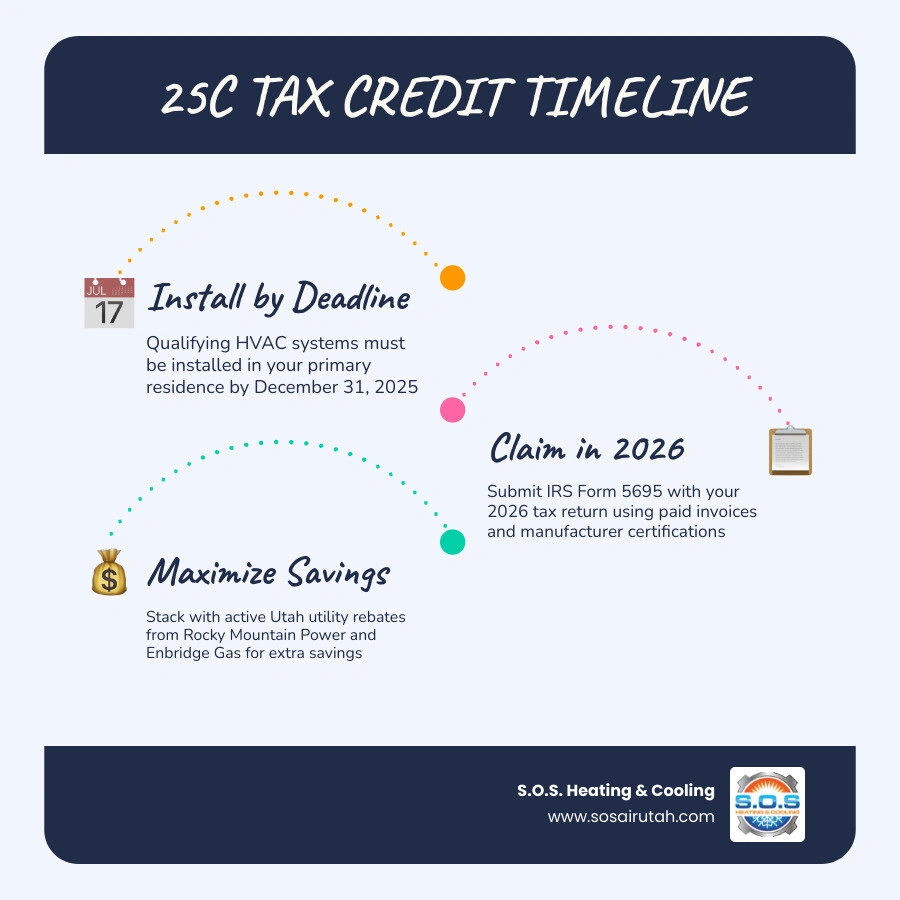
- Still claimable in 2026? Yes — if your qualifying system was installed by December 31, 2025, you can still claim the credit on your 2026 tax return using IRS Form 5695
- Income limits: None — any homeowner who owes federal income taxes may claim it
- New construction: Does not qualify — only existing primary residences are eligible
- Utah utility rebates: Still active in 2026 through Rocky Mountain Power Wattsmart and Enbridge Gas ThermWise programs
If you installed a qualifying heat pump or high-efficiency HVAC system before the deadline, you have not missed your chance to capture significant savings. And even without the federal credit, Utah homeowners still have real money on the table through local utility rebate programs.
This guide walks you through everything — what qualified, how to claim it if you still can, and how to maximize what is still available in 2026.
I am Bryson Ninow, an NATE-certified HVAC professional with years of experience helping Utah homeowners navigate energy-efficient upgrades and understand complex incentive programs like what is the 25C tax credit for HVAC equipment in Utah. At S.O.S. Heating & Cooling, I have guided countless families through rebate stacking strategies and equipment decisions that stretch their dollars further — and this guide reflects that hands-on experience.
Understanding What Is the 25C Tax Credit for HVAC Equipment in Utah

To fully grasp the financial benefits that were available, it helps to understand the origin of these incentives. The 25C Energy Efficient Home Improvement Credit was significantly expanded under the landmark Inflation Reduction Act of 2022. Prior to this expansion, homeowners faced a lifetime limit of just $500 for energy-efficient upgrades. The updated 25C framework transformed this into an annual credit, allowing homeowners to claim up to 30% of their installation costs every single year for qualifying improvements.
Under this annual structure, the credit offered a generous maximum of up to $3,200 per year. This overall cap was divided into two main categories:
- Up to $1,200 annually for standard home energy improvements, including weatherization measures like insulation, air sealing, energy-efficient exterior doors ($250 per door, up to $500 total), windows ($600 total), and home energy audits ($150).
- Up to $2,000 annually specifically carved out for high-efficiency electric or natural gas heat pumps and heat pump water heaters.
Because of this unique structure, a homeowner could install a qualifying heat pump (claiming the $2,000 credit) and upgrade their attic insulation at the same time (claiming the $1,200 credit) to reach the full $3,200 limit in a single tax year.
To qualify for these credits, the IRS established strict rules regarding the property itself. The upgrades had to be installed in an existing home located in the United States that was owned and used by the taxpayer as their principal residence. This meant that new construction projects were entirely excluded from the 25C program, as the credit was specifically designed to help transition the existing housing stock to cleaner, more efficient technologies.
What Is the 25C Tax Credit for HVAC Equipment in Utah and Is It Still Available in 2026?
As we navigate the current landscape of 2026, many homeowners along the Wasatch Front are asking whether they can still take advantage of this federal tax credit. The short answer is: only if your qualifying system was installed and placed in service on or before December 31, 2025.
Recent legislative changes, specifically the budget reconciliation bill (often referred to as the One Big Beautiful Bill), officially brought the 25C program to an end for any new installations completed after the final day of 2025.
However, if you completed your high-efficiency HVAC installation in late 2025—perhaps during the busy autumn heating season in Salt Lake City, Sandy, or Layton—you are still in a prime position to claim the credit. When you file your federal income tax return in 2026 for the 2025 tax year, you can retroactively claim your 30% credit (up to the $2,000 or $600 limits) by submitting the proper documentation.
It is important to remember that the 25C credit is nonrefundable. This means the credit can reduce your federal tax liability down to zero, but the government will not issue a refund check for any leftover credit amount. For example, if you qualify for a $2,000 heat pump tax credit but only owe $1,500 in federal income taxes for the year, your tax liability will be reduced to zero, but you will not receive the remaining $500 as a cash refund, nor can you carry that specific unused credit forward to future tax years.
Qualifying HVAC Equipment and Efficiency Standards
To prevent manufacturers from simply labeling standard equipment as "energy-efficient," the federal government established rigorous performance standards. To qualify for the 25C credit, HVAC systems had to meet or exceed the highest efficiency tiers (excluding the advanced tier) established by the Consortium for Energy Efficiency (CEE).
The table below breaks down the specific technical standards and maximum credit caps for the primary categories of qualifying residential HVAC equipment:
| Equipment Type | Required Efficiency Standards (CEE Tier 1 or Higher) | Maximum 25C Tax Credit |
|---|---|---|
| Electric or Natural Gas Heat Pumps | Must meet CEE Tier 1 ratings (specific SEER2, HSPF2, and COP standards based on region) | 30% of cost up to $2,000 |
| Central Air Conditioners | Split systems: SEER2 $\ge$ 16.0, EER2 $\ge$ 12.0 | 30% of cost up to $600 |
| Gas Furnaces | AFUE (Annual Fuel Utilization Efficiency) $\ge$ 97% | 30% of cost up to $600 |
| Hot Water Boilers (Gas/Oil) | AFUE $\ge$ 95% | 30% of cost up to $600 |
Meeting these benchmarks required advanced engineering. For instance, a standard gas furnace typically operates at around 80% to 90% AFUE, meaning a significant portion of the fuel is lost as waste heat through the exhaust flue. A qualifying 97% AFUE furnace, on the other hand, converts nearly all of its fuel directly into usable warmth for your home.
If you are considering how these high-efficiency systems impact your long-term household budget, we recommend reading our detailed guides on Investing in an Efficient AC System and exploring how these advanced systems deliver superior comfort in our dry mountain climate.
Maximizing Savings: Stacking Federal Incentives with Utah Utility Rebates
One of the most effective ways we help homeowners save money is through a strategy known as "incentive stacking." While the federal 25C tax credit has expired for 2026 installations, local utility rebates in Utah remain fully active and highly lucrative.
When you combine multiple programs, the upfront cost of upgrading your heating and cooling systems drops dramatically. However, there is an important IRS rule you must keep in mind regarding how utility rebates interact with federal tax credits for 2025 installations.
According to IRS guidelines, a utility rebate received at the time of purchase or as a direct price adjustment is generally treated as a reduction in the purchase price of the equipment. This means you must subtract the utility rebate amount from the total installation cost before calculating your 30% federal tax credit.
For example, if a qualifying heat pump installation costs $6,000 and you receive a $1,000 rebate from your electric utility, your net cost basis for the federal tax credit is $5,000. Your 30% tax credit would then be calculated from that $5,000 basis, resulting in a $1,500 tax credit.
Even with this basis reduction, stacking incentives is always the most financially advantageous path. To see the full picture of what is available locally, check out our comprehensive resource on Utah Energy Rebates for HVAC Upgrades and learn more about the real-world financial returns in our article on How Much Does a High Efficiency AC System Save.
Rocky Mountain Power Wattsmart Incentives
For homeowners living along the Wasatch Front—including communities from Bountiful and Layton down to Salt Lake City, Murray, and Draper—Rocky Mountain Power provides electric service and offers the robust Wattsmart Homes program. This program is fully active in 2026 and features excellent rebates for homeowners transitioning to high-efficiency cooling and electric heating.
Some of the most popular Wattsmart incentives available in 2026 include:
- Air Source Heat Pumps: Up to $1,700 for qualifying high-efficiency upgrades.
- Heat Pump Conversions: Up to $2,000 when converting from electric resistance heating (like baseboard heaters or an electric furnace) to an energy-efficient heat pump system.
- Ductless Mini-Split Heat Pumps: Up to $1,700 for multi-zone installations, which are perfect for older homes in historic areas of Salt Lake City or Holladay that lack traditional ductwork.
- Smart Thermostats: Up to $100 for qualifying ENERGY STAR certified models that help optimize your daily heating and cooling schedules.
To qualify for these rebates, the equipment must be installed by a licensed contractor, and the application must typically be submitted within 90 days of the installation date. Rocky Mountain Power is known for processing these applications quickly, often mailing out rebate checks within 14 business days of approval. For a deeper dive into these specific electric incentives, read our guide on Rocky Mountain Power Rebates for Wasatch Front Homeowners.
Enbridge Gas ThermWise Rebates
For natural gas customers along the Wasatch Front, Enbridge Gas (formerly Dominion Energy) runs the widely popular ThermWise program. Because natural gas is the primary heating fuel for the vast majority of homes in Northern Utah, these rebates are incredibly valuable when upgrading older, inefficient heating systems.
The ThermWise program provides significant rebates for:
- High-Efficiency Gas Furnaces: Rebates are available for installing furnaces with an AFUE rating of 95% or higher, with additional incentives for reaching the ultra-efficient 97% AFUE tier.
- Weatherization Measures: Rebates for adding blown-in attic insulation, wall insulation, and professional air sealing to keep your conditioned air inside where it belongs.
By combining a high-efficiency furnace upgrade with targeted attic insulation, you can drastically reduce your monthly winter gas bills. If you want to make sure you don't miss a single step in the paperwork process, we have put together a step-by-step walkthrough in our article How to Apply for Energy Rebates in Utah.
How to Claim the Credit and Plan Future Upgrades
Making major home improvements requires careful timing and financial planning. By understanding the administrative steps required to claim past credits and tracking the rollout of new state-level programs, you can make highly informed decisions for your household. If you are planning an upgrade but want to keep your monthly cash flow flexible, we encourage you to explore our various HVAC Financing Options Utah to find a plan that fits your budget.
How to Claim What Is the 25C Tax Credit for HVAC Equipment in Utah for 2025 Installations
If you successfully installed a qualifying heat pump, AC, or furnace in your primary residence on or before December 31, 2025, here is exactly how to claim your credit on your tax return:
- Gather Your Documentation: You will need the detailed, paid invoice from your installation. This invoice must clearly show the installation date, the physical address of your primary residence, the equipment manufacturer, the exact model numbers of both the indoor and outdoor units, and a breakdown of the installation costs.
- Obtain the Manufacturer Certification Statement: This is a formal document issued by the equipment manufacturer certifying that the specific model numbers installed meet the federal efficiency criteria required for the 25C credit. You can typically download this directly from the manufacturer's website or request a copy from us.
- Locate the Product Identification Number (PIN): For any qualifying energy property placed in service, the IRS requires the product identification number to be included on your tax documents to verify eligibility.
- Fill Out IRS Form 5695: This form, titled Residential Energy Credits, is where you calculate your total qualifying expenses. You will input your HVAC costs on the designated lines for central air conditioners, furnaces, or heat pumps, apply the 30% calculation, and carry the final nonrefundable credit amount over to your main Form 1040.
Keep all of these records, receipts, and certification statements in your permanent tax files. While you do not need to mail the manufacturer certification with your return, you must have it on hand as proof of eligibility in the event of an IRS review.
Strategic Planning for 2026 and Beyond
Now that the calendar has turned to 2026 and the 25C credit has expired, how should Utah homeowners plan their comfort upgrades? Fortunately, there are several outstanding options still available.
First, Section 25D Geothermal Credits remain fully active. Unlike the expired 25C credit for air-source heat pumps, geothermal (ground-source) heat pump systems are covered under Section 25D. This program provides an uncapped 30% federal tax credit that runs all the way through 2032. While geothermal installations require a larger initial investment due to the ground loops that must be excavated, the uncapped 30% credit makes it an incredibly powerful option for major remodels or custom home builds along the Wasatch Front.
Second, we are closely watching the rollout of Utah's state-administered Home Energy Rebates. Funded by a $101 million federal allocation, these programs are divided into two categories:
- The HOMES Program (Home Energy Performance-Based, Whole-House Rebates): This program provides rebates based on verified energy savings achieved through a combination of upgrades, such as insulation, air sealing, and HVAC improvements.
- The HEEHRA Program (High-Efficiency Electric Home Rebate Act): This program is specifically designed for low- to moderate-income households, offering point-of-sale discounts of up to $8,000 for qualifying heat pumps, $4,000 for electrical panel upgrades, and $1,600 for weatherization.
While the state of Utah is still finalizing the complex administrative portals required to launch these rebates, current estimates suggest they will become active in late 2026 or early 2027.
Finally, when planning any cooling upgrade in our region, it is vital to account for local climate factors. High-elevation areas like Park City, or even Wasatch Front cities situated above 4,500 feet, experience thinner air, which reduces heat-transfer efficiency. This means standard off-the-shelf equipment must be carefully sized and derated for altitude to perform as intended. To understand how elevation and dry air impact your home's cooling needs, check out our guide on High Efficiency AC Benefits for High Desert Climates.
Frequently Asked Questions about Utah HVAC Incentives
Can I still claim the 25C tax credit for an HVAC installation completed in 2026?
No. The federal 25C Energy Efficient Home Improvement Credit officially expired on December 31, 2025. Any air-source heat pump, central air conditioner, or gas furnace installed on or after January 1, 2026, is no longer eligible for this federal tax credit. You can only claim the credit on your tax return if the qualifying equipment was fully installed and placed in service in your principal residence on or before the December 31, 2025 deadline.
What is the difference between Section 25C and Section 25D tax credits?
The primary differences lie in the technology covered, the credit limits, and the expiration dates:
- Section 25C covered residential energy property like air-source heat pumps (capped at $2,000), central air conditioners (capped at $600), and gas furnaces (capped at $600). This credit expired on December 31, 2025.
- Section 25D covers residential clean energy property, including solar electric panels, wind turbines, solar water heaters, battery storage systems, and geothermal (ground-source) heat pumps. Section 25D provides an uncapped 30% tax credit, meaning there is no maximum dollar limit on what you can claim, and this program remains fully active through December 31, 2032.
How do local utility rebates affect my federal tax credit basis?
Under IRS guidelines, if you receive a utility rebate directly at the point of sale or as a promotional discount that reduces the initial purchase price, you must subtract that rebate amount from your total project cost before calculating your federal tax credit.
For example, if you installed a qualifying system in 2025 for $5,000 and received an immediate $500 rebate from your utility provider, your qualifying expense basis for the 30% federal tax credit is $4,500. Your calculated tax credit would be 30% of $4,500, which equals $1,350.
Conclusion
Navigating the transition of energy incentives in 2026 can feel overwhelming, but you don't have to figure it out alone. While the federal 25C tax credit has drawn to a close for new installations, Utah homeowners still have access to exceptional savings through active utility rebates from Rocky Mountain Power and Enbridge Gas.
At S.O.S. Heating & Cooling, we are proud to serve families across the entire Wasatch Front, including Salt Lake City, Sandy, Draper, Murray, Millcreek, Layton, and Bountiful. Whether you are filing taxes for a high-efficiency system installed in late 2025, or looking to maximize active utility rebates for a new project in 2026, our team of friendly, experienced professionals is here to guide you every step of the way.
Ready to upgrade your home comfort while keeping your utility bills low? Start saving with Utah energy rebates today, or give us a call to schedule your customized home assessment!
Explore Our Latest Insights and Updates in Plumbing Services

Why Your High Altitude Home Needs a Special Kind of AC Math
The Dynamic Duo of Home Cooling
Utah Energy Rebates: How to Save Big on High Efficiency Heating and Cooling