
What Size Water Heater Do I Need for My Salt Lake Valley Home?


.avif)

Determining What Size Water Heater Do I Need for My Salt Lake Valley Home
#
What size water heater do I need for my Salt Lake Valley home depends primarily on how many people live there and how much hot water you use during your busiest hour of the day. Here is a quick reference to get you started:
| Household Size | Recommended Tank Size | Minimum First-Hour Rating |
|---|---|---|
| 1-2 people | 30-40 gallons | 40-50 gallons |
| 3-4 people | 40-50 gallons | 60-70 gallons |
| 5+ people | 50-80 gallons | 80+ gallons |
For tankless systems in Salt Lake Valley, size by flow rate:
- 1-2 bathrooms: 6-8 GPM
- 3 bathrooms: 8-10 GPM
- 4+ bathrooms: 10-12+ GPM
Important for Salt Lake Valley homeowners: Because Salt Lake City sits at 4,226 feet and carries some of the hardest water in the country at 13 grains per gallon, these numbers are starting points — not final answers. Both factors can meaningfully reduce your water heater's real-world output and lifespan.
Getting the size right matters more than most homeowners realize. Too small, and you're running cold mid-shower during a busy morning. Too large, and you're paying to heat water you never use — every single day. Salt Lake Valley adds its own layer of complexity: cold incoming groundwater temperatures, high-altitude air that reduces gas combustion efficiency, and mineral-heavy water that quietly shrinks your tank's usable capacity over time.
I'm Bryson Ninow, an HVAC professional with NATE, EPA, DOPL, and RMGA certifications, and I've helped many Salt Lake Valley homeowners figure out exactly what size water heater they need for their Salt Lake Valley home — accounting for Utah's unique elevation, hard water, and climate conditions. In the sections below, I'll walk you through each factor step by step so you can make a confident, informed decision.
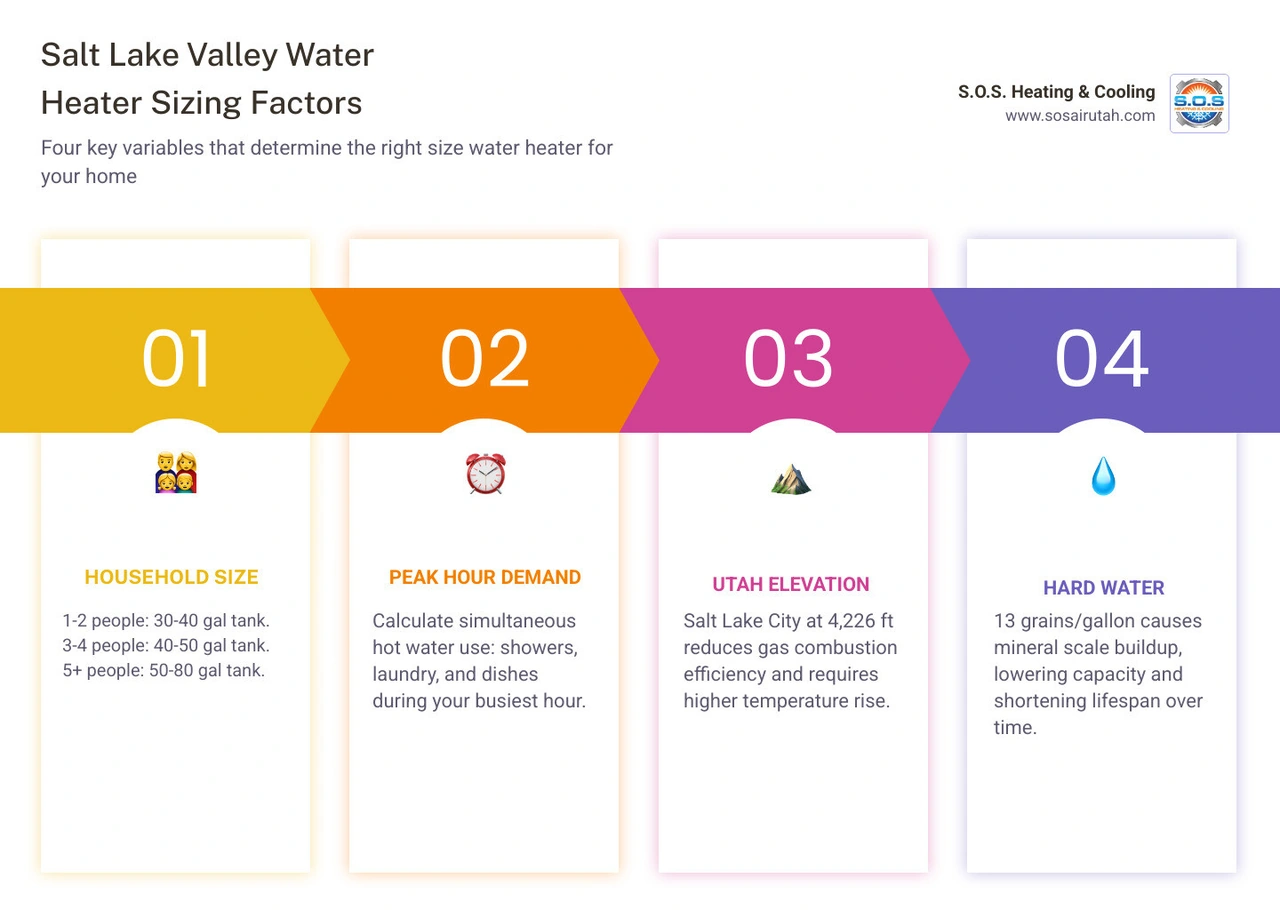

When we help homeowners in areas like Sandy, Draper, or South Jordan choose a new water heater, we look far beyond the physical size of the metal cylinder sitting in their basement. While physical tank capacity (measured in gallons) is a helpful starting point, it only tells part of the story.
To determine exactly what size water heater do I need for my salt lake valley home, we have to look at how your household uses water. A home with two people who take back-to-back showers, run the dishwasher, and wash a load of laundry all at 7:00 AM will need a vastly different setup than a home with four people who space their hot water usage throughout the day.
To make an accurate calculation, we evaluate two main metrics:
- Tank Capacity: The physical volume of water the tank holds (typically 30, 40, 50, or 75+ gallons).
- First-Hour Rating (FHR): The actual measure of how much hot water the unit can deliver in a single hour of continuous, heavy use, starting with a fully heated tank.
Calculating Peak-Hour Demand: What Size Water Heater Do I Need for My Salt Lake Valley Home?
To calculate your peak-hour demand, you need to identify the single hour of the day when your household uses the most hot water. For most families in the Salt Lake Valley, this is the morning rush hour between 6:30 AM and 7:30 AM, or the evening wind-down.
During this peak hour, write down every fixture and appliance that might run simultaneously. Here is how standard hot water usage breaks down per activity:
- Standard Shower: 10 to 20 gallons of hot water (assuming a flow rate of 2 to 2.5 GPM for a 10-minute shower).
- Deep Tub Bath: 15 to 25 gallons.
- Washing Machine (Warm Wash): 25 to 40 gallons per load.
- Dishwasher: 5 to 10 gallons per cycle.
- Shaving / Handwashing: 1 to 2 gallons.
Let's look at a real-world example of a family of four living in Holladay or Millcreek. During their busiest morning hour, they run:
- Two back-to-back showers (approx. 30 gallons total).
- One load of warm laundry (approx. 30 gallons).
- A quick run of the kitchen sink for breakfast prep and handwashing (approx. 6 gallons).
Adding these together, this family's peak-hour demand is 66 gallons. To prevent anyone from getting a freezing wake-up call mid-shower, they need a water heater with a First-Hour Rating of at least 66 gallons. If you want to dive deeper into how to plan your next upgrade in these specific neighborhoods, take a look at our Water Heater Replacement Guide Holladay UT.
First-Hour Rating (FHR) Explained
So, where do you find this magical First-Hour Rating? It is prominently displayed in the top-left corner of the yellow Federal EnergyGuide label on every new water heater.
FHR is not just a random estimate; it is a calculation that combines the tank's storage volume with its recovery rate (how quickly the burner or heating elements can heat cold incoming water up to 120°F).
- Gas water heaters recover much faster than electric models. A 40-gallon gas unit can easily have an FHR of 65 to 70 gallons because the gas burner heats water rapidly.
- Standard electric water heaters recover much slower. An electric 40-gallon unit might only have an FHR of 50 to 55 gallons.
If you have an electric system in South Salt Lake, you may actually need to size up to a 50-gallon tank just to achieve the same FHR that a 40-gallon gas unit provides. For more information on navigating these local fuel and sizing differences, check out our Water Heater Replacement Guide South Salt Lake UT.
How Utah’s Climate and Hard Water Impact Sizing
If you use a generic online sizing calculator, you will likely get an answer designed for a home in Florida or California. Along the Wasatch Front—from Bountiful down to Herriman—our unique geography, high altitude, and mineral-dense mountain water supply completely change the math.
Failing to adjust for these regional realities is the number-one reason local homeowners end up with undersized systems that struggle to keep up, especially during our freezing Utah winters. To learn more about how our unique local water supply impacts your home's pipes and appliances over time, read about How Hard Utah Water Causes Mineral Buildup in Toilet and Drain Lines.
The Impact of Cold Groundwater and High Altitude
First, let's talk about temperature rise. Your water heater's job is to take cold groundwater and heat it to a comfortable 120°F. In the summer, our incoming groundwater might sit at a relatively mild 55°F to 60°F. But in the dead of a Salt Lake winter, that incoming mountain runoff can drop to a freezing 40°F to 45°F.
To reach 120°F, your water heater has to achieve a massive 75°F to 80°F temperature rise. This requires significantly more energy and time, which slows down your system's recovery rate.
Second, we have to account for our altitude. S.O.S. Heating & Cooling services homes across the valley, ranging from Salt Lake City's base elevation of 4,226 feet up to the higher benches of Mt. Olympus and Sandy, which can exceed 5,000 feet.
- Thinner air means less oxygen.
- Because of this, gas-fired water heaters experience a drop in combustion efficiency.
- At our average elevation, gas tankless and tank units lose approximately 17% of their heating capacity compared to their sea-level ratings.
If a gas system is rated to produce 100,000 BTUs at sea level, it will only output about 83,000 BTUs in the Salt Lake Valley. This means we must carefully size up gas-fired units—especially tankless models—to compensate for this high-altitude performance drop.
How Hard Water Affects Long-Term Capacity
Salt Lake Valley water is notoriously hard, carrying dissolved calcium and magnesium minerals at an average of 13 grains per gallon (157 to 189 ppm). When this hard water is heated inside your tank, these minerals crystallize and settle to the bottom as a thick layer of rock-like sediment.
This sediment buildup causes two major issues:
- Displaces Usable Water Volume: Over several years, sediment can easily fill up the bottom few inches of your tank. A 50-gallon tank choked with mineral scale might only hold 42 to 45 gallons of actual water, quietly reducing your hot water capacity.
- Acts as an Insulator: In a gas water heater, the burner is at the bottom of the tank. The heat must pass through the steel tank bottom to reach the water. If there is a thick blanket of mineral scale in the way, the burner has to run much longer and hotter to heat the water, which drastically accelerates the wear and tear on your tank and causes popping or rumbling noises.
Because of this constant mineral assault, tank-style water heaters in the Salt Lake Valley typically last only 8 to 12 years compared to the 10 to 15 years seen in soft-water regions of the country. To help you weigh your options against Utah's tough water, we've put together a guide on Tankless vs Tank Water Heater for Utah Hard Water as well as our review of the Best Water Heater Options Hard Water 2026.
Sizing Tankless and Heat Pump Systems for the Wasatch Front
As technology has advanced, many homeowners in Layton, Kaysville, and Riverton are moving away from traditional atmospheric gas tanks. Instead, they are opting for highly efficient tankless systems or hybrid heat pump water heaters. However, sizing these modern systems requires an entirely different methodology.
Tankless Flow Rates: What Size Water Heater Do I Need for My Salt Lake Valley Home?
Tankless water heaters do not store water; they heat it on demand as it flows through a compact heat exchanger. Therefore, you do not size them by gallons. Instead, you size them by Gallons Per Minute (GPM) and the required temperature rise.
To find the right tankless size, we calculate the combined GPM of all fixtures you might run at the exact same time.
- Standard Showerhead: 2.0 to 2.5 GPM
- Low-Flow Showerhead: 1.5 to 1.8 GPM
- Bathroom Faucet: 0.5 to 1.5 GPM
- Kitchen Faucet: 1.5 to 2.2 GPM
If you want to be able to run two showers (totaling 4.5 GPM) and a dishwasher (1.5 GPM) simultaneously, your tankless system must support a flow rate of 6.0 GPM.
However, remember our winter groundwater temperature! To heat 40°F winter water to 120°F, we need an 80°F temperature rise. While a tankless unit might comfortably deliver 9 GPM in a warm climate with a 40°F temperature rise, that same unit might only be able to output 5 GPM under Utah's winter conditions.
Additionally, we must check your home's gas line capacity. Tankless units require a massive, sudden burst of gas to heat water instantly, often requiring a larger gas line than your old tank-style heater did.
Heat Pump and Hybrid Water Heater Sizing
Hybrid heat pump water heaters are incredibly popular in Utah right now, thanks to their outstanding energy efficiency. They work like a refrigerator in reverse: pulling heat from the surrounding air and transferring it into the water tank.
Because they rely on ambient air temperature, they perform exceptionally well in Utah basements, which typically stay between 55°F and 60°F year-round. However, because the heat pump mechanism heats water slowly, hybrid units rely on standard electric backup elements when hot water demand spikes (which is why they are called "hybrids").
When sizing a hybrid system, we almost always recommend sizing up by one category. If your household normally requires a 40-gallon standard gas tank, we will typically recommend a 50-gallon or even an 80-gallon hybrid water heater. This larger storage volume ensures you have plenty of pre-heated water ready to go, allowing the system to stay in its ultra-efficient "heat pump only" mode as much as possible, maximizing your utility rebates and monthly energy savings.
Frequently Asked Questions about Sizing Water Heaters in Utah
Choosing a water heater is a long-term investment in your daily comfort. Here are some of the most common questions we hear from our customers along the Wasatch Front.
Should I choose a gas or electric water heater for my Salt Lake Valley home?
For the majority of homes in our service areas—including Murray, Cottonwood Heights, and South Jordan—gas is the preferred fuel source. Gas water heaters offer a much faster recovery speed, meaning they can heat water roughly twice as fast as a standard electric tank. This faster recovery allows you to install a slightly smaller physical tank while still meeting your peak-hour demand.
However, if your home does not have an existing gas line, or if you are looking to transition away from fossil fuels, electric is a highly reliable option. If you do go electric, we highly recommend looking into hybrid heat pump models to avoid high winter electricity bills. For a complete breakdown of the top-performing models in our area, take a look at our Best Water Heater Replacement SLC Guide.
When should I repair vs. replace my water heater in Salt Lake City?
As a general rule of thumb, if your tank-style water heater is over 8 to 10 years old and starts showing signs of trouble, replacement is usually the smartest and most cost-effective path. Once a steel water tank begins to leak, it cannot be repaired; the inner glass lining has fractured, and a catastrophic tank failure is often just around the corner.
However, if your water heater is relatively young (under 6 years old) and is experiencing minor issues like a failed heating element, a faulty thermocouple, or a broken pilot light, a quick repair is highly practical. To help you diagnose your system's current condition, check out our Water Heater Repair Salt Lake City Guide and our helpful Affordable Water Heater Replacement Guide Salt Lake City UT.
How often does a water heater need maintenance in Utah's hard water?
Because of the heavy mineral content along the Wasatch Front, regular maintenance is absolutely critical to preserve your system's efficiency and overall capacity:
- Standard Tank Water Heaters: We recommend a professional sediment flush at least once a year to clear out mineral accumulation. Additionally, the sacrificial anode rod (which attracts corrosive elements to protect the steel tank) should be checked every 3 to 5 years.
- Tankless Water Heaters: These units should be professionally descaled with a specialized flushing solution every 6 to 12 months to prevent scale from clogging the narrow passages of the heat exchanger. If you have a whole-home water softener installed, you can often extend this descaling window to every 18 to 24 months.
Conclusion
Finding the perfect water heater size for your home doesn't have to be a guessing game. By calculating your family's peak-hour demand and adjusting for Utah's cold winter groundwater, high-altitude burner performance, and notoriously hard water, you can secure reliable, energy-efficient comfort for the next decade.
At S.O.S. Heating & Cooling, we have spent years helping homeowners across the Salt Lake Valley find and install the perfect water heating systems for their unique spaces. Whether you are in Farmington, Centerville, Woods Cross, or anywhere else along the Wasatch Front, our highly trained, certified technicians are here to help. We provide expert advice, professional sizing calculations, and seamless, code-compliant installations.
Ready to upgrade your home's hot water experience? Contact us today to schedule your professional consultation and explore our Water Heater Installation Salt Lake City UT services!

Plumbing
Expert plumbing services offering reliable repairs, installations, maintenance, and emergency support.

Air Conditioning
Comprehensive air conditioning services include installation, repairs, maintenance, and energy-efficient solutions.
Heat Pumps
Enjoy year-round comfort with our energy-efficient and professional heat pump solutions.

Indoor Air Quality
Enhance your home’s air with our cutting-edge indoor air quality solutions you can trust.

Fireplaces
Transform your space into a warm and cozy atmosphere with our professional fireplace services.

Heating
Specialized heating services provide reliable installation, repair, system maintenance, and energy-optimization solutions.
Explore Our Latest Insights and Updates in Plumbing Services
A Practical Guide to Furnace Lifespan in Utah

All About How Wildfire Smoke Affects Indoor Air Quality in the Salt Lake Valley