

How to Reduce Your Rocky Mountain Power Bill in Summer


.avif)

Why Is My Rocky Mountain Power Bill So High in the Summer?
If you've been wondering why is my Rocky Mountain Power bill so high in the summer, you're not alone — and the answer isn't just "because it's hot outside." Several factors stack up at the same time to push your bill higher, often dramatically.
The main reasons your Rocky Mountain Power bill spikes in summer:
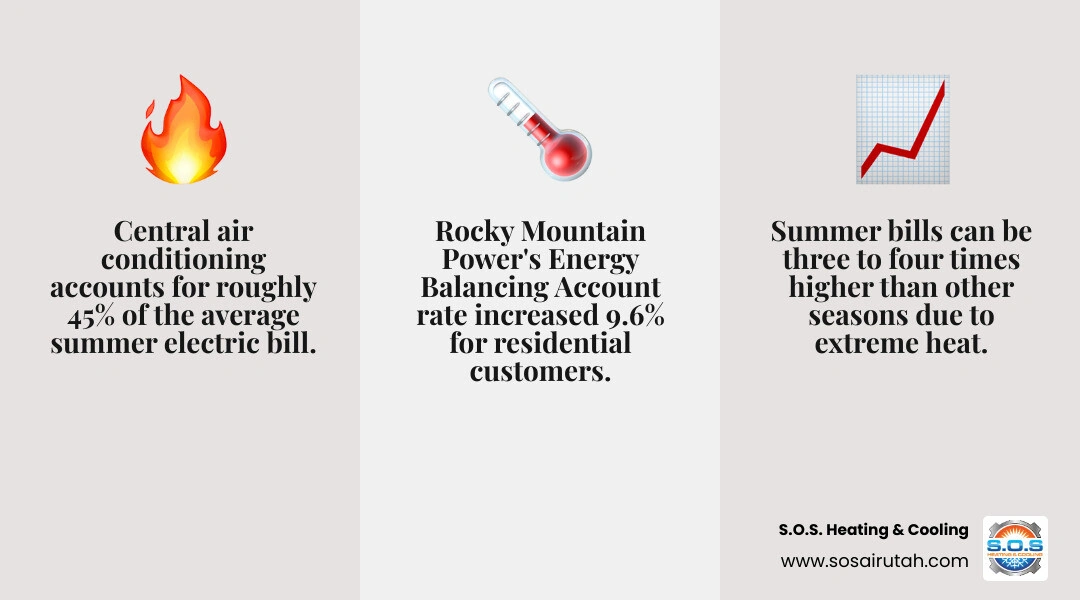
- Air conditioning demand — Cooling your home accounts for roughly 45% of your summer electric bill on average, and a home with central AC can use three to four times more electricity in summer than in other seasons
- Extreme heat — When temperatures climb into the triple digits across the Salt Lake City area, your AC runs longer and harder to keep up
- Rate adjustments — Rocky Mountain Power's Energy Balancing Account (EBA) rate increased 9.6% for residential customers to recover hundreds of millions in deferred fuel and power costs
- Wildfire liability and infrastructure costs — Rising insurance and grid investment expenses are being passed through to customers via rate cases
- Time of Use pricing — If you're on a Time of Use plan, using electricity during peak afternoon and evening hours costs significantly more per kilowatt-hour
- Household changes — Guests, new appliances, schedule changes, or a new electric vehicle can quietly add significant usage
- Longer or unusual billing cycles — More days in a billing period means more kilowatt-hours on your bill, even if your daily habits haven't changed
One South Jordan resident recently saw her bill jump from $44 to $111 over a single summer — with the same thermostat settings and the same household. That kind of increase feels shocking, but it reflects exactly the combination of factors listed above.
I'm Bryson Ninow, an HVAC professional with certifications in energy efficiency and extensive experience helping Salt Lake City homeowners understand why their Rocky Mountain Power bill is so high in the summer and what they can do about it. In this guide, I'll walk you through every factor driving your bill up — and the practical steps you can take to bring it back down.
The Impact of Extreme Heat: Why Is My Rocky Mountain Power Bill So High in the Summer?
When summer temperatures spike along the Wasatch Front, our high desert climate puts an immense load on residential cooling systems. Cities like Salt Lake City, Sandy, Draper, and South Jordan regularly experience prolonged stretches of triple-digit heat. During these hot spells, your central air conditioning system has to work overtime to keep your indoor spaces comfortable.
On average, 45% of a summer utility bill goes strictly toward cooling a home with central air. When the outdoor temperature reaches 95°F or 100°F, the temperature difference between the blistering outdoor air and your target indoor temperature (say, 72°F) forces your AC compressor to run almost continuously. It is not uncommon for a home with central air conditioning to have summer bills with usage that is three or four times greater than other times of the year.
This dramatic shift in volume is the primary driver of summer bill shock. In fact, data shows a typical 30% to 40% step-up in residential electric bills from June to July across many regions as summer heat peaks. To help manage this sudden surge in energy consumption, homeowners can implement targeted operational strategies. To learn how to optimize your system's performance during these extreme weather events, read our guide on How to Lower AC Bills During Summer Heat.
Household Changes: Why Is My Rocky Mountain Power Bill So High in the Summer?
While weather is the most obvious culprit, changes inside your home can quietly amplify your electricity consumption. Many homeowners overlook how small lifestyle adjustments and new equipment additions compound during the summer months.
Common household factors that drive up summer energy consumption include:
- Additional Occupants: Having kids home from school, college students returning for the summer, or hosting out-of-town guests leads to more frequent door openings, extra laundry loads, and increased hot water usage.
- New Appliances and Electronics: Installing a second refrigerator in the garage to keep drinks cold can consume massive amounts of energy, especially as the garage heats up to over 90°F.
- Electric Vehicle (EV) Charging: Plucking your new EV into a home charger during peak afternoon hours can instantly inflate your monthly billing tier.
- Pool and Spa Equipment: Running pool filtration pumps and water features continuously during the day draws constant power.
Understanding the unique demands of our semi-arid climate is key to stopping these hidden energy drains. For practical, daily habits you can adjust to keep your home comfortable without sending your power bill into orbit, explore our Summer AC Efficiency Tips for High Desert Homes.
Understanding Rocky Mountain Power Rate Adjustments
Those soaring summer electricity bills hitting Utahns are not only rising because of the heat. Rocky Mountain Power has implemented significant rate adjustments to recover deferred fuel costs and rising operational expenses, meaning you are paying more for every single kilowatt-hour (kWh) you consume compared to previous years.
The Energy Balancing Account (EBA) Rate Increase
The Energy Balancing Account (EBA) is a regulatory pricing mechanism that credits or debits customers for the differences between Rocky Mountain Power's actual fuel and wholesale power costs and the projected costs built into base rates. When fuel costs for coal and natural gas plants rise, or when wholesale market power prices spike, the utility is permitted to recover those deferred costs from ratepayers.
Under Utah Senate Bill 115 (passed in 2016), the historical 70-30 cost-sharing band between the utility and its customers was removed. This legislative change allows Rocky Mountain Power to recover 100% of its prudently incurred fuel and power costs from customers.
As a result, Rocky Mountain Power implemented a major EBA rate adjustment to recover $455 million in deferred costs over a 24-month period. This adjustment resulted in an 11.6% overall rate increase, which translated to a 9.6% rate increase specifically for residential customers. To put this in perspective, the EBA adjustment in 2023 was a much smaller 4.6% overall increase (3.8% for residential), making the current rate environment significantly more challenging for household budgets.
Wildfire Liability and Infrastructure Costs
Beyond direct fuel and power purchasing adjustments, broader environmental and operational challenges are reshaping utility rates. Wildfire risk has become an existential threat to electric utilities across the Western United States. To protect the grid and secure financial stability, Rocky Mountain Power has faced staggering increases in wildfire liability insurance.
In neighboring states within their service territory, wildfire liability insurance costs have skyrocketed by 1,888% over a five-year period. To mitigate these risks, the utility is investing heavily in grid hardening, wildfire mitigation technology, and robust transmission infrastructure. These multi-million dollar investments, alongside rising insurance premiums, are major drivers behind the utility's general rate cases, directly impacting the base rates paid by homeowners in Utah.
How Time of Use (TOU) Rate Plans Work
To help manage grid stress during periods of peak demand, Rocky Mountain Power offers Time of Use (TOU) rate structures. Under these plans, the price you pay for electricity changes depending on the time of day and the season. By understanding these structures, you can strategically shift your heavy energy usage to lower-cost periods.
| Rate Period (Utah Schedule 1 TOU) | Summer Months (June - Sept) Rate | Winter Months (Oct - May) Rate |
|---|---|---|
| On-Peak Hours (1:00 PM – 8:00 PM, Monday - Friday) | ~32.08¢ per kWh | ~28.39¢ per kWh |
| Off-Peak Hours (All other hours, weekends & holidays) | ~7.13¢ per kWh | ~6.31¢ per kWh |
Note: Holidays designated as off-peak all day include New Year's Day, Memorial Day, Independence Day, Pioneer Day, Labor Day, Thanksgiving Day, and Christmas Day.
Shifting Energy Usage to Off-Peak Hours
As shown in the rate table, summer on-peak electricity costs over four times more than off-peak electricity. If you run high-draw appliances during the heat of the afternoon, your bill will reflect those premium rates.
To take advantage of TOU pricing, focus on shifting these major activities to off-peak hours (before 1:00 PM or after 8:00 PM):
- Laundry and Dishwashing: Delay running your clothes dryer and dishwasher until late evening.
- Electric Vehicle Charging: Program your EV to begin charging at 10:00 PM or later.
- Water Heating: If you have an electric water heater, limit heavy shower use and hot water washing to off-peak windows.
By adjusting when you consume power, you reduce the need for the utility to run expensive peak-generation power plants. To see how modern HVAC systems play a role in optimizing this type of grid-friendly energy consumption, read about How Variable Speed Technology Saves Energy.
Smart Thermostat Automation
Managing a Time of Use schedule manually can be exhausting. This is where smart, programmable thermostats become invaluable. By automating your home's cooling schedule, you can "pre-cool" your home during cheap off-peak hours and let the indoor temperature coast during expensive on-peak hours.
For example, you can program your thermostat to lower your home's temperature to 70°F during the late morning. At 1:00 PM, when peak rates begin, program the thermostat to step up to 78°F. Because your home was pre-cooled, your air conditioner will run minimally during the hottest, most expensive hours of the day. To learn how variable-capacity cooling systems complement these temperature adjustments, check out our article on How Variable Speed AC Handles Utah Temperature Swings.
Upgrading Your HVAC System for Long-Term Savings
If your home relies on an outdated, single-stage air conditioner, operational tweaks can only take you so far. Upgrading to a modern, high-efficiency cooling system is the most effective way to permanently slash your summer power bills.
Investing in High-Efficiency AC Systems
Modern air conditioners are rated by their Seasonal Energy Efficiency Ratio 2 (SEER2). Older systems installed ten to fifteen years ago typically operate at SEER ratings of 10 to 13. Today's premium high-efficiency systems can achieve SEER2 ratings well over 20.
Unlike traditional single-stage systems that turn on at 100% capacity and shut off repeatedly (a process that consumes massive amounts of starting current), variable-speed and two-stage systems modulate their output. They run at lower, highly efficient speeds for longer periods, maintaining a perfectly steady indoor temperature while using a fraction of the electricity.
Because our high desert climate experiences intense daily temperature swings and low humidity, system longevity is a key consideration. Learn more about How High Desert Weather Affects AC Equipment Lifespan to understand how local conditions impact your system.
To evaluate whether a system upgrade makes financial sense for your household, explore these detailed resources:
- Learn the mechanical differences in How High Efficiency AC Systems Reduce Summer Costs.
- Calculate your potential return on investment with How Much Does a High Efficiency AC System Save.
- Compare different technology tiers in our guide, Are Two Stage and Variable Speed Systems Worth the Extra Cost.
Leveraging Utah Energy Rebates and Incentives
To make high-efficiency upgrades more accessible, Wasatch Front homeowners can take advantage of several lucrative rebate programs and tax incentives. Combining these utility, state, and federal programs can offset a significant portion of your upfront installation costs.
Key incentives available to Utah homeowners include:
- Rocky Mountain Power Rebates: Direct cash-back incentives for qualifying high-efficiency AC and heat pump installations. Read more at Rocky Mountain Power Rebates for Wasatch Front Homeowners.
- Utah State Energy Rebates: State-level programs designed to reward energy-conscious home upgrades. Learn more about Utah Energy Rebates for HVAC Upgrades and find step-by-step instructions on How to Apply for Energy Rebates in Utah.
- Federal Tax Credits (Inflation Reduction Act): Homeowners can claim substantial federal tax credits for qualifying high-efficiency HVAC installations, heat pumps, and electrical panel upgrades. Discover how to maximize these savings with Inflation Reduction Act Benefits for Utah Homeowners.
Frequently Asked Questions about Rocky Mountain Power Summer Bills
What is the Energy Balancing Account rate?
The Energy Balancing Account (EBA) rate is an annual price adjustment on your Rocky Mountain Power bill. It reflects the difference between the projected cost of fuel and wholesale power and the actual market prices paid by the utility. If market costs for natural gas, coal, or purchased power are higher than expected, a temporary surcharge is added to customer bills to recover those costs.
How much of my summer bill goes toward cooling?
On average, cooling your home with a central air conditioning system accounts for 45% of your total summer electric bill. During peak heat waves in July and August along the Wasatch Front, this percentage can climb even higher, causing your total electricity consumption to triple or quadruple compared to mild spring and autumn months.
Can solar panels eliminate my summer Rocky Mountain Power bill?
While residential solar panels can significantly reduce your electricity costs by generating power during sunny daylight hours, they rarely eliminate your bill entirely. Solar customers still pay a basic monthly customer charge to remain connected to the grid. Additionally, because solar panels do not produce power at night, you will still draw electricity from Rocky Mountain Power when the sun goes down, which is billed under standard or Time of Use rates unless offset by stored battery power or accumulated net metering credits.
Conclusion
Managing high summer utility bills along the Wasatch Front requires a combination of smart habits, an understanding of Rocky Mountain Power's rate structures, and highly efficient home equipment. While you can't control the summer heat or utility rate increases, you have complete control over how efficiently your home responds to them.
At S.O.S. Heating & Cooling, we are dedicated to helping our neighbors throughout Salt Lake City, Sandy, Draper, South Jordan, Layton, and the surrounding Wasatch Front communities stay comfortable while keeping energy costs under control. Whether you need to restore your current system's efficiency or want to explore a high-efficiency AC upgrade, our expert team is here to help 24/7.
Take control of your home comfort and start saving today. Schedule professional AC repair in Salt Lake City or call us to book your system maintenance check!

Plumbing
Expert plumbing services offering reliable repairs, installations, maintenance, and emergency support.

Air Conditioning
Comprehensive air conditioning services include installation, repairs, maintenance, and energy-efficient solutions.

Heating
Specialized heating services provide reliable installation, repair, system maintenance, and energy-optimization solutions.

Indoor Air Quality
Enhance your home’s air with our cutting-edge indoor air quality solutions you can trust.

Fireplaces
Transform your space into a warm and cozy atmosphere with our professional fireplace services.

Heat Pumps
Enjoy year-round comfort with our energy-efficient and professional heat pump solutions.
Explore Our Latest Insights and Updates in Plumbing Services
How to Verify an HVAC and Plumbing Contractor Is Licensed in Utah
Ultimate Guide to Hard Water from Utah Aquifers Damaging Pipes and Fixtures
An Essential Guide to Pipe Replacement Age
