

How to Fix Dry Winter Air in Utah Homes


.avif)

Why Is the Air So Dry Inside a Utah Home in Winter?
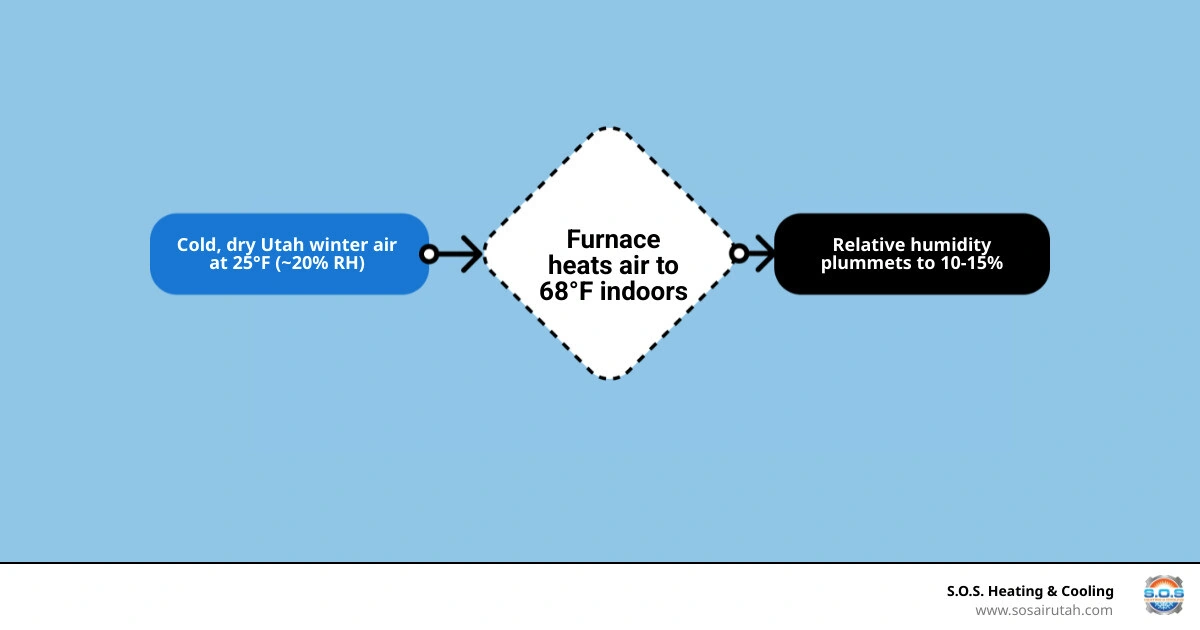
Why is the air so dry inside a Utah home in winter? It comes down to two things working against you at the same time: Utah's naturally arid, high-elevation climate starts you off with very little moisture in the outdoor air, and then your heating system makes it even worse. When cold, dry outdoor air is pulled inside and heated by your furnace, its relative humidity can plummet to as low as 10–15% — far below the comfortable range of 30–50%. If your skin feels tight, your nose is irritated, or you keep getting zapped by static electricity, dry indoor air is almost certainly the reason.
Here is why Utah homes get so dry in winter:
- Cold air holds very little moisture. The colder the air, the less water vapor it can contain — so Utah's winter air starts out dry before it ever enters your home.
- High elevation and desert climate. Utah sits in the rain shadow of the Wasatch Range and receives far less precipitation than most of the country, meaning outdoor humidity is already very low.
- Heating makes it worse. When your furnace heats that cold, dry air from 25°F to 68°F indoors, the relative humidity drops even further — sometimes below 15%.
- Gas furnaces consume and vent moisture. Forced-air heating systems continuously circulate dry air throughout your home, stripping out whatever moisture remains.
- Modern tight construction traps dry air. Well-sealed homes prevent natural air exchange, locking in the dry conditions your heating system creates.
I'm Bryson Ninow, an NATE-certified HVAC professional with years of experience helping Salt Lake City area homeowners understand why the air is so dry inside a Utah home in winter and how to fix it for good. In this guide, I'll walk you through exactly what's happening in your home and what actually works to bring your indoor comfort back into balance.
To truly understand why our homes along the Wasatch Front feel like the Sahara Desert in January, we have to look at the unique combination of Utah's geography and the laws of thermodynamics. Whether you live in Salt Lake City, Sandy, or Layton, our high-altitude environment sets the stage for extreme winter dryness.
The Science Behind Why Is the Air So Dry Inside a Utah Home in Winter
The root of the problem lies in the physics of air and water vapor. Cold air simply cannot hold as much moisture as warm air. As temperatures drop, water molecules condense out of the air, which is why winter outdoor air is naturally dry.
When you combine this temperature drop with Utah's geography, the effect is magnified. The Salt Lake Valley sits in the rain shadow of the Sierra Nevada and Cascade mountain ranges, which strip out oceanic moisture before it ever reaches the Intermountain West. By the time winter air settles over Bountiful, Draper, or Riverton, it is already exceptionally dry.
But the real magic—or rather, the real discomfort—happens when this cold air enters your home. This is where "relative humidity" comes into play. Relative humidity (RH) is the amount of moisture currently in the air compared to the maximum amount of moisture the air could hold at that specific temperature.
When outdoor air at 15°F with a seemingly high 75% relative humidity leaks into your home and is heated to 70°F by your furnace, its capacity to hold water vapor skyrockets. However, because no new moisture has been added, the relative humidity drops off a cliff—frequently falling to 10% or 15% RH. This is actually drier than the average relative humidity of the Sahara Desert, which typically hovers around 23%! To learn more about how this affects our local climate, check out our guide on Ideal Indoor Humidity Levels for the Wasatch Front.
How Heating Systems Worsen Why Is the Air So Dry Inside a Utah Home in Winter
Your home's heating system is the second half of the dry-air double whammy. Standard gas furnaces and forced-air heating systems do not inherently destroy water molecules, but their operation dramatically lowers indoor relative humidity in a few distinct ways:
- The Heating Cycle: As your furnace cycles several times per hour, it continuously blows hot, dry air through your ductwork. This constant air movement accelerates evaporation from every moisture source in your home, including your skin, houseplants, and wood furniture.
- Atmospheric Combustion and Negative Pressure: Older, standard-efficiency furnaces (often called atmospheric units) pull air from inside your home to fuel the combustion process, venting it up the chimney. To replace this lost air, your home pulls cold, dry outdoor air in through tiny cracks around windows, doors, and your foundation. This constant infiltration of freezing outdoor air keeps your indoor humidity levels bottomed out.
- High-Efficiency Condensing Furnaces: While modern, sealed-combustion furnaces do not pull combustion air from inside the home, they produce highly efficient heat that rapidly warms the air, driving down relative humidity levels just as effectively.
When your heating system runs continuously during a cold snap in South Jordan or Millcreek, it acts like a giant sponge, absorbing every drop of moisture it can find. If you suspect your heating system is driving your home's humidity down to uncomfortable levels, you can read about the Signs Your Home Is Too Dry or Too Humid to identify the warning signs early.
The Impact of Low Humidity on Health, Comfort, and Your Home
Living in a home with chronically dry air is more than just a minor inconvenience. It directly impacts your physical health, your daily comfort, and the structural integrity of your property.
Health and Comfort Consequences
Your body is highly sensitive to the humidity of its environment. When indoor relative humidity drops below the recommended 30% threshold, you will likely begin to notice several physiological symptoms:
- Respiratory and Sinus Irritation: Your nasal passages and throat are lined with mucous membranes that act as your body's first line of defense against airborne pathogens. Dry air strips away this protective moisture, leaving your sinuses irritated, inflamed, and highly susceptible to nosebleeds and infections.
- Increased Virus Transmission: Studies show that maintaining indoor humidity levels between 40% and 60% can reduce the transmission of airborne viruses by up to 30%. Research from the Mount Sinai School of Medicine has demonstrated that flu virus transmission is significantly less likely when relative humidity is kept at 50% or higher. In dry air, respiratory droplets shrink, remain airborne longer, and travel further, increasing your risk of getting sick.
- Skin and Eye Discomfort: Dry air rapidly evaporates moisture from your skin and eyes, leading to itchy, flaky skin, chapped lips, and dry, irritated eyes—especially for those who spend hours looking at computer screens.
- Disrupted Sleep: Dry air can aggravate snoring, cause you to wake up with a scratchy throat, and disrupt your body's natural cooling process during sleep. You can discover more about how balanced air quality leads to better rest in our article on how to Enhance Sleep Quality with Better Indoor Air.
Improving your home's moisture balance is a critical step toward protecting your family's overall Indoor Air Quality, particularly during the winter months when we spend the vast majority of our time indoors.
Damage to Wood Floors and Home Materials
It isn't just your body that suffers when the air gets dry; your home itself takes a beating. Wood is a hygroscopic material, meaning it behaves like a sponge—it naturally absorbs and releases moisture to stay in equilibrium with the surrounding air.
When winter dryness strikes, wood materials throughout your home begin to lose moisture and contract:
- Hardwood Flooring Gaps: Hardwood floors typically require around 40% indoor humidity to prevent cracking, warping, or shrinking. When the air dries out, wood contracts, leading to visible gaps between floorboards and annoying squeaks when you walk.
- Structural Cracking: Crown molding, wooden doors, baseboards, and wood furniture will shrink and pull apart at the joints. Over time, this can lead to permanent structural cracking and warping.
- Musical Instruments: Pianos, guitars, and violins are incredibly sensitive to humidity fluctuations. Chronic dry air can cause wood instruments to warp, lose their tuning, or even develop catastrophic structural cracks.
- Static Electricity: Dry air is an excellent electrical insulator, allowing static charges to build up easily. If you notice frequent shocks when touching doorknobs, metal objects, or even your family members, your indoor air is far too dry.
Finding the Ideal Indoor Humidity Range for Utah Winters
To keep your home comfortable, healthy, and structurally sound, you need to target the "Goldilocks Zone" of indoor relative humidity. While the EPA and ASHRAE generally recommend keeping indoor humidity between 30% and 50% year-round, Utah's extreme winter cold requires a slightly more nuanced approach.
If you keep your indoor humidity at 50% when it is 10°F outside in Cottonwood Heights or Kaysville, you will quickly notice heavy condensation forming on your windows. This moisture can drip down, damage your window frames, and create a breeding ground for mold, which can begin forming within 24 to 48 hours of moisture exposure.
| Outdoor Temperature (°F) | Recommended Indoor Humidity Range (%) | Effects on Comfort, Health, and Home |
|---|---|---|
| Above 40°F | 40% – 50% | Optimal comfort, hydrated skin, minimal static, excellent wood protection. |
| 20°F to 40°F | 35% – 40% | Balanced protection for wood floors, reduced virus survival, no window condensation. |
| 0°F to 20°F | 25% – 30% | Prevents window frost and condensation while protecting sinuses from extreme dryness. |
| Below 0°F | 20% – 25% | Minimizes structural condensation risk during extreme cold snaps. |
Maintaining this balance manually can be incredibly difficult, which is why monitoring your air with a digital hygrometer is so important. To dive deeper into finding the sweet spot for your specific home, take a look at our detailed guide on Perfect Home Humidity Levels.
Why Portable Humidifiers and DIY Fixes Fall Short
When Utah homeowners first notice the effects of dry winter air, they often turn to quick, temporary fixes. You might buy a few portable room humidifiers, place bowls of water near heating vents, or fill your home with moisture-loving houseplants. While these methods are well-intentioned, they rarely solve the root of the problem for an entire house.
- Localized Moisture: Portable humidifiers are only designed to treat a single, small room. While a tabletop unit might make your bedroom more comfortable at night, it cannot compete with the massive volume of dry air being circulated throughout your entire house by your central HVAC system.
- Constant Refilling and Maintenance: Portable units have small reservoirs that must be refilled daily. Even worse, if they are not cleaned with vinegar every 2 to 3 days, they quickly become breeding grounds for bacteria and mold, which are then blown directly into your breathing air.
- Uneven Humidity Levels: A portable humidifier often over-saturates the immediate area around it—sometimes causing damp carpets or condensation on nearby walls—while leaving the rest of the home completely dry.
- DIY Methods Are Ineffective: Placing bowls of water around the house or relying on houseplants simply does not generate enough water vapor to make a measurable difference in a modern, heated home.
To understand why localized solutions struggle to keep up with high-desert winter conditions, you can read our analysis of How Humidifiers Improve Winter Comfort in Dry Climates.
The Whole-Home Humidifier Solution
The most effective, efficient, and low-maintenance way to combat winter dryness is to integrate a whole-home humidifier directly into your existing heating and cooling system.
Instead of trying to humidify your home room-by-room, a whole-home system treats the air at the source. Installed directly onto your furnace's ductwork, it injects controlled amounts of water vapor directly into the heated air stream before it is distributed through your registers. This ensures that every single room in your home receives perfectly balanced, consistent moisture.
There are two primary types of whole-home humidifiers used in Utah homes:
- Bypass Humidifiers: These systems use the pressure difference between your supply and return ducts to draw warm air across a water-saturated pad (often called a humidifier pad or water panel). The air absorbs the moisture and is then circulated throughout your home. Bypass systems are highly reliable, energy-efficient, and easy to maintain.
- Steam Humidifiers: Often considered the gold standard of humidification, steam systems use electrical elements to boil water and generate steam independently of your furnace's heat. The steam is injected directly into the supply duct. Steam humidifiers offer incredibly precise control, making them ideal for larger homes or properties with high-end hardwood floors and musical instruments.
Integrating moisture control with your central HVAC system also provides year-round benefits, helping your air quality systems work in harmony. You can learn more about this synergy in our article on How Adding a Humidifier Works with Your AC in Dry Weather.
Key Benefits of a Whole-Home Humidifier:
- Consistent, Even Distribution: Every room in your home benefits from the same balanced humidity level, eliminating dry zones.
- Lower Heating Bills: Moist air retains heat much better than dry air. By maintaining proper humidity, you can often turn your thermostat down by 2 or 3 degrees and feel just as warm, saving up to 10% on your heating costs.
- Hands-Free Operation: Whole-home systems are connected directly to your home's water line, meaning you never have to refill a water tank again.
- Automatic Adjustments: Modern smart humidistats monitor outdoor temperatures and automatically adjust your indoor humidity to prevent window condensation.
- Low Maintenance: Instead of daily cleanings, a whole-home system only requires a quick water panel replacement once or twice per heating season.
- Protects Your Home Investment: Consistent humidity prevents your expensive hardwood floors, trim, and wooden furniture from shrinking and cracking, resulting in 20% fewer wood-related home repairs each year.
Frequently Asked Questions about Utah Home Humidity
What is the ideal indoor humidity level for a Utah home in winter?
For most Utah homes during the winter, the ideal relative humidity range is 30% to 50%, with 35% to 45% being the sweet spot for overall comfort and home protection. However, when outdoor temperatures drop below freezing, you should lower your humidistat setting to 25% to 30% to prevent condensation and frost from forming on your windows.
Can a whole-home humidifier cause mold or damage?
When properly installed and calibrated, a whole-home humidifier will not cause mold or structural damage. The key is professional installation and the use of an automatic humidistat. These smart controls monitor outdoor temperatures and automatically reduce indoor humidity levels during extreme cold snaps, ensuring that moisture never accumulates on cold surfaces like windows or wall cavities.
How do I know if my home's air is too dry?
The most accurate way to check is by using a digital hygrometer, which you can place in a central living area away from vents and direct sunlight. If your reading is consistently below 30%, your air is too dry. Other common signs include frequent static shocks, waking up with dry sinuses or a scratchy throat, dry skin, and visible gaps forming in your hardwood floorboards.
Conclusion
Dry winter air is a classic Utah challenge, but it isn't something you and your family have to tolerate. Understanding why the air is so dry inside a Utah home in winter is the first step toward taking back control of your indoor comfort, protecting your health, and preserving your home's valuable wood materials.
If you're ready to say goodbye to static shocks, dry skin, and scratchy throats this winter, our team at S.O.S. Heating & Cooling is here to help. We specialize in designing and installing custom indoor air quality solutions, including state-of-the-art bypass and steam humidifiers, tailored specifically to the unique high-desert climate of the Salt Lake Valley.
Whether you need a system inspection, a furnace tune-up, or a professional humidifier installation, we provide reliable, expert service across Salt Lake City, Sandy, Draper, South Jordan, and the surrounding areas. Contact us today to learn more about our Whole Home Humidifiers Salt Lake City UT and schedule your indoor comfort consultation!
Explore Our Latest Insights and Updates in Plumbing Services
How Heat Pumps Work for Heating and Cooling in Utah
How to Stack Rocky Mountain Power and Federal Rebates for HVAC Upgrades in Utah

A Practical Guide to Drain Cleaning Frequency in the Wasatch Front