

A Step-by-Step Guide: How to Apply for Energy Rebates in Utah


.avif)

Why Utah Homeowners Are Leaving Money on the Table With Energy Rebates
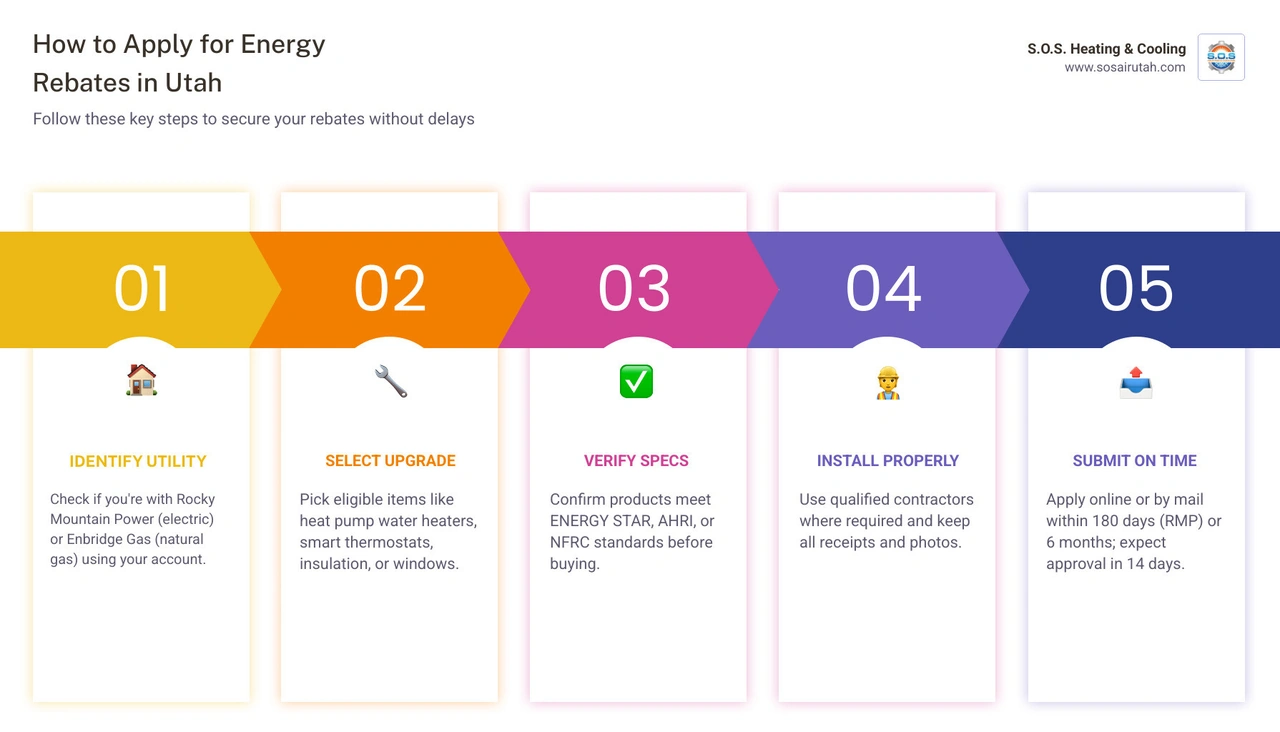
If you've been wondering how to apply for energy rebates in Utah, here's the short answer:
- Identify your utility provider — Rocky Mountain Power (electric) or Enbridge Gas (natural gas)
- Choose an eligible upgrade — heat pump water heater, smart thermostat, insulation, windows, etc.
- Verify product specifications meet program requirements before purchasing
- Complete your installation using a qualified contractor when required
- Submit your application — online, by mail, or through a participating vendor — within the program deadline (typically 180 days for Rocky Mountain Power, 6 months for Logan City)
- Collect your rebate after approval
Utah homeowners have access to a range of energy rebate opportunities, but with multiple overlapping programs from utility companies, local cities, federal initiatives, and low-income assistance funds, the process can feel overwhelming before you even get started.
The programs are real, but the paperwork, deadlines, and eligibility rules are easy to get wrong — and a single misstep, like tossing the NFRC sticker off your new window or filing a week past the deadline, can cost you the rebate entirely.
This guide breaks the whole process down into plain, simple steps so you know exactly where to go, what to bring, and what to watch out for.
We'll walk you through everything you need to know so you can capture every dollar available to you.
How to Apply for Energy Rebates in Utah: Start With the Right Program
The first step is not buying equipment. It is finding the correct rebate program for your address, utility account, and project type.
For homeowners in Salt Lake City and surrounding communities we serve, most rebate opportunities fall into four buckets:
- Electric utility rebates
- Natural gas utility rebates
- Local or city-specific rebates
- Income-qualified assistance and weatherization programs
Main energy rebate programs available to Utah homeowners
Here are the main programs worth checking in 2026:
- Rocky Mountain Power Wattsmart Home rebates for electric-saving upgrades like heat pumps, heat pump water heaters, smart thermostats, insulation, windows, and some cooling equipment
- Enbridge Gas ThermWise rebates for qualifying gas appliances, weatherization, and home-efficiency improvements
- City or utility-specific local programs that may offer their own rebates on items like smart thermostats, heat pump water heaters, or other electrification upgrades
- Low-income support programs including HEAT, HELP, Weatherization Assistance, and related aid
- Commercial and business rebate programs for non-residential properties
If you want a quick starting point for current options, our rebates page is a helpful place to organize what may apply to your project.
Statewide vs local rebates: what is different
Statewide utility rebates usually depend on who provides your power or gas service. That means two neighbors in the same county can have different options if they have different providers.
Local rebates, by contrast, are usually tied to a city utility or local program rules. They may differ in:
- Service area eligibility
- Rebate amounts
- Submission deadlines
- Product requirements
- Whether low-income households receive enhanced incentives
- Whether a W-9 is required for higher annual payout totals
In short: do not assume a rebate you saw online applies to your home just because it applies somewhere in Utah. Rebate programs are a little like snowstorms on the Wasatch Front - very local and occasionally surprising.
What is paused, active, and worth checking in 2026
As of May 2026, the big federal Home Energy Rebate programs created under the Inflation Reduction Act - HOMES and HEEHRA, sometimes grouped under HER - are still not broadly available for Utah homeowners to apply for directly. Utah was approved for major funding, but state rollout has been delayed or paused pending federal processing and program launch details.
What is active right now?
- Utility rebates through Rocky Mountain Power and Enbridge Gas
- Local utility or city rebates where offered
- Federal tax credits, including the Energy Efficient Home Improvement Credit under Section 25C, for qualifying upgrades
That distinction matters. If you are planning work now, focus first on active utility and local rebates, then check whether your upgrade may also qualify for a federal tax credit at tax time.
Check Eligibility Before You Buy Equipment or Schedule Work
This is the part that saves people from heartbreak and mildly dramatic shouting in the garage.
Do not purchase equipment based only on a product ad, store display tag, or a neighbor's recommendation. Rebate programs care about exact specifications.

Who qualifies for residential energy rebates in Utah
Eligibility varies by program, but common qualifying groups include:
- Homeowners in existing homes
- Some landlords with eligible residential rental properties
- Certain multifamily properties
- Manufactured home owners for specific measures
- Utility account holders on qualifying residential rate schedules
- Low-income households for income-qualified assistance programs
Renters may have fewer direct equipment rebate options because they usually do not own the home systems, but they may still benefit from weatherization, utility bill assistance, and renter-focused efficiency guidance.
For low-income households, Utah assistance programs often use income thresholds tied to the Federal Poverty Level or Area Median Income. Research from Utah programs shows:
- HEAT is generally open from November 1 through April 30, subject to funding
- HEAT commonly serves households up to 150% of the Federal Poverty Level
- Weatherization Assistance may serve households up to 200% of the Federal Poverty Level
- Weatherization participants average about 35% energy savings, or roughly $583 per year
Eligible upgrades and how to verify your home or equipment qualifies
Common rebate-eligible upgrades include:
- Air-source heat pumps
- Ductless mini-splits
- Heat pump water heaters
- Smart thermostats
- Gas furnaces
- Attic insulation
- Duct sealing
- High-performance windows
- Weatherization measures
- Evaporative cooling equipment in some programs
To confirm eligibility, check for the technical proof the program wants. That may include:
- ENERGY STAR certification
- AHRI certificate for HVAC equipment
- SEER2, HSPF2, or AFUE ratings
- NFRC labels for windows
- U-factor requirements for window rebates
- Existing-home requirements rather than new construction
Example: some Utah window rebates require windows with a U-factor of 0.22 or lower, and the NFRC sticker or manufacturer documentation is often required. If that sticker gets peeled off and tossed, your rebate application can get much harder.
Tools that help you confirm rebate fit before applying
Several tools can help you decide what to upgrade before you apply:
- Utility rebate eligibility tools
- Home EnergyPlan or similar gas utility home reports
- Utility energy comparison reports
- ENERGY STAR rebate and product finder tools
- ENERGY STAR Home Energy Yardstick for benchmarking household energy use
- Home energy assessments
Utah program data shows that homeowners who start with an assessment are much more likely to complete useful upgrades. In one Utah home performance dataset, 1,277 out of 2,188 homeowners moved from assessment to completed improvements - about a 58% conversion rate.
If you are sorting through options, our rebates resource page can help you narrow down likely categories before you start paperwork.
How to Apply for Energy Rebates in Utah Through Utility Programs
Most rebate applications follow the same rhythm:
- Confirm you are eligible
- Confirm the product qualifies
- Complete the installation
- Gather your documents
- Submit the form on time
- Wait for approval and payment
Step-by-step: applying for electric utility home rebates
For many Utah homeowners, this means using Rocky Mountain Power's Wattsmart Home program.
Here is the usual process:
- Find the exact rebate category
- Go to the rebate page for your upgrade, such as heat pump water heater, smart thermostat, windows, or insulation.
- Read the product qualifications carefully.
- Check whether the rebate is online, mail-in, or instant discount
- Some categories offer instant discounts through participating vendors
- Others require an online application
- Some still use downloadable or mail-in forms
- Verify your utility eligibility
- Make sure your home is in the correct service area
- Confirm your electric account and service address
- Check that your rate schedule or home type qualifies if the program lists restrictions
- Buy qualifying equipment and complete installation
- Use a qualified installer if required
- Save every invoice, model number sheet, and proof of installation
- Submit within the deadline
- Rocky Mountain Power residential rebate applications commonly must be filed within 180 days of installation
- Track payment
- Some approved rebates are processed quickly
- Certain window rebate information indicates payment may be issued within about 14 business days after approval
Wattsmart rebates often cover popular upgrades such as smart thermostats, heat pumps, ductless systems, insulation, and heat pump water heaters.
Step-by-step: applying for natural gas weatherization and appliance rebates
If your project affects natural gas usage, Enbridge Gas ThermWise may be the relevant program.
The typical process looks like this:
- Find the appliance or weatherization rebate category
- Look at the Utah-specific rebate section and specification documents
- Review equipment standards
- Confirm the furnace, water heater, insulation, or weatherization measure meets program rules
- Use home analysis tools if needed
- ThermWise offers tools like a Home EnergyPlan and energy comparison reporting to identify opportunities before you buy
- Complete installation
- Follow program requirements on existing homes, contractor work, and eligible measures
- Gather documents
- Utility account number
- Itemized receipt or contractor invoice
- Product specifications
- Installation date
- Any required application form attachments
- Submit through the specified channel
- Program instructions may vary by measure, so always use the exact method listed for that specific rebate
If you are combining gas and electric improvements, review both utility programs before work begins. A whole-home project may qualify for more than one incentive source.
Documentation you usually need for a successful application
Most rebate programs ask for some version of the following:
- Utility account number
- Service address
- Applicant name matching the utility record when required
- Itemized receipt
- Contractor invoice
- Installation date
- Manufacturer name
- Model number
- Serial number
- Product specification sheets
- AHRI certificate for HVAC systems when required
- NFRC labels or stickers for windows
- Photos for certain projects
- Signed application form
- W-9 form if required by a local program and payout thresholds are met
A good rule: create one digital folder for the project before installation starts. Put every invoice, sticker photo, permit record, and spec sheet in it. Future you will be very grateful.
Popular Rebate Categories, Deadlines, and Common Application Mistakes
Some rebate categories get searched over and over because they are practical, common, and usually deliver meaningful savings.
Current rebate examples homeowners often search for first
Here are examples from Utah programs homeowners frequently ask about:
| Upgrade category | Example Utah rebate details in 2026 | Notes |
|---|---|---|
| Heat pump water heater | Utility rebates may be available through qualifying programs | Check model eligibility and application method |
| Smart thermostat | Rebate availability varies by program | Household limits may apply |
| Ductless heat pump | Utility incentives may be available for qualifying systems | Exact amount depends on system type and program |
| Windows | Per-window rebates may apply for qualifying high-performance windows | NFRC documentation is critical |
| Attic insulation | Cash-back may be based on square footage | Existing-home rules often apply |
| Whole house fan | Some local programs offer rebates if airflow minimums are met | Check CFM requirement carefully |
The lesson is simple: rebate amounts vary by provider and program year. Always confirm current terms before purchase.
Deadlines and processing times you should not miss
Deadlines are one of the biggest reasons applications fail.
Key timing rules from Utah programs include:
- Rocky Mountain Power: commonly within 180 days of installation
- Some local rebate programs: within 6 months of purchase or installation
- HEAT assistance: generally November 1 through April 30, unless funds run out early
Processing times also vary. Some programs issue payment after approval, while others take longer depending on review volume and missing paperwork.
If your upgrade is seasonal, do not wait until the end of summer or winter to start the paperwork. The equipment may be installed in one day, but the documentation chase can take much longer.
Mistakes that delay or void rebate applications
The most common problems we see are avoidable:
- Buying a model that does not meet the required efficiency rating
- Assuming ENERGY STAR alone is enough when the program wants specific AHRI, SEER2, HSPF2, AFUE, or U-factor values
- Missing the filing deadline
- Submitting an application with a service address that does not exactly match the utility account
- Throwing away NFRC stickers or product labels
- Uploading blurry or incomplete receipts
- Leaving out contractor information
- Applying under the wrong rebate year or wrong form version
- Self-installing when the rebate requires contractor installation
- Forgetting a W-9 for local programs with annual payout thresholds
Local Utah Rebate Options, Low-Income Help, and Extra Savings Resources
Not every savings opportunity comes from a major utility rebate.
How local city rebates work and why Logan is a good example
Some Utah cities run their own programs with separate rules, forms, and deadlines. While Logan is outside our service area, it is a useful example of how local programs can differ from statewide utility rebates.
City programs may include:
- Different rebate amounts than statewide utility programs
- Separate applications based on purchase date or program year
- Filing windows of 6 months instead of 180 days
- W-9 requirements once annual rebates cross a threshold
- Higher incentives for some low-income households
- Extra categories like yard equipment or whole house fans
Why mention this if you live in Salt Lake City, Sandy, Draper, Murray, South Jordan, or nearby areas we serve? Because the principle still applies: always check whether your city or local utility has rules in addition to the main utility rebate.
Support for income-qualified households and renters
If your household needs help beyond standard rebates, Utah has several support programs worth knowing about:
- HEAT: seasonal heating bill assistance, generally open November through April
- HELP: additional support that may be easier to access after applying for HEAT
- Weatherization Assistance Program: energy-saving home improvements for qualifying households
- Energy Assistance Fund and similar emergency bill help
- 2-1-1: a useful starting point for finding local utility and housing assistance resources
For renters, direct equipment rebates are often limited, but you may still qualify for:
- Utility bill help
- Weatherization support in eligible situations
- Energy education tools and renter-focused guidance
These programs can matter a lot. Weatherization participants in Utah average around 35% energy savings, which can make a real difference in comfort as well as monthly bills.
How rebates can work with tax credits, financing, and research tools
One of the most important questions in how to apply for energy rebates in Utah is whether you can stack incentives.
In many cases, yes:
- Utility rebates may be combined with federal tax credits when the upgrade qualifies
- The federal 25C tax credit remains an important option for eligible efficiency improvements
- You should keep all invoices, model details, and product certifications for your tax records
Research tools that can help include:
- DSIRE for broader incentive searches
- ENERGY STAR Rebate Finder
- ENERGY STAR Product Finder
- Utility assessment and comparison tools
And if you are planning a larger project, flexible payment options may help you move forward at the right time. You can learn more on our financing page.
Frequently Asked Questions About How to Apply for Energy Rebates in Utah
Can I combine utility rebates with federal tax credits?
Often, yes. Utility rebates can usually be paired with a federal tax credit if the improvement qualifies under federal rules. That tax credits are claimed separately on your tax return, while rebates are applied through the utility or local program.
Because tax rules can change, it is smart to keep:
- Itemized invoices
- Product certification statements
- Manufacturer and model information
- Proof of payment
- Rebate confirmation records
How do I find approved contractors or trade allies?
Many utility programs provide a list of participating contractors, trade allies, or approved vendors. You can usually find these on the specific rebate page for the upgrade you want.
Before choosing an installer, verify:
- They work within the rebate program requirements
- They understand the needed efficiency specs
- They can provide itemized invoices and supporting documentation
- They know whether the rebate is instant, online, or mail-in
That last part matters more than it should. A great install with bad paperwork is still bad rebate news.
Are there commercial or business energy rebate programs in Utah?
Yes. Utah businesses may have access to non-residential rebate programs for upgrades such as lighting, HVAC, motors, controls, food service equipment, compressed air, and building envelope improvements.
Commercial incentives usually differ from residential programs in a few ways:
- The business must be on eligible non-residential utility rate schedules
- Application methods may involve pre-approval
- Trade ally participation is often encouraged
- Financing options may be available through program partners
If you own or manage a commercial property, check the business-side incentive program that matches your electric or gas utility.
Conclusion
Applying for energy rebates in Utah is not difficult once you break it into the right steps: choose the correct program, verify the equipment before you buy, save every document, and file on time.
That planning matters. Utah program results show strong real-world value: better equipment efficiency, meaningful utility savings, and rebates that help offset the cost of making your home more comfortable. In one Utah dataset, furnace efficiency improved from 69.59% AFUE to 94.95% after upgrades - a big reduction in wasted fuel. Statewide, the potential savings are enormous, including billions of kilowatt-hours and trillions of BTUs in reduced energy use.
If you are planning an HVAC or home-efficiency upgrade in Salt Lake City or nearby communities we serve, we can help you think through the rebate side before paperwork becomes a scavenger hunt. Start by reviewing our rebates page so you can see which opportunities may fit your project and prepare the right documentation from day one.
Explore Our Latest Insights and Updates in Plumbing Services
Avoid the Summer Meltdown with These Proactive Spring Steps
Should You Fix or Flee Your Old AC Unit?
Is Your AC Over-Staged? The Truth About Extra Costs and Benefits