

The Early Bird Gets the Coolest Air This Summer
Why Spring Is the Best Time for an AC Tune-Up (And Why It Matters Now) Spring is the best time for an AC tune-up — and if you're a…
Why Spring Is the Best Time for an AC Tune-Up (And Why It Matters Now)
Spring is the best time for an AC tune-up — and if you're a homeowner in Salt Lake City, acting now before summer heat arrives could save you from a costly, sweaty emergency down the road.
Here's a quick snapshot of why spring is the right time:
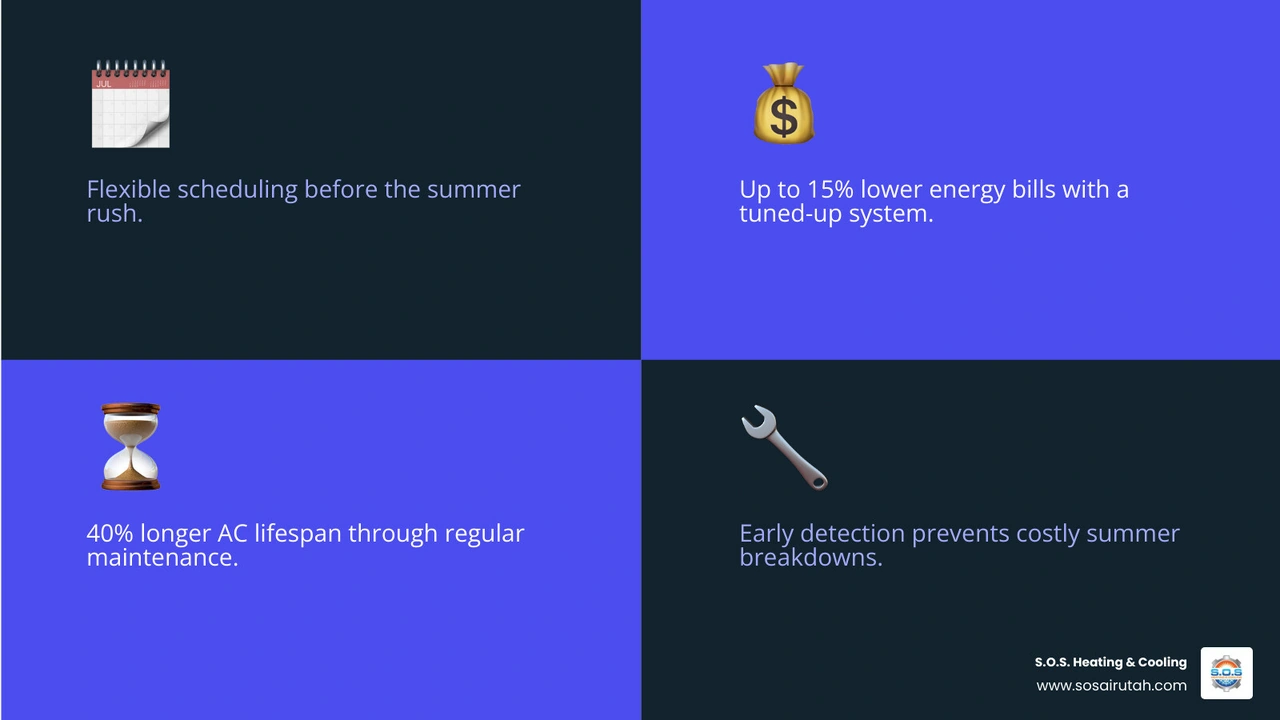
- Flexible scheduling — HVAC technicians are available before the summer rush hits
- Lower energy bills — A well-maintained system uses up to 15% less energy
- Longer system life — Regular maintenance helps your AC last 40% longer
- Catch problems early — Small issues found in spring cost far less than emergency repairs in July
- Warranty protection — Most manufacturers require proof of annual service to honor parts claims
Think about it this way: most AC failures happen during the hottest week of the year, when every technician in town is already slammed with calls. A system that seemed fine in April can quietly be losing efficiency every single month it goes without service — roughly 5% per year, according to industry data. By the time temperatures in the Wasatch Front climb into the high 90s, that neglected unit is already working harder than it should.
Spring gives you a window — a calm, comfortable window — to get ahead of all of that.
I'm Bryson Ninow, an NATE-certified HVAC professional with years of hands-on experience helping Salt Lake City homeowners avoid exactly the kind of mid-summer breakdowns that make spring the best time for an AC tune-up a piece of advice I give to every homeowner I meet. Let's walk through exactly why this timing matters and what you can do right now to protect your home comfort all season long.
5 Reasons Why Spring Is the Best Time for an AC Tune-Up
As we move through May 2026, the Wasatch Front is shaking off the last of the winter chill. While your mind might be on gardening or hiking, your air conditioner is sitting dormant, likely covered in a layer of winter dust and debris. Scheduling your maintenance now isn't just a suggestion; it's a strategic move for your home's health.
Here are the top five reasons we recommend booking your service before the thermometer hits 80°F:
- Scheduling Flexibility: Right now, our calendars are open. You can pick a Tuesday morning or a Thursday afternoon that actually fits your life. Once the first 90-degree day hits, our phones ring off the hook, and wait times across Utah can stretch into days or even weeks.
- Peak Demand Prevention: By getting a Time to Schedule an AC Tune-Up on your calendar in the spring, you ensure your system is ready for "peak demand" months. You don't want to find out your capacitor is dead at 5:00 PM on a Friday in July.
- Maximum Reliability: A spring visit allows us to verify that every component survived the winter. Between freezing temperatures and nesting pests, a lot can happen to a dormant unit.
- Optimized Performance: An early tune-up ensures that when you finally flip that switch to "Cool," the air coming out of your vents is crisp and refreshing from the very first minute.
- Local Expertise: For those looking for an AC Tune-Up Salt Lake City UT, spring allows our technicians the time to perform a truly deep-dive inspection without the pressure of a hundred emergency calls waiting in the queue.
Why Spring Is the Best Time for an AC Tune-Up to Lower Energy Bills
We often tell our neighbors in Millcreek and Murray that an unmaintained AC unit is basically a "money pit." According to the U.S. Department of Energy, regular HVAC maintenance can improve your system’s efficiency by up to 15%.
When your system is dirty or out of calibration, it has to run longer and work harder to achieve the same temperature. This creates a massive efficiency loss. In fact, an unmaintained AC unit can lose roughly 5% of its efficiency every single year it goes without professional care.
During a spring visit, we focus on How a Tune-Up Improves Efficiency and Lowers Bills by:
- Cleaning the coils: Dirt acts as an insulator, preventing the heat exchange process.
- Tightening connections: Loose electrical wires can cause high resistance and wasted power.
- Reducing strain: Lubricating moving parts ensures the motor doesn't have to fight friction to keep you cool.
Not only does this lower your monthly utility costs, but it also reduces your home's carbon footprint — a win for your wallet and the Utah environment.
Beating the Heatwave Rush
There is a specific kind of stress that comes with a broken AC during a Utah heatwave. When the "summer rush" begins, HVAC companies are often forced to triage calls, prioritizing total system failures over minor issues.
By choosing to be proactive, you secure early detection. If we find a frayed wire or a leaking valve in May, we can fix it in an hour. If that same part fails in August, it could lead to a catastrophic compressor failure. Whether you need an AC Tune-Up Draper or service in Layton, booking in spring gives you the ultimate peace of mind. You’ll be the one relaxing in the cool air while others are frantically searching for a technician who isn't booked solid.
What a Professional Spring Tune-Up Typically Includes
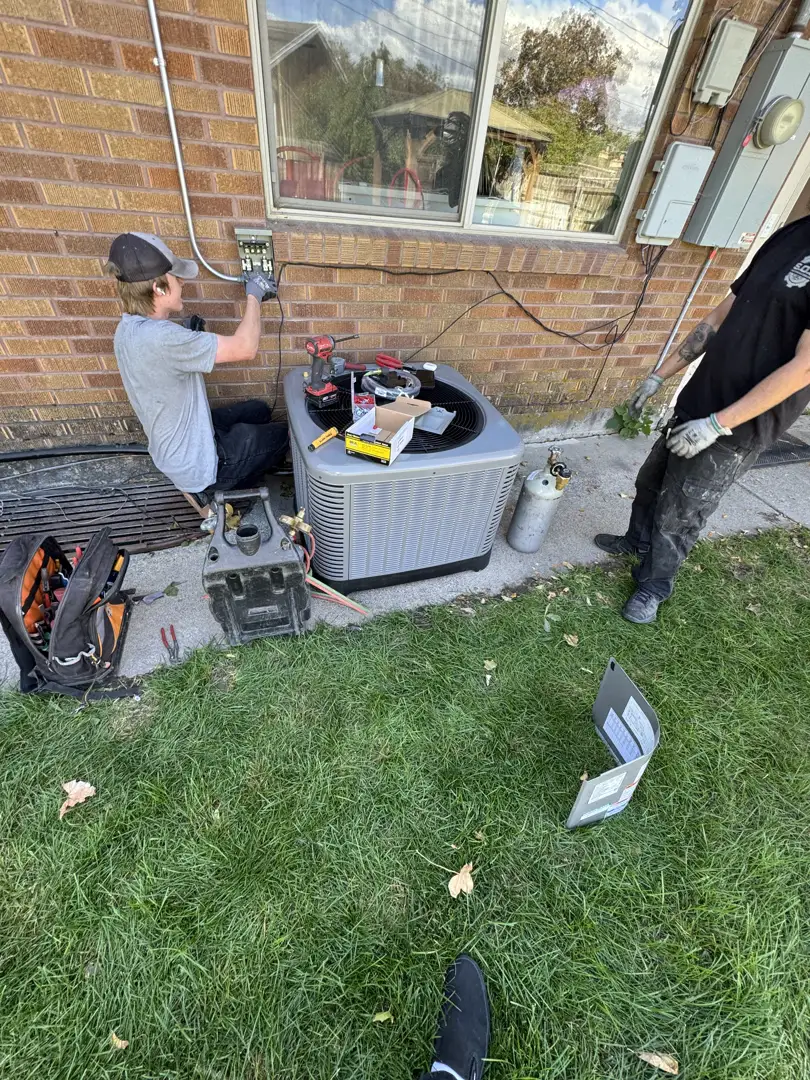
A professional tune-up is much more than just a quick glance at your unit. It is a multi-point, surgical inspection designed to optimize every inch of your cooling system. When we visit homes from South Jordan to Kaysville, we follow a rigorous AC Tune-Up Checklist: What Your Technician Should Check to ensure nothing is missed.
Our comprehensive process includes:
- Checking refrigerant levels (low refrigerant is a sign of a leak, not "normal" usage).
- Inspecting and tightening all electrical connections.
- Lubricating all moving parts to prevent friction and heat buildup.
- Testing the thermostat for accuracy and calibration.
- Inspecting the condensate drain line for clogs or algae growth.
- Evaluating the ductwork for air leaks that waste your cooled air.
For a deeper look at what we do, check out our AC Maintenance Millcreek UT Complete Guide.
Cleaning the "Lungs" of Your System
Think of your AC coils and filters as the "lungs" of your home. Over the winter, these components can become clogged with dust, pet dander, and Utah's notorious spring pollen.
When your evaporator and condenser coils are dirty, they can't "breathe." This forces the system to work overtime, leading to weak airflow and poor indoor air quality. During our Pre-Season AC System Inspection Guide process, we use specialized tools to gently clear away this buildup.
Cleaning the condenser fins is especially important. If these delicate aluminum fins are bent or clogged with debris like cottonwood seeds (a common problem in Bountiful and Sandy), your system can't release heat effectively. We straighten these fins and clear the airflow paths to ensure your home stays crisp and clean.
Testing the "Heart" and "Brain"
If the coils are the lungs, the compressor is the "heart" and the thermostat is the "brain."
We use precision instruments to measure the temperature split — that’s the difference between the air entering your system and the air leaving it. Ideally, this should be between 16°F and 20°F. If it's outside that range, we know something is wrong under the hood.
We also look for "pitting" on the contactors. Contactors are electrical switches that tell your AC to turn on. Over time, electrical arcing can cause little pits to form on the metal, which can eventually cause the switch to stick. This might result in your AC refusing to turn on — or worse, refusing to turn off. Catching this in spring is one of the many reasons The Importance of AC Tune-Ups cannot be overstated.
Maximizing Efficiency and System Lifespan
We want your air conditioner to be a long-term resident of your home, not a temporary guest. A central AC system that is neglected might only last 10 to 12 years. However, with regular professional care, that same system can easily last 15 to 20 years.
Data shows that air conditioners that go through regular HVAC maintenance last 40% longer. That’s several extra years of comfort you don’t have to pay to replace.
| AC Condition | Expected Lifespan | Energy Efficiency | Frequency of Repairs |
|---|---|---|---|
| Regularly Maintained | 15 - 20 Years | Peak (100%) | Rare / Minor |
| Neglected System | 10 - 12 Years | Declining (-5%/yr) | Frequent / Major |
| Maintained (with SOS) | 20+ Years | Optimized | Preventative |
Investing in Better AC Lifespan with Regular Tune-Ups is the most cost-effective way to manage your home's infrastructure. By reducing the daily wear and tear on the motor and compressor, you’re essentially adding years back onto the life of the unit. Our Annual AC Tune-Ups are designed to do exactly that.
Why Spring Is the Best Time for an AC Tune-Up to Protect Your Warranty
Many homeowners don't realize that their AC warranty isn't just a "given." Major manufacturers like Lennox, Carrier, and Trane often include a clause in the fine print: The warranty is only valid if the system receives annual professional maintenance.
If your compressor fails in three years and you can't provide proof of service, the manufacturer might deny your claim, leaving you responsible for a massive repair bill. Following our AC Tune-Up Guide for Wasatch Front Homeowners ensures you have the paper trail you need. A spring tune-up is essentially "warranty insurance" that protects your financial investment.
Preventing Costly Summer Breakdowns
There is nothing quite like the "pungent smell" of a system failing on a 95-degree Saturday in Herriman. Most of these "sudden" breakdowns aren't sudden at all — they are the result of small issues that were ignored in the spring.
Common summer-stoppers we find during spring visits include:
- Weak Capacitors: This is the most common failure point. A capacitor is like a battery that gives your motor the "kick" it needs to start. We can see if a capacitor is losing its charge long before it actually dies.
- Pest Invasions: Mice and spiders love nesting in control boxes over the winter. They can chew through wires or create shorts that lead to AC Tune-Ups Prevent Breakdowns.
- Clogged Drains: Your AC removes up to 5 gallons of water a day from the air. If the drain line is clogged with winter algae or sludge, that water can back up into your home, causing warped floors or ceiling damage. We flush these lines in the spring to keep the water flowing where it belongs.
Signs Your Home Needs a Tune-Up Before Summer
While we recommend a tune-up for every system, some units are practically screaming for help. If you notice any of the following "red flags," you should definitely make sure spring is the best time for an AC tune-up for your specific home:
- Uneven Cooling: If your bedroom is a sauna while your living room is an icebox, you likely have airflow or ductwork issues.
- Strange Noises: Squealing, banging, or rattling sounds are your AC's way of telling you a part is loose or failing.
- Weak Airflow: If you have to put your hand right up to the vent to feel anything, your "lungs" (coils and filters) are likely clogged.
- High Humidity: Your AC is also a dehumidifier. If your home feels "sticky" or "muggy," the system isn't doing its job.
- Short-Cycling: If the AC turns on and off every few minutes, it’s under immense stress and needs immediate Why Regular AC Tune-Ups Are Vital.
- Spiking Bills: If your energy bill is significantly higher than it was last May, your efficiency has likely plummeted.
Frequently Asked Questions About Spring AC Maintenance
How long does a professional AC tune-up take?
A standard, high-quality professional AC tune-up typically takes between 60 and 90 minutes. This gives our technicians enough time to perform a multi-point inspection, clean the necessary components, and run a full cycle to test for performance. If your system is older or hasn't been serviced in several years, it may take a bit longer to ensure everything is brought back up to spec.
What DIY steps can I take before my appointment?
While the technical work should be left to the pros, there are a few things you can do to help your system:
- Change your filter: This should be done every 30-90 days. If you can't see light through it, it's too dirty!
- Clear the perimeter: Ensure there is at least a 2-foot clearance of debris, weeds, or bushes around your outdoor unit.
- Vacuum your registers: Keep indoor vents clear of dust and ensure furniture isn't blocking the airflow.
- Visual check: Look for any obvious signs of damage or frayed wires on the outdoor unit (but don't touch them!).
Is a tune-up necessary if my AC is working fine?
Absolutely. Think of it like an oil change for your car. Your car might "run fine" for a while without one, but eventually, the engine will seize. Preventative care catches "silent killers" like refrigerant leaks or weak capacitors before they leave you stranded. Plus, the efficiency gains alone often pay for the cost of the visit through lower monthly utility bills.
Conclusion
Don't wait for the first heatwave to find out if your air conditioner is up to the task. By acting now, you can ensure your home remains a cool sanctuary all summer long, from the quiet streets of Farmington to the bustling neighborhoods of South Salt Lake.
At S.O.S. Heating & Cooling, we pride ourselves on being the Wasatch Front’s trusted experts. We understand the unique challenges of the Utah climate — from the dry air to the heavy spring pollen. We are here to provide 24/7 emergency support, though our goal is to make sure you never need it! With no evaluation fees during business hours and flexible financing options, we make it easy to prioritize your home comfort.
The early bird gets the coolest air. Schedule your professional spring AC tune-up today and breathe easy knowing you're ready for whatever the Utah summer throws your way!
Contact Us

Let's Get You From Distress to Rest
No heat, no cool, a backed-up drain, or just due for a tune-up? Call now or request service and our local team will be on the way — upfront pricing, no surprises.