

The Ultimate Guide to Mini Split vs Window Unit Cooling


.avif)

Choosing Between a Mini Split vs Window Unit for Cooling a Room in Extreme Utah Heat
When you're weighing a mini split vs window unit for cooling a room in extreme Utah heat, the short answer is this: mini splits perform better under pressure, but window units cost less upfront. Here's a quick breakdown to help you decide fast:
| Feature | Mini Split | Window Unit |
|---|---|---|
| Efficiency (rating) | 20-35 SEER2 | 8-15 CEER |
| Performance above 100°F | Maintains efficiency | Drops off significantly |
| Noise level | 19-25 dB (near silent) | 50-60 dB (loud hum) |
| Winter heating | Yes, effective heat pump | Limited or none |
| Installation | Professional required | DIY-friendly |
| Upfront cost | Higher | Lower |
| Lifespan | 15-20 years | 8-12 years |
| Altitude adjustment needed | Yes (Utah-specific) | Minimal |
| Best for | Long-term homeowners | Renters or short-term use |
When Utah summers push past 100°F across the Salt Lake Valley and higher-elevation spots like Park City see wildfire smoke rolling in by August, the cooling system you choose for a single room matters more than most people expect. A window unit might seem like the obvious quick fix — plug it in, point it at yourself, done. But in Utah's unique combination of extreme dry heat, high altitude, and four-season weather swings, the differences between these two systems go well beyond the price tag.
I'm Bryson Ninow, an HVAC professional with NATE, EPA, and DOPL certifications and years of hands-on experience helping Utah homeowners navigate exactly this kind of decision — including the real-world impact of altitude derating and desert heat on a mini split vs window unit for cooling a room in extreme Utah heat. In the sections ahead, we'll walk through everything you need to know to make a confident, informed choice for your home.
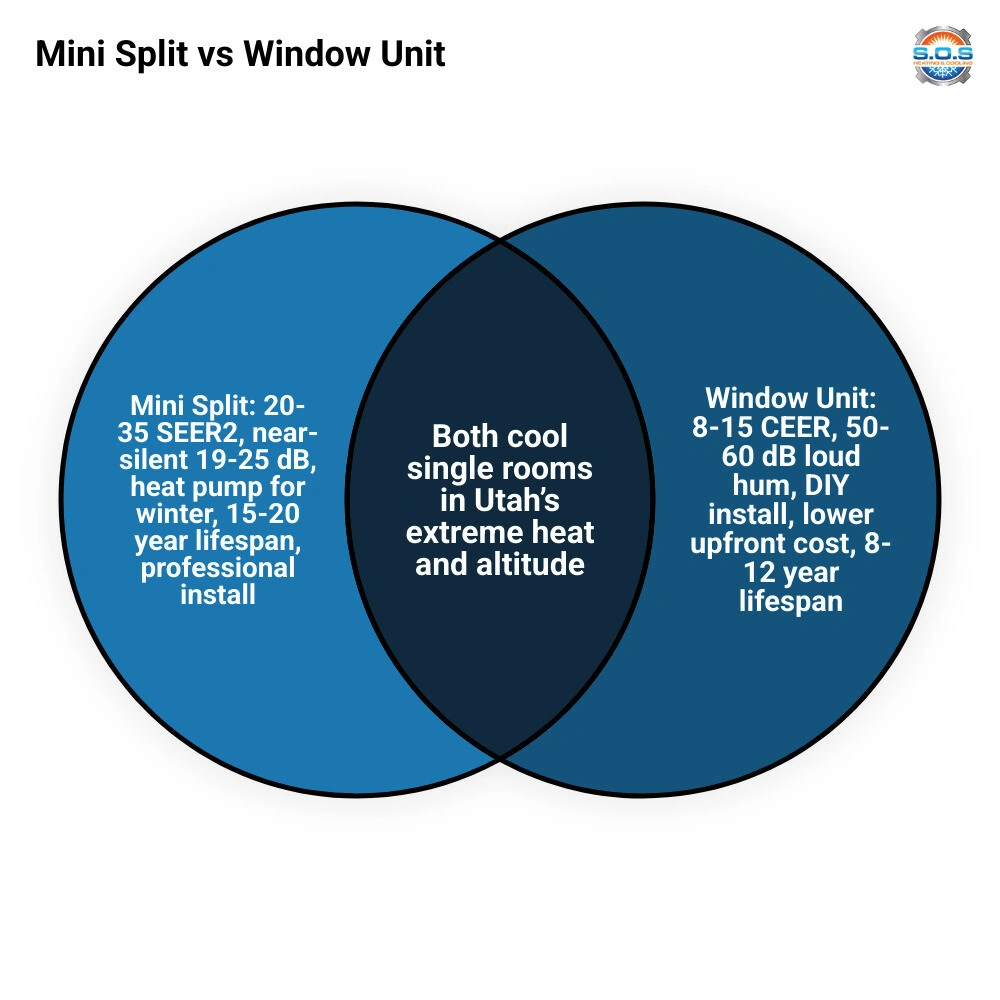
Mini Split vs Window Unit for Cooling a Room in Extreme Utah Heat
When the summer sun beats down on the Wasatch Front, our homes become literal hot boxes. To understand why a mini split and a window unit perform so differently under these conditions, it helps to look at how they manage heat.
Both systems rely on the same basic refrigeration cycle: they absorb heat from inside the room and dump it outside. However, how they execute this process in a high-desert environment is worlds apart. To learn more about the physics behind this, you can read about How Air Conditioning Works Differently in Arid Climates.
Technology and Inverter Performance
The single biggest mechanical difference between these two options lies in the compressor. Traditional window units typically use single-stage compressors. This means they operate on a simple "on/off" cycle. When your room gets warm, the window unit kicks on at 100% capacity, blasting cold air and drawing maximum power. Once the thermostat is satisfied, it shuts off completely. This constant cycling creates noticeable temperature swings and massive energy spikes.
Ductless mini splits, on the other hand, utilize advanced inverter-driven variable-speed compressors. Instead of turning completely off, a mini split's compressor can dial its output up or down to match the exact cooling load of the room (modulating anywhere from 20% to 100% capacity).
In extreme Utah heat, this is a game-changer. When outdoor temperatures climb past 100°F, a window unit struggles with "thermal bridging" and air leakage. Because a window unit sits directly in an open window frame, the physical barrier between the scorching outdoor air and your cool indoor sanctuary is incredibly thin. Hot air constantly seeps in through the accordion side panels, forcing the single-stage compressor to run continuously at maximum capacity.
A mini split completely bypasses this issue. The compressor is located outdoors, and the indoor air handler is mounted high on an interior wall, connected only by a small three-inch conduit through the wall. There is no open window to leak air, allowing the inverter technology to easily maintain a perfectly steady indoor temperature.
Sizing and Altitude Adjustments for a Mini Split vs Window Unit for Cooling a Room in Extreme Utah Heat
If you live along the Wasatch Front — whether in the Salt Lake Valley at 4,300 feet or up in Park City at 7,000 feet — altitude is a critical factor that many out-of-state resources completely ignore.
As elevation increases, the air becomes less dense. Because thin air carries less heat per cubic foot, air conditioning systems lose some of their cooling capacity. This is known as altitude derating. At elevations above 5,000 feet, a mini split or window unit can experience a capacity loss of roughly 17% or more.
For example, a standard 12,000 BTU unit (which normally cools about 350 to 550 square feet at sea level) will only deliver about 9,960 BTUs of actual cooling in high-altitude areas like Park City or the upper benches of Draper and Sandy.
When choosing a mini split vs window unit for cooling a room in extreme Utah heat, this altitude factor makes precise sizing essential. A professional HVAC installer will perform an elevation-corrected Manual J load calculation to determine the exact BTU capacity your room needs. If you buy a standard window unit off the shelf without accounting for this altitude capacity loss, you will likely end up with an undersized unit that runs constantly, wears out prematurely, and fails to keep you cool on a 100-degree July afternoon.
Efficiency, Operating Costs, and Winter Heating
To truly evaluate these systems, we have to look at how much they cost to run and whether they can serve your home year-round. Utah's climate demands robust cooling in the summer, but we also face freezing, snow-heavy winters.
| Metric / Feature | Standard Window Unit | Modern Inverter Window Unit | Ductless Mini Split Heat Pump |
|---|---|---|---|
| Cooling Efficiency | 8 - 11 CEER | Up to 15 CEER | 20 - 35 SEER2 |
| Heating Capability | None (or inefficient resistance electric) | None | Highly efficient heat pump (down to -15°F) |
| Air Leakage Risk | High (gaps in window frame) | Moderate | None (sealed wall penetration) |
| Duct Energy Loss | N/A (ductless) | N/A (ductless) | N/A (ductless) |
| Average Lifespan | 8 - 12 years | 8 - 12 years | 15 - 20 years |
SEER2 vs CEER Ratings in Arid Climates
When comparing the energy efficiency of these systems, you will encounter two primary metrics: SEER2 (Seasonal Energy Efficiency Ratio 2) for mini splits and CEER (Combined Energy Efficiency Ratio) for window units.
Mini splits are the undisputed champions of efficiency. While basic mini splits start around 20 SEER2, premium models can reach an astounding 35 SEER2. In contrast, standard window units typically max out at a CEER of 12 (equivalent to a SEER of less than 14), though some modern inverter-driven window units are beginning to close the gap by reaching up to 15 CEER.
What does this mean for your monthly utility bills? Because of their superior inverter compressors and advanced heat exchangers, ductless mini splits use 30% to 40% less electricity than standard window units to cool the exact same space.
Furthermore, during extreme heatwaves, window units suffer a severe performance drop-off. When outdoor temperatures exceed 100°F, a window unit's actual efficiency can plummet into the single digits. Mini splits, designed with much larger outdoor condenser coils, maintain their high efficiency even when the high-desert heat is at its worst. For more advice on keeping your bills low during the peak of summer, check out our Summer AC Efficiency Tips for High Desert Homes.
Year-Round Performance and Winter Heating
A window air conditioner is a seasonal appliance. When October rolls around, you either have to leave a drafty, cold metal box sitting in your window all winter or go through the back-breaking annual ritual of hauling the heavy unit out of the window and finding a place to store it in your garage or basement.
A ductless mini split is a permanent, year-round heat pump. It doesn't just cool your room in the summer; it reverses the refrigeration process to provide highly efficient heating during Utah's freezing winters.
In fact, modern cold-climate mini splits can extract heat from the outdoor air even when temperatures drop well below zero (often down to -13°F or -22°F). Because they move heat rather than creating it, mini splits can heat a room up to 300% to 400% more efficiently than traditional electric resistance wall heaters or space heaters. This dual-season capability makes them an incredibly smart investment for Utah homes that experience the full spectrum of all four seasons.
Installation, Aesthetics, and Security Considerations
How a cooling system physically integrates into your home affects everything from your daily comfort to your home's safety. If you are looking at adding air conditioning to a home that does not have central ductwork, you can read our comparison of Adding Cooling Without Ductwork Options Compared.
Installation Complexity and Ductwork Options
Window units are popular primarily because they are cheap and easy to install. You open a window, slide the unit in, secure the brackets, adjust the side panels, and plug it into a standard wall outlet. It is a classic DIY job.
However, window units come with significant physical limitations. They completely block your view, render that window entirely unusable for fresh air, and require a perfectly compatible single- or double-hung window frame to sit in safely.
Installing a mini split is a much more involved, professional process. It requires mounting an indoor unit on the wall, placing an outdoor condenser on a concrete pad or wall bracket, and running a line set (containing refrigerant lines, control wiring, and a condensate drain line) through a small three-inch hole in your exterior wall.
Because this process involves handling specialized refrigerants, vacuuming lines, and working with high-voltage electrical connections, professional installation is absolutely required. To understand what this process looks like from start to finish, take a look at our Ductless AC Installation Utah Complete Guide.
HOA Compliance, Aesthetics, and Home Security
If you live in a modern Utah development — such as the Daybreak community in South Jordan or various neighborhoods in Herriman, Draper, and Layton — you are likely subject to strict Homeowners Association (HOA) guidelines. Many Utah HOAs explicitly ban window air conditioners because they protrude from the side of the home, drip water onto pathways, and negatively impact the community's overall curb appeal.
Mini splits are much easier to get approved by HOAs. The outdoor condenser can be tucked away discreetly behind landscaping or on the side of the house, and the refrigerant lines can be covered in painted line-set covers that match your home's exterior siding perfectly.
Security is another major concern with window units. A window unit essentially turns a secure window into an easy entry point for intruders. Even with basic window locks and brackets, a determined burglar can often push a window unit inward or pull it outward to gain access to your home.
Mini splits pose zero security risks. The small three-inch hole drilled through the wall for the refrigerant lines is completely sealed and impossible to exploit, leaving your windows fully closed, locked, and secure.
Comfort, Maintenance, and Lifespan in Utah's Climate
Utah's high-desert climate is beautiful, but it can be incredibly harsh on mechanical equipment. Between dusty summer windstorms, winter snow accumulation, and seasonal wildfire smoke, your cooling system has to be built to last. For a deeper dive into this topic, read about How High Desert Weather Affects AC Equipment Lifespan.
Noise Levels and Daily Comfort
If you have ever tried to watch a movie or sleep in a bedroom with a running window unit, you know how incredibly loud they can be. Because the compressor, fan, and condenser are all housed in a single box sitting right in your window, window units typically produce noise levels between 50 and 60 decibels (dB). That is equivalent to the hum of a noisy office or a loud conversation.
Mini splits are designed to keep the noise outside. Because the noisy compressor is located in the outdoor unit, the indoor air handler runs at a near-whisper level — usually between 19 and 25 dB. To put that in perspective, a mini split is quieter than rustling leaves or a library whisper.
Additionally, because of their inverter technology, mini splits maintain a incredibly consistent temperature, eliminating the cold blasts and warm drafts associated with window units.
Dust, Wildfire Smoke, and Maintenance Requirements
In places like Salt Lake City, Murray, and Bountiful, summer often brings dusty winds off the Great Salt Lake, and late summer can bring heavy wildfire smoke into the valley.
Window units offer very basic, low-MERV mesh filters that only catch large dust bunnies and pet hair. They do almost nothing to filter out fine dust, pollen, or dangerous wildfire smoke particles (PM2.5), meaning that smoky outdoor air can easily seep into your room through the gaps around the window frame.
Mini splits feature much more sophisticated filtration systems. Because they are sealed, permanent systems, they do not let outdoor air leak in. Many high-quality mini splits can accommodate advanced multi-stage filters that capture fine dust, allergens, and even smoke particles, significantly improving your indoor air quality.
To keep a mini split running efficiently in our dusty climate, you should rinse the indoor filters every two to four weeks. Additionally, scheduling an annual professional tune-up is essential to clean the outdoor coils and ensure the system is operating at peak efficiency.
Long-Term Value of a Mini Split vs Window Unit for Cooling a Room in Extreme Utah Heat
While a window unit is undeniably cheaper on day one, it is a short-term band-aid. Window units typically have a lifespan of only 8 to 12 years, and they do nothing to increase the value of your property. In fact, they can actually hurt your home's resale value if buyers see them as a sign of an inadequate or outdated heating and cooling system.
A professionally installed ductless mini split is a permanent home improvement. With proper maintenance, a mini split will easily last 15 to 20 years — roughly twice as long as a window unit.
Because they provide highly efficient, zoned heating and cooling, they are highly attractive to modern home buyers and can noticeably boost your home's overall market value. To see how the economics of mini splits compare to other permanent systems, read our Mini Split vs Central AC Cost Comparison.
Frequently Asked Questions about Room Cooling in Utah
Do mini-splits work efficiently in Utah's high altitude?
Yes, mini splits work exceptionally well at high altitudes, but they must be sized correctly by an experienced professional. Because of the lower air density along the Wasatch Front and in mountain communities like Park City, HVAC systems experience an altitude capacity loss (derating) of about 17% or more.
By performing an elevation-corrected load calculation, we can select a unit with the appropriate BTU capacity to ensure your room stays perfectly cool even on the hottest summer days.
Are there utility rebates available for mini-splits in Utah?
Yes! Because ductless mini splits are incredibly energy-efficient, they often qualify for significant financial incentives. Homeowners in Utah can take advantage of federal energy-efficiency tax credits (which can cover a portion of the installation cost for qualifying heat pumps).
Additionally, local utilities like Rocky Mountain Power frequently offer rebates for customers who upgrade to high-efficiency ductless mini-split systems. These incentives help offset the initial investment and speed up your payback period.
Which system is better for a bedroom in Salt Lake City?
For a bedroom, a mini split is almost always the superior choice. The near-silent operation (19-25 dB) of a mini split means your sleep won't be disrupted by the loud, clunking start-up noises of a window unit compressor.
Furthermore, the precise temperature control prevents you from waking up freezing cold or sweating in the middle of the night. For a broader comparison of bedroom cooling options, see our guide on Central Air vs Mini Split for the Wasatch Front Homes.
Conclusion
When it comes to surviving the peak of summer along the Wasatch Front, choosing a mini split vs window unit for cooling a room in extreme Utah heat is a decision that impacts your daily comfort, energy bills, and peace of mind. While window units offer a cheap, temporary fix for renters or tight budgets, they simply cannot compete with the whisper-quiet operation, year-round heating capabilities, and massive energy savings of a modern ductless mini split.
At S.O.S. Heating & Cooling, we are dedicated to keeping families across the Salt Lake Valley comfortable in every season. Whether you are in Bountiful, Sandy, Draper, or Salt Lake City, our team of highly certified technicians is ready to help you find the perfect zoning solution for your home. We offer 24/7 emergency repairs, priority service for our partners, no evaluation fees during business hours, and flexible financing options to make your home comfort upgrade as smooth as possible.
Ready to ditch the noisy window unit and upgrade to premium, year-round comfort? Schedule a professional mini-split installation with S.O.S. Heating & Cooling today, or give us a call to speak with one of our local home comfort experts!
Explore Our Latest Insights and Updates in Plumbing Services
Is Your AC Over-Staged? The Truth About Extra Costs and Benefits
Why Your AC is Working Overtime and How to Stop the Madness
Don't Sweat the Bill: Easy Hacks to Keep Your Home Chilled