Why Your HVAC Needs a Humidity Sidekick to Keep You Comfortable
Why Whole Home Humidity Solutions Explained Right Now Could Save Your Home and Health whole home humidity solutions explained simply…
Why Whole Home Humidity Solutions Explained Right Now Could Save Your Home and Health
whole home humidity solutions explained simply: these are HVAC-integrated systems — dehumidifiers, humidifiers, or both — that automatically maintain your indoor air at a healthy relative humidity (RH) level throughout every room, 24 hours a day.
Here is a quick overview of the main whole-home humidity solutions:
- Whole-house dehumidifier - Removes excess moisture from your air. Ideal for humid summers or damp basements. Prevents mold, dust mites, and structural damage.
- Whole-house humidifier - Adds moisture to dry air. Critical in arid, high-altitude climates like Salt Lake City during winter heating season. Prevents dry skin, static electricity, and wood damage.
- HVAC-integrated humidity control - Both systems can connect directly to your existing ductwork and be managed automatically by a humidistat or smart thermostat.
- Standalone units - Operate independently without ductwork, ideal for targeted areas like basements or crawlspaces.
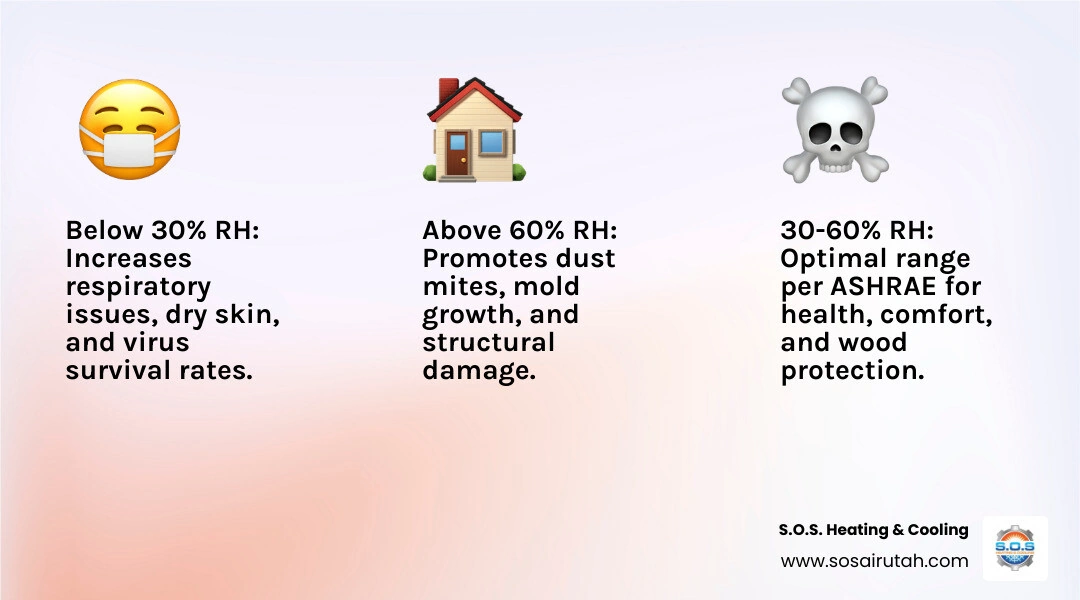
- Target humidity range - The EPA recommends keeping indoor RH between 30% and 50%. ASHRAE widens this to 40%–60% for overall health and comfort.
Most Salt Lake City homeowners are surprised to learn that their HVAC system alone cannot reliably manage humidity. Your air conditioner removes some moisture as a byproduct of cooling, but it was never designed to be a dedicated humidity control tool. When temperatures are mild, the AC may not run long enough to pull meaningful moisture out of the air — leaving your home feeling sticky, stale, or, in winter, bone dry. The result is a home that feels uncomfortable even when the thermostat reads exactly where you set it.
That gap between temperature and true comfort is exactly what whole-home humidity systems are built to close.
I'm Bryson Ninow, an NATE-certified HVAC professional with hands-on experience helping Salt Lake City homeowners navigate whole home humidity solutions explained — from high-desert dry air in winter to monsoon-season moisture spikes in summer. I'll walk you through everything you need to know so you can make a confident decision for your home.
Whole Home Humidity Solutions Explained: Dehumidification vs. Humidification
When we talk about Indoor Air Quality, we have to talk about "load." In the HVAC world, your home has two types of heat loads: sensible and latent.
- Sensible Load: This is the temperature you can read on a thermometer. It’s the heat your AC works to remove.
- Latent Load: This is the moisture hidden in the air.
If your AC only tackles the sensible load, you end up with a house that is 72 degrees but feels like a swamp. This is where whole home humidity solutions explained through dedicated equipment become vital.
While a portable unit might help a single bedroom, it’s often a "drop in the bucket" compared to the needs of a full house. Portable units require constant manual emptying, they are noisy, and they only treat the air in their immediate vicinity. In contrast, a whole-home system is integrated into your ductwork, treating every cubic inch of air as it circulates.
Whole-House vs. Portable Units: A Quick Comparison
| Feature | Whole-House System | Portable Unit |
|---|---|---|
| Coverage | Entire Home (Every Room) | Single Room |
| Maintenance | Annual Professional Service | Daily Water Tank Emptying |
| Noise | Quiet (Located in Utility Room/Ducts) | Loud (Located in Living Space) |
| Lifespan | 10–20 Years | 3–8 Years |
| Efficiency | High (Energy Star Integrated) | Lower (High Power Draw per sq. ft.) |
| Control | Automated via Smart Thermostat | Manual Settings |
By managing Air Quality through a central system, we ensure that the air in your basement is just as comfortable and healthy as the air in your master suite.
How Whole-House Dehumidifiers Work to Protect Your Home
A whole-house dehumidifier is essentially a specialized refrigeration system. Here is the technical magic that happens inside the cabinet:
- Air Intake: The unit pulls air from your home’s return ductwork.
- Refrigeration Cycle: The air passes over extremely cold evaporator coils.
- Condensation: As the warm, moist air hits the cold coils, the water vapor turns into liquid (just like the "sweat" on a cold soda can).
- Drainage: This water is collected and sent directly down a floor drain or out via a condensate pump. You never have to empty a bucket!
- Reheating: The now-dry air is slightly reheated so it doesn't feel "chilly" or "clammy" when it enters your rooms.
- Distribution: The balanced air is sent back through your supply vents.
Most high-quality units, like those used for Whole House Dehumidification Salt Lake City UT, also include a MERV 8 filter. This means that while the system is removing moisture, it’s also capturing dust, pollen, and mold spores. The entire process is controlled by a humidistat—a device that works like a thermostat but measures moisture instead of temperature.
Why Arid Climates Need Whole Home Humidity Solutions Explained
Living along the Wasatch Front means we deal with a unique challenge: the high-desert climate. In places like Layton, Draper, and Salt Lake City, our air is naturally thin and dry. When winter hits and we turn on our furnaces, that air gets even drier.
A forced-air furnace can heat air up to 500 degrees Fahrenheit internally, which effectively zaps any remaining moisture. Without Whole Home Humidifiers Salt Lake City UT, your indoor relative humidity can drop as low as 15%. For context, the Sahara Desert averages about 25% humidity.
This extreme dryness leads to several "high-desert" problems:
- Static Electricity: That annoying "zap" every time you touch a doorknob.
- Wood Damage: Hardwood floors, cabinets, and even musical instruments like pianos can shrink, crack, or warp.
- Physical Discomfort: Dry skin, scratchy throats, and bloody noses are common winter complaints.
There are two primary ways we add moisture back into your home:
- Bypass Humidifiers: These use the furnace's blower to move air through a water-soaked pad. They are simple, reliable, and use almost no electricity.
- Steam Humidifiers: These are the "gold standard." They boil water to create actual steam, which is then injected into the airflow. They work faster and more precisely, making them perfect for larger homes or those with expensive wood finishes.
Understanding these Humidity Control Benefits for High Desert Homes is the first step to staying comfortable from November through March.
The Health and Structural Impact of Improper Humidity
Humidity isn't just about feeling "sticky" or "dry"; it has a profound impact on the physics of your home and the biology of your body.
Health Risks of High and Low Humidity
When humidity exceeds 60%, your home becomes a playground for biological pollutants. Dust mites, which are a primary trigger for asthma and allergies, require humidity above 50% to survive and reproduce. Furthermore, mold can begin to grow on organic surfaces (like drywall or wood) in as little as 24 to 48 hours if the environment is damp enough.
On the flip side, very dry air (below 30%) makes it easier for airborne viruses like influenza to travel. When the air is dry, respiratory droplets stay smaller and lighter, floating in the air longer for you to breathe in. Improving Your Homes Indoor Air Quality by keeping humidity at 50% has been shown to reduce viable viruses in the air to less than 1% in just two days.
Structural Damage
Your home is an investment, and humidity is its silent enemy.
- High Humidity: Causes window condensation, which leads to sill rot and mold. It can cause paint to peel and "cupping" in hardwood floors where the edges of the boards rise higher than the center.
- Low Humidity: Causes wood to contract. You might notice gaps in your floorboards, "creaking" stairs, or doors that no longer latch properly because the frames have shifted.
The Role of Indoor Air Quality in Your Home is to act as a buffer, protecting both your respiratory system and your floorboards from these extremes.
Choosing the Right System: Sizing and Integration
You wouldn't buy a pair of shoes without knowing your size, and you shouldn't buy a humidity system without a professional assessment. Sizing is critical. An undersized dehumidifier will run constantly without ever reaching the target RH, while an oversized one will "short cycle," turning on and off so fast that it wastes energy and wears out the compressor.
Capacity (Pints Per Day)
Dehumidifiers are rated by "Pints Per Day" (PPD). This is the amount of water the unit can pull from the air in 24 hours.
- 1,200 sq. ft. home: Generally needs a 50–60 PPD unit.
- 2,000–3,000 sq. ft. home: Usually requires a 70–90 PPD unit.
- Large Estates (5,000+ sq. ft.): May require high-capacity units or multiple integrated systems.
At S.O.S. Heating & Cooling, we use Manual J load calculations to determine exactly what your home needs. We look at your square footage, how well your home is insulated, and even how many people live there (humans are moisture-generating machines!).
Integration Styles
- Ducted Integrated: The unit is installed in your HVAC return plenum. It treats the air before it even hits your furnace or AC. This provides the most uniform coverage.
- Standalone/Zoned: Ideal for homes in places like Salt Lake City or Bountiful that have a damp basement but a dry upstairs. These can be installed in a crawlspace or basement with dedicated discharge vents.
When we perform a Whole Home Air Filtration Salt Lake City UT installation, we often look at how a dehumidifier or humidifier can work in tandem with your air purifier to create a "sealed" healthy environment. Maintaining Optimal Indoor Air Quality is about balance, not just filtration.
Maximizing Efficiency with Whole Home Humidity Solutions Explained
One of the best "hidden" whole home humidity solutions explained is the energy savings. Most people think adding another appliance will skyrocket their power bill, but the opposite is often true.
The "Feels Like" Factor
Humid air holds heat better than dry air. In the summer, if your home is at 75 degrees with 60% humidity, you will feel hot and sticky. If you drop that humidity to 45%, that same 75 degrees will feel like 70 degrees. This allows you to set your thermostat higher, reducing the workload on your AC. In fact, raising your thermostat by just one degree can save you about 3% on cooling costs.
Year-Round Comfort
In the winter, humidified air feels warmer. Dry air causes moisture to evaporate off your skin rapidly, which makes you feel chilled even when the heater is running. By adding a humidifier, you can often lower your thermostat by 2–3 degrees without feeling any colder, which significantly trims your heating bill.
Using an ENERGY STAR-certified unit is also key. Modern systems, like the Bryant DEHXX (often recognized as the most efficient), use between 500 and 1,000 watts per hour—less than a standard hairdryer—while providing Benefits of Dehumidifiers in the Summer that far outweigh their operating costs.
Frequently Asked Questions about Home Humidity
What is the ideal indoor relative humidity level?
According to the EPA, the ideal range is between 30% and 50%. However, this changes with the seasons. In the dead of a Salt Lake City winter, you might want it closer to 30% to prevent window condensation. In the summer, 45%–50% is the "sweet spot" for comfort. Check out our Indoor Air Quality FAQs for more on seasonal targets.
Can a dehumidifier be used during the winter?
Yes, particularly in basements or "tight" modern homes. New homes are built so well that they don't "breathe," which can trap moisture from showers and cooking inside. If you see fog on your windows in January, your indoor humidity is too high, and a dehumidifier can help. This is a big part of Enhancing Your Homes Comfort year-round.
How much maintenance do these systems require?
They are surprisingly low-maintenance!
- Dehumidifiers: Usually just require a filter change every 6 to 12 months and a quick inspection of the drain line to ensure no clogs.
- Humidifiers: Require a new water panel (evaporator pad) once a year. If you have a steam unit, you’ll need to have the tank cleaned or replaced every 1–2 years to remove mineral scale.
Consistent maintenance is the secret to Maintaining Optimal Indoor Air Quality without unexpected breakdowns.
Conclusion
Achieving the Perfect Home Humidity Levels isn't just a luxury—it's a fundamental part of home health and structural preservation. Whether you are dealing with the bone-dry winters of Sandy or the muggy summer afternoons in South Jordan, there is a solution that fits your home's unique footprint.
At S.O.S. Heating & Cooling, we specialize in the precision engineering required to integrate these "humidity sidekicks" into your existing HVAC system. From Bountiful to Riverton, we help our neighbors breathe easier and live more comfortably.
If you're ready to stop guessing and start controlling your indoor climate, we are here to help. Managing the Role of Indoor Air Quality in Your Home is what we do best. Explore our full range of Air Quality Services and let's find the perfect balance for your family.
Contact Us
Let's Get You From Distress to Rest
No heat, no cool, a backed-up drain, or just due for a tune-up? Call now or request service and our local team will be on the way — upfront pricing, no surprises.